
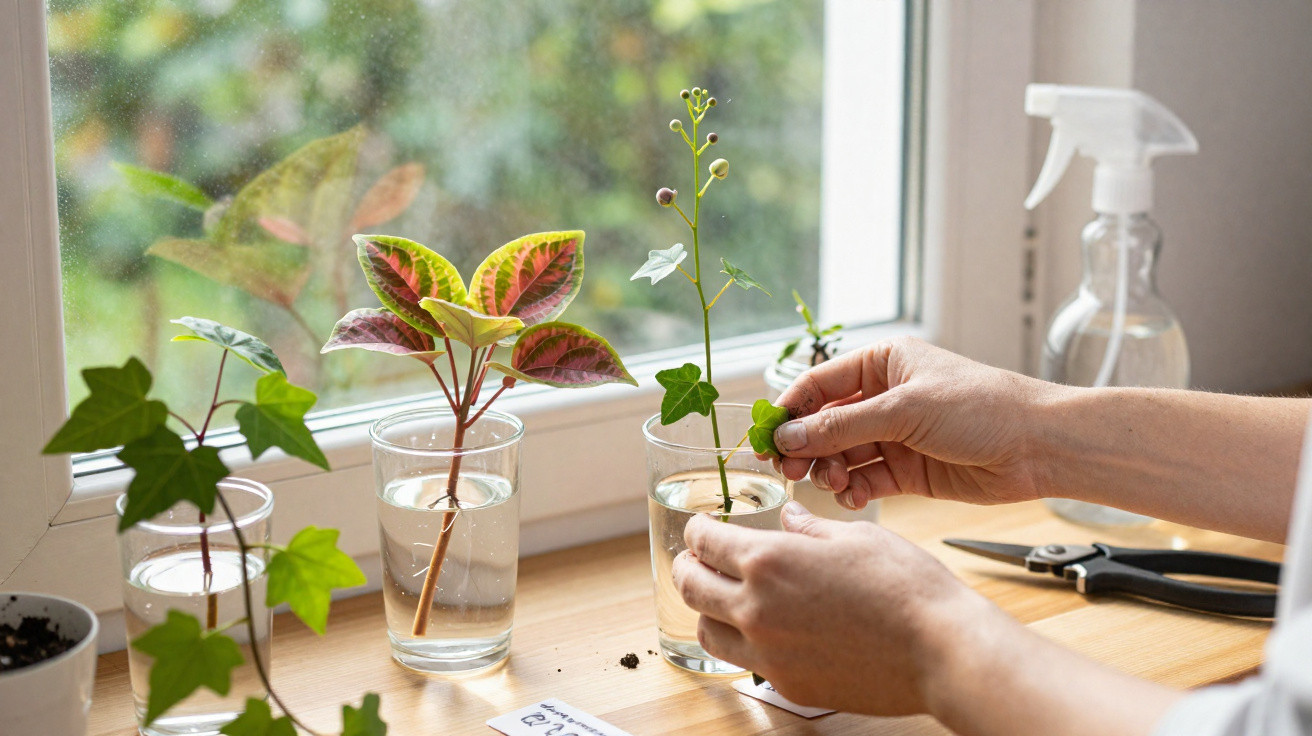
If you browse garden centres in early summer, you will soon notice how quickly the planting budget disappears while beds can still look rather sparse. That is where an almost surprisingly simple method comes in: snip shoots from popular ornamental plants, place them in a glass of water and, a few weeks later, plant the sturdy young plants in beds or containers – at no extra cost.
Why early summer is the ideal time for cuttings in a glass of water
Many ornamental plants can be propagated easily from cuttings from spring until late summer. The period around June is especially favourable. Plants are growing vigorously, their shoots remain young and flexible, and temperatures are generally between 20 and 25°C. Cut surfaces recover quickly at this time, while fresh roots develop rapidly.
“In early summer, a glass of water on the windowsill is often all that is needed to fill entire window boxes within four weeks.”
Depending on the species, starting now can give you rooted cuttings within one to four weeks, ready to plant straight into pots, window boxes or beds. Three familiar garden favourites respond particularly well:
- Ivy – for ground cover, fences or hanging baskets
- Coleus – for vividly coloured foliage in containers and window boxes
- Busy Lizzie – as a mass of flowers for shady spots
A complete patio display can be created from only a few parent plants. There is also a practical advantage: propagating your own favourite varieties means you are no longer dependent on the often limited selection available in shops.
Basic equipment: what you really need for cuttings in water
Although this approach may sound like professional nursery work, it is highly suitable for beginners. Most of what you need is already at home. Only a few basic items are essential:
- clean, sharp secateurs or a knife
- glass or transparent containers, such as drinking glasses, small vases or jam jars
- tap water left to stand for several hours
- a bright position away from harsh midday sunshine
Specialist rooting powders can speed up the process, but they are usually unnecessary for the three plants mentioned here. Clean cuts, fresh water and sufficient light are what matter most.
The basic method: turning a shoot into a new plant
The core process is almost the same for ivy, coleus and Busy Lizzie. The main differences are the shoot length required and the speed at which new roots emerge.
- Select a healthy, vigorous shoot from the parent plant.
- Cut a shoot measuring around 7 to 15 centimetres, depending on the species.
- Make the cut directly below a leaf node, the slight swelling on the stem.
- Remove all leaves from the lower section so that none can rot in the water.
- Submerge one or two leaf nodes, keeping the shoot tip above the water.
- Put the container somewhere bright but out of direct sunshine.
- Replace the water every two to five days.
- Plant into compost once the roots are about 2.5 to 5 centimetres long.
“It is important that only stems sit in the water, never leaves – otherwise the glass quickly turns and the cuttings rot.”
Ivy in a glass of water: the easy-going long-term performer
Ivy is ideal for anyone who prefers low-maintenance planting. A handful of cuttings can become a dense carpet or a lush trailing display in a window box within just a few months.
How to take ivy cuttings
Choose a healthy shoot around 10 to 15 centimetres long with several leaf nodes. Cut immediately below a node, then strip leaves from the bottom third to half of the shoot. Place the stem in water so that one or two nodes are fully submerged.
In good conditions, the first pale root tips will appear after two to four weeks. Wait until they reach roughly five centimetres. The cutting can then be planted in a pot containing loose, relatively humus-rich compost. In the garden, pots or containers help control ivy’s vigorous spreading habit – otherwise it can readily smother nearby plants.
Coleus: an explosion of colour from a glass
Coleus is the quiet star of many balconies. Its flowers are unobtrusive, but its bold foliage in shades of red, yellow and green makes an impact. Water propagation can turn one plant into an entire collection of colours in a short time.
The ideal coleus cutting
Take shoots measuring 8 to 12 centimetres that do not yet carry flowers. Leave two or three leaves at the top and remove everything below them. This directs the plant’s energy away from flowering and fully into making new roots.
Place the cuttings in a glass of lukewarm water and change it every three to five days. Fine roots often appear after only one week in favourable conditions, and after two weeks they are frequently long enough for potting on. A humus-rich, lightly moist mix of balcony or flower compost is entirely sufficient.
“One tip: remove flower buds from coleus consistently – this keeps plants bushy and their leaf colours more intense.”
Busy Lizzie: more flowers for shady areas
Busy Lizzie is a classic choice for shaded window boxes and partially shaded beds. It brings dependable colour beneath balconies or along north-facing sides in particular. Anyone with a few strong plants can quickly add rows of new ones using cuttings in a glass of water.
Rooting Busy Lizzie cuttings
Pick shoots 7 to 10 centimetres long without buds or flowers. Remove the lower leaves, leaving only the cluster at the top. The stems are slightly more sensitive than ivy, so it is worth changing the water more often – approximately every two to three days.
Roots grow quickly at suitable temperatures. It often takes only 1 to 2 weeks for roots measuring 2.5 to 3 centimetres to form. This is enough length for the plants to establish swiftly after planting in window-box or bed compost and to continue flowering throughout the summer.
Common mistakes that slow water rooting
The technique is straightforward, but there are still a few potential pitfalls. Knowing them can save many unsuccessful attempts.
- Too much sun: Direct midday sunshine heats the water, encourages algae and puts cuttings under stress.
- Dirty containers: Residue and bacteria in the glass cause stems to rot more quickly.
- Leaves under water: Decaying leaves discolour the water and hinder root formation.
- Potting on too late: Densely tangled roots from a glass of water break easily during planting.
- Ice-cold water: Very cold tap water noticeably slows root activity.
Care after potting: helping cuttings become permanent plants
The first week after planting determines whether new plants establish properly. Immediately after potting, the young roots should sit in a thoroughly watered but lightly moist root ball. Waterlogging is harmful, whereas consistent moisture is helpful.
Keep freshly potted cuttings in partial shade initially, even if the mature plant can tolerate more sun. The roots need time to make proper contact with the compost. After one to two weeks, gradually acclimatise them to their final position.
How the three plants differ in everyday garden use
All three species can be propagated in a glass of water, but they behave very differently in the garden:
| Plant | Position | Special feature |
|---|---|---|
| Ivy | Partial shade to shade, hardy | Evergreen and can spread vigorously |
| Coleus | Bright, without harsh midday sunshine | Grown mainly for foliage colour, usually cultivated as an annual |
| Busy Lizzie | Partial shade, sheltered from wind | Long flowering period and prefers even moisture |
Taking these differences into account from the outset avoids later frustration with scorched leaves, failed window boxes or overgrown areas.
Why cuttings in a glass of water are worthwhile for beginners
Watching roots grow visibly through a transparent container fascinates adults as much as children. Day by day, you can see an ordinary stem become an independent plant. That encourages you to continue and experiment with different varieties.
The method also leaves room for experimentation: which coleus leaf colours work best together in a window box? How many ivy plants are needed for a dense privacy screen on a balcony? And what effect does a shaded courtyard have when several rows of Busy Lizzies are planted along a wall?
Anyone who has seen how quickly a few parent plants can produce a whole group of young, sturdy offspring in early summer will soon plan garden purchases more carefully. A handful of good-quality starter plants is enough – glasses of water, a sharp cutting tool and a little patience will do the rest.


Comments
No comments yet. Be the first to comment!
Leave a Comment