
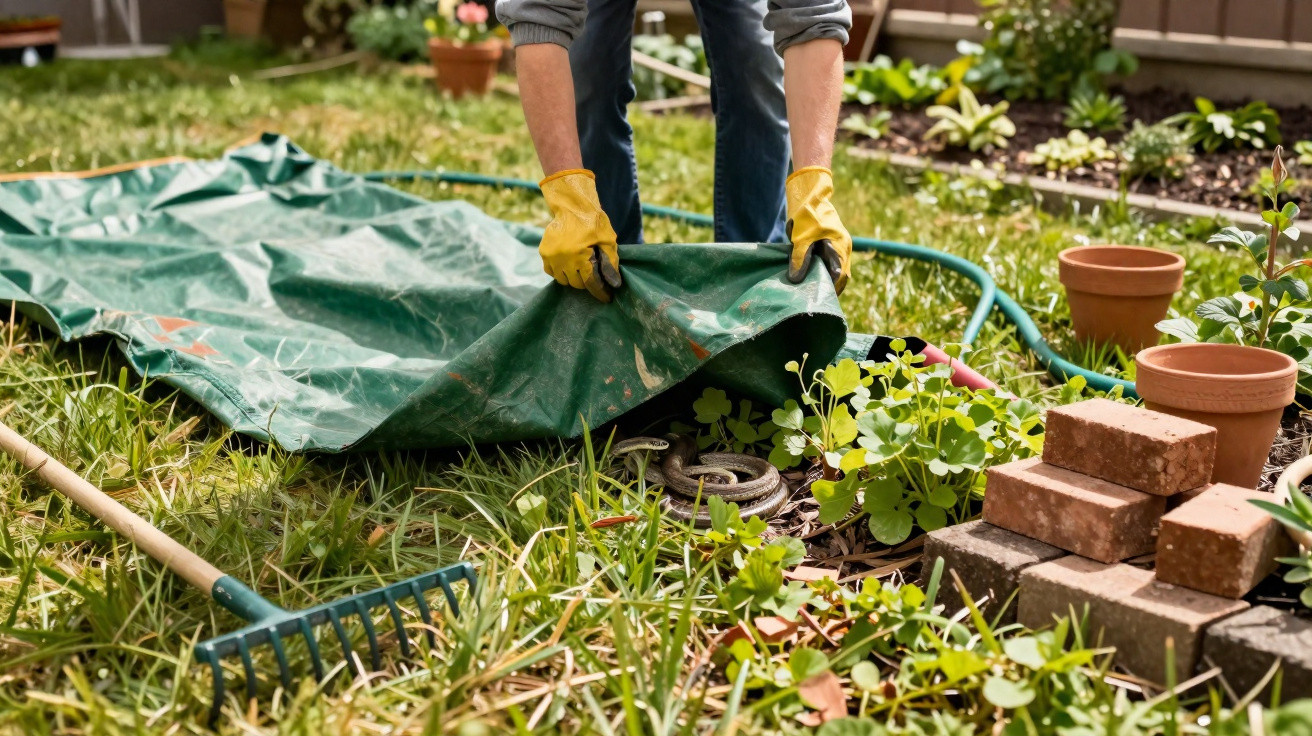
Spring draws people into the garden – but an everyday item left outdoors can prove irresistibly attractive to unwelcome snakes and become a real test of the nerves.
Many keen gardeners are thinking about fresh flowers, new beds and the year’s first barbecue. Yet few consider that an unremarkable item, casually left behind after building work or gardening tasks, can turn into an ideal snake hideaway in the spring sunshine – right beside the patio, lawn or sandpit.
The overlooked risk: why a tarpaulin attracts snakes
When people think of snakes in the garden, they usually picture tall grass, thick hedges or untidy corners. However, something else can act as a magnet: dark garden tarpaulins, plastic sheeting and metal sheets lying flat on the ground.
The reason is straightforward. Once the sun is out, these materials heat up considerably. Beneath a tarpaulin or sheet of metal, a small heat chamber forms. This is exactly what snakes seek out, as they are cold-blooded and depend on external warmth to become active.
Dark tarpaulins and sheets on the ground create a warm, sheltered microclimate below the surface – ideal for snakes after winter dormancy.
This matters particularly in spring. While daytime temperatures may already be mild, nights often remain cold. Under a tarpaulin, temperatures stay comparatively stable and can often reach around 25 to 30 degrees. For many reptiles, this is the ideal comfort zone.
How an ordinary tool becomes a “snake hotel”
The pattern is often the same: after digging over the garden, a tarpaulin is placed on the compost heap. Once a raised bed has been built, a piece of plastic sheeting is left on the ground. Old metal or fibre-cement sheets are set down “temporarily” at the edge of the property – then remain there for weeks or months.
For snakes, this is an ideal situation. They find everything they need there:
- warmth from sunshine and trapped heat
- protection from predators such as birds of prey or cats
- peace and quiet away from inquisitive people and pets
- often food as well, such as mice in woodpiles or compost heaps
The following are especially appealing:
- dark garden tarpaulins or plastic sheeting placed directly on soil
- covered compost heaps
- woodpiles on bare ground, possibly with sheeting underneath
- old metal or fibre-cement sheets laid flat on the ground
Arranging a garden in this way unintentionally provides something like five-star accommodation for reptiles – complete with heating, a roof overhead and a place to retreat.
Dangerous or simply unsettling? How risky snakes in the garden really are
Across Central Europe, most snake species are harmless to people. Their usual response when disturbed is to flee. Many will disappear as soon as they detect vibrations or footsteps.
Even so, panic can quickly set in, especially when children are playing in the garden or a dog is sniffing around curiously. The real danger comes less from the snake itself than from thoughtless human reactions, such as sudden movements or attempts to drive the animal away or kill it.
Anyone who encounters a snake in the garden should remember: most species want only one thing – to get away from you as quickly as possible.
In some countries, every native snake species is protected by law. Anyone who kills or deliberately injures one may face penalties. Specialists clearly advise against trying to “intervene” yourself. A better approach is to make the garden less appealing to the animals.
Practical steps: making your garden less attractive to snakes
There is no need to turn your garden into a sterile space. A few simple habits can greatly reduce the likelihood of snakes settling there permanently, particularly near areas where people spend time.
Common mistakes you can easily avoid
- Leaving tarpaulins and plastic sheeting out after finishing a job
- Putting metal sheets on the ground “temporarily”
- Storing woodpiles directly on the soil
- Covering compost with dark plastic sheeting and leaving it undisturbed for years
Specific tips for a garden with fewer snakes
These measures will make your property considerably less attractive to reptiles:
- Remove tarpaulins, plastic sheeting and sheets immediately after use, then store them upright or on shelving.
- Stack wood on pallets where possible, rather than directly on the ground.
- Turn compost regularly and avoid permanently covering it with dense, dark plastic sheeting.
- Thin out dense vegetation immediately beside the patio, play area or house entrance.
- Plan wilder areas towards the edge of the property, away from heavily used spaces.
| Problem | Result | Simple solution |
|---|---|---|
| Dark tarpaulin lying flat on the ground | A warm, sheltered space for snakes | Remove the tarpaulin, let it dry and store it upright |
| Woodpile on bare soil | A hiding place for rodents and reptiles | Store wood on pallets or racks |
| Old metal or fibre-cement sheets in the grass | A permanent heat store for reptiles | Stand the sheets upright or dispose of them |
What to do if you find a snake after all
Almost everyone is startled when a snake darts out from beneath a tarpaulin. What matters is how you respond. Touching it directly, or even attempting to kill it, greatly increases the chance that the animal will react defensively.
Experts recommend the following:
- Keep a distance of one to two metres.
- Stay calm and avoid sudden movements.
- Back away slowly and leave the area.
- Put pets on a lead or take them indoors.
If the snake does not move away on its own or is in an unsuitable spot, contact the local council, a nature conservation organisation or a wildlife rescue centre. Their specialists know the species found locally and can advise on what to do next.
Why tidying up achieves more than fear
Regularly tidying the garden, putting away tarpaulins and plastic sheeting, and positioning woodpiles carefully simply removes snakes’ most attractive hiding places around the house and patio. Their natural presence is then more likely to remain in quieter, more secluded parts of the property – or outside it altogether.
At the same time, this kind of precaution helps everyone who uses the garden to feel more at ease. Children can play, guests can enjoy a barbecue more comfortably, and there is far less concern about reptiles suddenly appearing while mowing the lawn.
Many people underestimate how much difference such small details can make. A single forgotten pile of tarpaulin, wood and metal may be enough to result in snakes being seen regularly in exactly that spot. Knowing and avoiding these typical “heat traps” reduces the risk with surprisingly little effort.
For wildlife-friendly garden owners, a middle way is possible: keep structurally varied, wilder areas towards the back of the property, while maintaining clear, tidy zones close to the house, patio and play areas. That leaves room for wildlife – just not where the next barbecue is taking place.


Comments
No comments yet. Be the first to comment!
Leave a Comment