
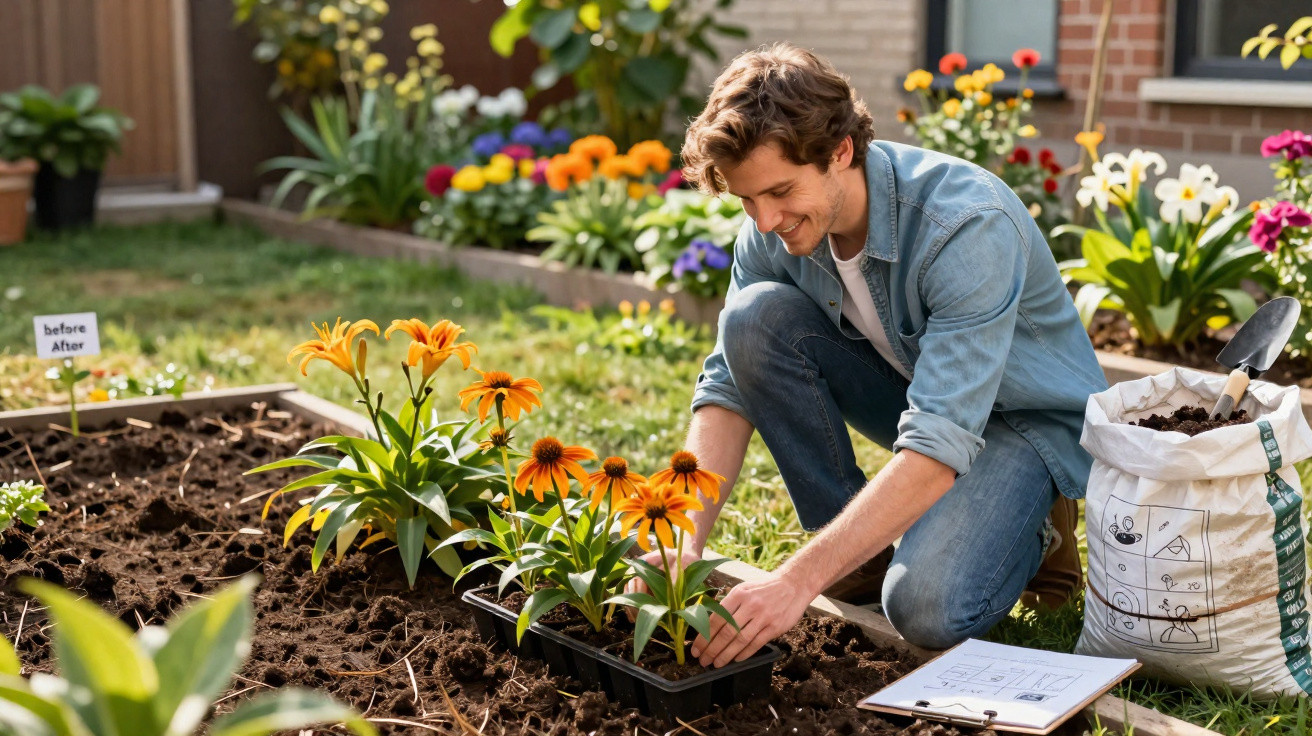
After the cold season, a look around the garden often reveals little more than flat, empty areas. Many people immediately think a complete redesign is needed, involving costly shrubs and plenty of hard work. Yet a carefully chosen mix of long-lasting perennials is often enough to make borders look almost completely transformed, with comparatively little effort.
Why perennials are the best choice for your garden now
Perennials are plants that return year after year. They grow more vigorous over time and form dense clumps. Once they have been planted properly, there is no need to buy them again every year. They save money, time and frustration while still bringing colour to the border from early spring well into autumn.
Their main advantage is that many return independently, spread gradually and slowly fill gaps around the garden. With a little planning, you can create a garden that remains interesting for almost the entire year.
With cleverly combined perennials, an “empty” garden can look new within one season – without a complete overhaul.
Spring planting: plant now, enjoy the results in summer
Spring offers the ideal opportunity to get perennials into the ground. After winter, the soil is still moist but no longer frozen. Periods of rain help roots establish themselves before hot spells arrive in summer.
Points to consider:
- The ground must not be frozen.
- Avoid waterlogging: do not plant in completely saturated soil.
- Wait for a mild spell with no severe frost forecast.
- Depending on the region, March to May is a broad guide.
In northern areas or at higher elevations, the season is more likely to begin in April or May. In warmer regions, planting can often start as early as March. Those who use this window may see the first flowers in the same year, as many perennials establish surprisingly quickly.
Careful preparation: turning an “okay” border into a “wow” border
Before buying plants, take a close look at your garden. Not every perennial thrives in the same conditions. Full sun, partial shade and shade all place very different demands on plants.
Check the site before you buy
Walk around your borders carefully and make a note of:
- How many hours of sun does the area receive each day?
- Is the soil heavy and clay-based, or light and sandy?
- Does water sit for a long time, or does the area dry out quickly?
A south-facing position in full sun needs different plants from a north-facing strip behind the house. Ignore the needs of your perennials at this stage and you may face losses later on.
Prepare the soil: the overlooked boost
The same principle applies to all perennials: the better the soil preparation, the more easily they will establish.
- Remove weeds thoroughly, including deep-rooted weeds such as ground elder and couch grass.
- Loosen the soil with a garden fork rather than merely raking the surface.
- Work in well-rotted compost to improve nutrients and soil structure.
- Water generously after planting, then apply a layer of mulch.
Compost and mulch are like a starter pack for perennial borders: more nutrients, fewer weeds and better moisture retention.
15 robust perennials to visibly improve your garden now
The following selection covers a range of positions and styles, from a striking sunny border to a shady corner with a woodland feel.
For partially shaded and shady areas
- Christmas rose and Lenten rose (Helleborus): Flower from late winter onwards and bring early colour to partially shaded spots. Ideal beneath shrubs or along the edge of woody planting.
- Hosta: Large, ornamental leaves that vary by variety from light green and blue-green to variegated. Perfect for cool, shady sites with fairly moist soil.
- Coral bells (Heuchera): Valued primarily for their attractive foliage. Shades from lime green to deep purple add accents to the front of borders or in containers.
- Bergenia: Thick, glossy leaves and pink to red flowers in spring. It tolerates shade well and also copes with more challenging soils.
- Astilbe: Light, feathery flower plumes that love moist, humus-rich soil. Ideal beside a pond or in cool, shaded borders.
- Bleeding heart: Delicate, heart-shaped blooms hang in rows from arching stems. Best for partially shaded to shady positions with loose, nutrient-rich soil.
Sun-loving perennials for abundant flowers
- Peony: Large, often fragrant flowers and an impressive lifespan; in the right position, it can remain for decades. It needs plenty of sun and an undisturbed spot.
- Lupin: Candle-shaped flower spikes in strong colours. It adds height to the border and is particularly striking when planted in groups.
- Penstemon: Slender stems carrying many bell-shaped flowers. It blooms for a long period through summer, especially in warm, sheltered positions.
- Lavender: A classic for sunny, dry borders. It has an intense fragrance, attracts bees and can define paths, border edges or Mediterranean-style corners.
- Yarrow (Achillea): Flat, umbel-like flowers in yellow, pink, red or white. Very robust, it prefers relatively dry, nutrient-poor soils.
- Aster: A late-flowering plant that really comes into its own in autumn. It provides colour when much else has already finished flowering.
- Crocosmia: Arching stems with vivid red or orange blooms. It creates bold colour accents in summer.
- Delphinium: Tall, impressive flower spikes in blue, violet or white. Ideal at the back of a sunny border, though it needs staking in windy conditions.
Versatile choices for gaps and long flowering periods
- Hardy geraniums: Spread in a carpet-like way and flower from spring into autumn. Perfect for filling gaps and suppressing weeds.
How to combine perennials for maximum impact
Interesting borders depend on contrast: large leaves alongside delicate textures, tall plants behind low cushions, and differing flowering periods. For those who want a “spectacle”, these points matter:
- Layer plant heights: Place tall plants at the back (delphiniums, lupins, astilbes), medium-sized perennials in the middle (peonies, penstemons), and low-growing varieties at the front (coral bells, hardy geraniums).
- Mix flowering times: Use early flowers such as hellebores and bergenia, summer bloomers including lavender and yarrow, and late-flowering asters.
- Use foliage texture: Large hosta leaves look especially three-dimensional beside fine grasses or delicate astilbes.
- Choose a colour scheme: Either opt for soft pastel shades or deliberately bold colours; both work if the approach is consistent.
A well-planned mix ensures that your border never appears completely “empty” – even outside the main flowering season.
Low-maintenance, not maintenance-free: what perennials really need
Many gardeners choose perennials because they promise less work. However, they do not manage entirely without attention. A few straightforward routines will keep plants healthy and flowering well.
| Task | Frequency | Benefit |
|---|---|---|
| Water during dry spells | During prolonged heat | Prevents drought damage and protects flowering |
| Remove spent flowers | During the flowering period | Encourages the formation of new buds |
| Feed with compost | Once in spring | Provides plants with nutrients over the long term |
| Divide overgrown clumps | Every few years | Rejuvenates perennials and produces new plants |
Mistakes that can hold back your perennial border plans
People new to growing perennials often encounter the same difficulties. Three issues are especially common:
- Planting too closely: Perennials need room to develop. Gaps may look normal at first, but they are usually filled after two years.
- Choosing the wrong position: Shade-loving plants struggle in full sun, while sun lovers suffer in deep shade. It is worth properly reading the descriptions at the garden centre.
- Skipping mulch: Bare soil dries out quickly and gives weeds an ideal opportunity. A mulch layer of composted bark or wood chippings saves work.
Avoid these pitfalls and you will soon notice that perennial borders develop further each year. Many plants repay good care with increasingly abundant flowers and stronger growth.
How perennials save money and time in the long term
Compared with annual summer bedding plants, perennials can appear more expensive at the till. Over several years, however, the picture changes. A single peony may remain for decades, while hardy geraniums can cover entire areas without needing to be replanted annually. Dividing older clumps creates free new plants for other borders or for swapping with neighbours.
Insects also benefit enormously from perennials. Lavender, yarrow, asters and penstemons provide a reliable food source for bees, bumblebees and butterflies. A well-planned perennial border is therefore not only more attractive, but also a small contribution to greater biodiversity in your own garden.



Comments
No comments yet. Be the first to comment!
Leave a Comment