
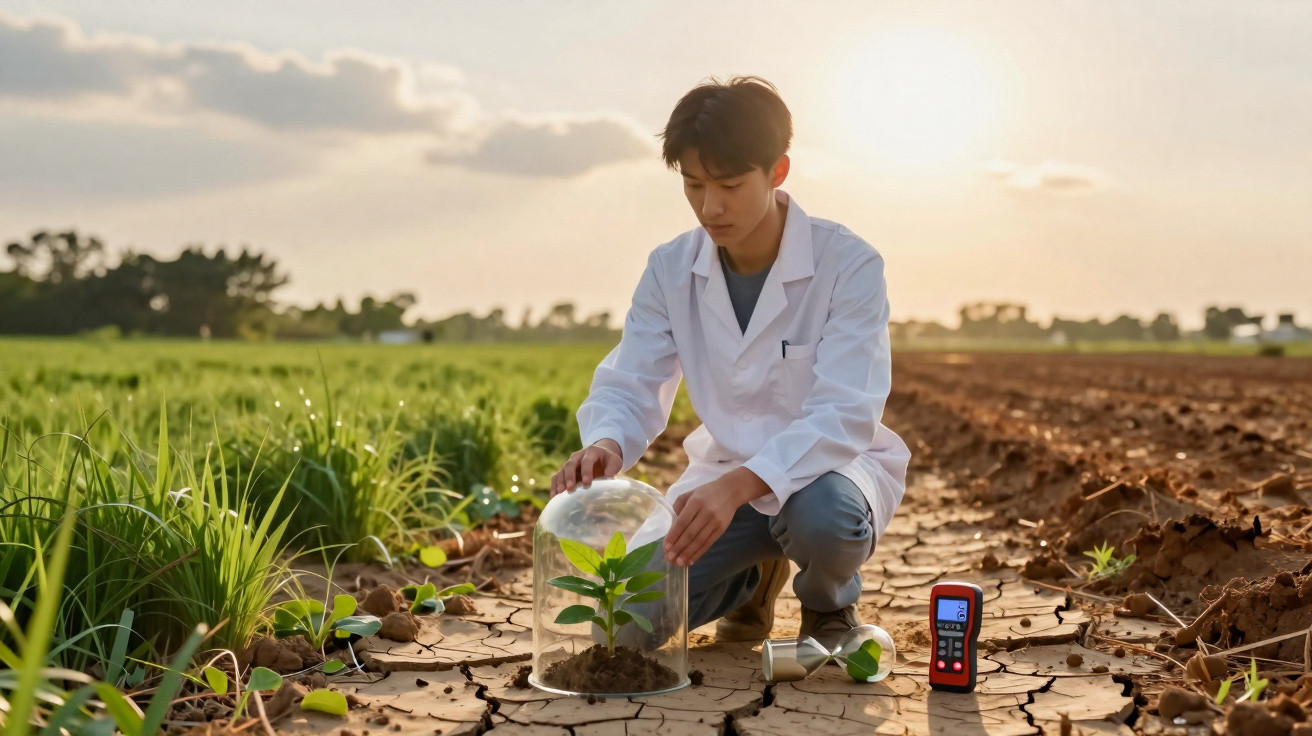
The plant kingdom has already endured five mass extinctions since plants first colonised dry land around 470 million years ago. How much longer can it survive?
According to a study published in Nature Geoscience in 2023, humanity’s extinction may already have a deadline: in 250 million years, the formation of a supercontinent (Pangaea Ultima) will trigger extreme volcanic activity. Temperatures will rise so dramatically that researchers believe just 8% to 16% of the land surface will remain habitable for mammals. Without intensive technological adaptation, such as living underground or air-conditioning entire cities, Homo sapiens and almost every other mammal will disappear at that point. But what will happen to plants?
Plants account for roughly 80% of Earth’s biomass, yet their survival relies on resources that the planet cannot provide forever: sunlight, liquid water, atmospheric carbon dioxide and mineral nutrients. In theory, they cannot persist beyond a certain limit. Two researchers at Blue Marble Space, an independent research institute based in Seattle, set out to identify it.
Astrobiologist Jacob Haqq-Misra and planetary climatologist Eric Wolf ran a series of simulations to determine when the plant biosphere would vanish. Their findings, published on 28 May in the Journal of Geophysical Research: Atmospheres, suggest that the final terrestrial plant may not die for another 1.87 billion years, when the Sun is 20% brighter than it is today.
Starvation or burning: the end of the plant kingdom
To reach this estimate, the two scientists created three-dimensional models of Earth’s climate over the next two billion years, incorporating the gradual increase in solar brightness and variations in atmospheric CO₂ levels.
Carbon dioxide is continually cycled through the planet. Rain removes it from the atmosphere and carries it into the oceans, where it slowly precipitates into carbonate sediments that eventually become rock. At subduction zones, these rocks are drawn down into the mantle, where heat breaks them apart and releases carbon for volcanoes to return to the atmosphere. This loop, known as the carbonate-silicate cycle, ultimately supports every organism on Earth that survives through photosynthesis.
How the carbonate-silicate cycle affects plants
Average global surface temperature affects how rapidly rainfall weathers rocks, but no study has ever quantified the precise scale of that effect. Haqq-Misra and Wolf therefore ran two separate simulations to define two extreme scenarios: one in which chemical weathering removes large amounts of CO₂, and another in which it removes very little.
In the first scenario, temperatures vary only slightly, while CO₂ concentrations become depleted. Plants ultimately starve to death in 1.84 billion years because they no longer have enough carbon to sustain their growth.
The second scenario produces the reverse outcome: CO₂ levels remain stable, but the Sun’s influence drives Earth’s average temperature up to 65°C. No land plant can survive such conditions, which far exceed the tolerances observed even among species adapted to the planet’s harshest deserts. This scenario gives plants an extra 30 million years compared with the first, pushing the deadline back to 1.87 billion years.
Whichever date proves correct, it lies far beyond estimates from earlier work on the same question. “This suggests that Earth’s photosynthetic biosphere could survive, in one form or another, until the Earth begins to lose its water,” Haqq-Misra and Wolf write. In their view, plants will therefore disappear at the same time as the last oceans vanish.
Earth and life: linked until the end?
The authors nevertheless acknowledge that their simulations rest on a methodologically questionable assumption: they never allowed for the possibility that plants might adapt through natural selection. The plants in their models are identical to those alive today, retaining the same physiological limits for nearly two billion years. That is four times longer than plants needed to emerge from the water and spread across the continents.
They readily accept this limitation, and it does not undermine their premise, since they never intended to predict the future of life itself. Their focus was chiefly on the habitability of Earth, the only framework in which a prediction remains defensible.
Could plants outlast Earth’s changing climate?
The rest of their reasoning more freely moves beyond that rigour. They imagine plants that could regulate their internal temperature and pressure, migrate to higher altitudes as the Sun becomes more scorching, establish themselves in the stratosphere, and even spread to low-gravity objects such as the Moon or comets. This is plainly speculative, but they defend the idea: “We suggest that the default scenario for the future of our planet is that life will survive there at least as long as the Earth itself,” they state. From this perspective, plants have no life expectancy: they would survive for as long as Earth retains its water. De facto, this is a question more closely related to geophysics than biology.



Comments
No comments yet. Be the first to comment!
Leave a Comment