
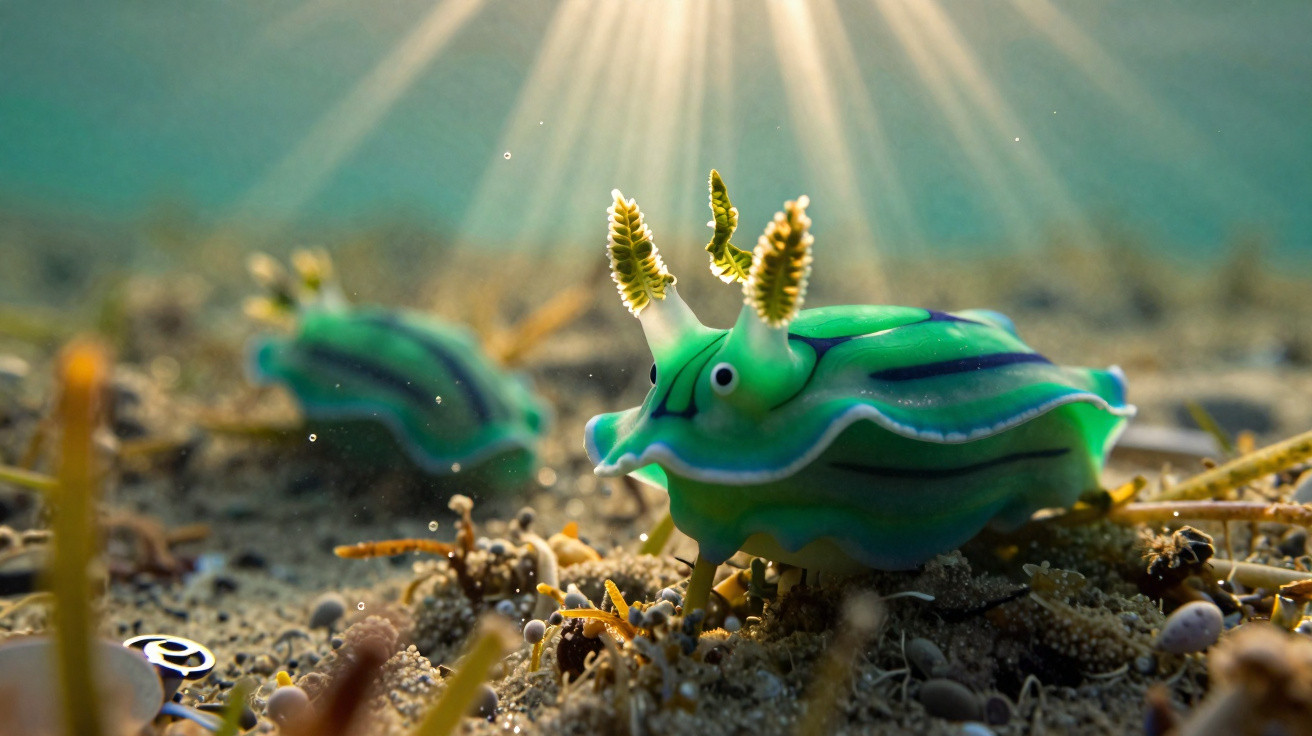
When Sayaka Mitoh came across a sea slug head moving on its own, it initially seemed unlikely that the animal would survive for long. Instead, the detached fragment remained alive and, over the following weeks, grew back a body complete with a heart and other organs - an exceptionally rare degree of regeneration in complex animals.
Which sea slugs can discard almost their entire body?
In 2021, Sayaka Mitoh and Yoichi Yusa of Nara Women’s University in Japan described this phenomenon in two species of sacoglossan sea slug. They recorded animals deliberately detaching their heads at the neck, leaving behind most of their bodies, including the heart and digestive system.
The research, published in Current Biology, referred to the behaviour as extreme autotomy. Many animals shed tails, limbs or other body parts to avoid danger, but losing virtually the whole torso represents something far more drastic. The discarded body did not grow a replacement head, whereas the separated head was able to regenerate in the opposite direction.
How can a head without a heart keep moving?
The heads of younger animals began feeding within a few hours and stayed active despite lacking the organs left behind. Such survival requires an extraordinary physiological reorganisation. The team found that the cut area closed over, after which a new body developed from that point, rather than the animal merely healing the injury.
In young specimens monitored in the laboratory, the heart and much of the body regenerated over roughly three weeks. Older sea slugs were less successful, indicating that age and physical condition affect their ability to complete this highly demanding process.
What does sunlight have to do with survival?
These sea slugs use kleptoplasty: when they eat algae, they retain working chloroplasts within their own tissues. For a period, those chloroplasts continue photosynthesising and may provide the animal with extra energy. The researchers proposed that this resource helps the head remain alive until its digestive system has been rebuilt.
The idea is particularly compelling because it connects feeding, stolen photosynthesis and regeneration. It still requires detailed testing, but it provides a plausible answer to a difficult question: where does enough energy come from to rebuild organs after such a radical loss?
- The detached head can begin eating within hours of autotomy.
- The abandoned body retains the heart and several other organs, but cannot regenerate a new head.
- Young individuals rebuilt their hearts and torsos in around three weeks.
- Chloroplasts taken from algae may help sustain the head during regeneration.
Watch the video shared by the YouTube channel Mundo Animal – news and curiosities, which shows the regeneration abilities of these sea slugs.
Why would a sea slug do something so extreme?
One clue came from parasites found in some individuals. The authors noted that autotomy may allow the animal to escape parasites established in its body, since the regenerated head was free from the infected section. That does not mean the cause has been established in every case.
The researchers also considered and tested explanations involving predator attacks, but complete separation happens too slowly to serve as an immediate escape mechanism. As a result, the anti-parasite hypothesis gained support, although the team acknowledged that several different pressures may have contributed to the evolution of this behaviour.
What does this discovery change about animal regeneration?
The finding suggests that the line between a lost body part and an organism able to start again may be far more flexible than previously thought. In vertebrates, losing the heart and digestive system would make survival impossible. In these small sea slugs, the head preserves enough functions to begin rebuilding the body.
The next challenge is to establish which cellular signals direct this reconstruction and how much kleptoplasty genuinely contributes. Seeing a head crawling around on its own would already be strange; learning that it can once again support a complete body makes it one of the most extreme known examples of regeneration.


Comments
No comments yet. Be the first to comment!
Leave a Comment