
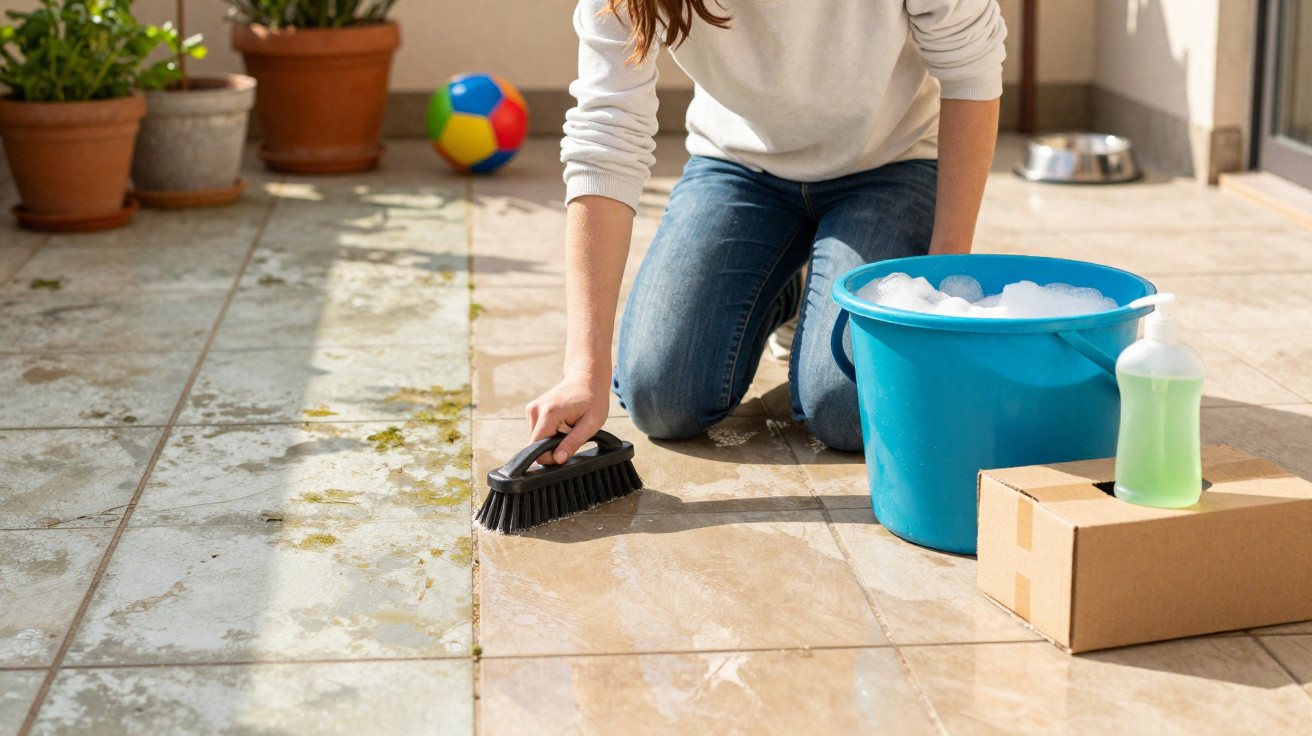
Many people instinctively reach for a pressure washer, chlorine or vinegar, then later wonder why their joints have broken away, their paving has dulled and their flowerbeds are suffering. Yet a straightforward blend of two everyday products delivers the same result – without white vinegar, professional equipment or unnecessary harshness for gardens and pets.
Why the patio looks so grimy after winter
Months of rain, frost and limited sunlight leave paving slabs covered in algae, lichen and layers of dirt. Rust rings and brown stains from metal furniture and wood can also appear where tables, chairs or barbecues have been standing.
Because this change happens gradually, it is barely noticeable during winter. Then, when you first sit outside in spring, the whole area can suddenly look grey, dull and neglected. Many people feel almost compelled to “use a sledgehammer to crack a nut” and bring out the pressure washer or harsh chemicals.
Why vinegar and pressure washers are not lasting solutions
A pressure washer can shift dirt effectively, but its powerful jet comes with drawbacks:
- Jointing material is washed out, allowing weeds to return more quickly.
- It roughens the slab surface, so dirt is more likely to stick in future.
- On older patios, whole slabs may loosen or edges can break away.
Many amateur gardeners turn instead to supposedly “natural” options and pour vinegar water over the patio. It may sound gentle, but it is not: vinegar is an acid. It can etch certain natural stones, leave pale marks and damage their structure. If the mixture runs into the soil, it can harm nearby plants and micro-organisms.
Anyone who uses vinegar, chlorine or a pressure washer every year risks ruining their patio in the long term – even though they are trying to save it.
The two simple products that clean patio slabs again
The method described uses a combination of soda crystals and ordinary washing-up liquid. Nothing else is required.
What soda crystals do
Soda crystals, also known as washing soda, were originally used for laundry care. They break down greasy dirt, soften organic deposits and help lift stubborn film from hard surfaces.
- They dissolve grease and barbecue residues.
- They loosen green deposits and general outdoor dirt.
- They can be rinsed away completely with water.
Important: washing soda is not the same as caustic soda. The latter is far more aggressive and has no place in patio joints. Washing soda is usually found in the laundry or cleaning aisle of shops.
Why washing-up liquid is the unsung hero
Washing-up liquid has two key benefits: it cuts through grease and spreads well across wet surfaces. On patios used regularly for barbecues, or those near roads where soot and fine dust settle, slabs often develop a light greasy coating. This makes dirt and green growth cling more readily.
A basic clear washing-up liquid without added bleach is entirely sufficient. Those aiming to be as considerate as possible towards plants can choose an eco-labelled version.
How the 2-product trick works, step by step
The benefit is that no specialist machinery and no noise are involved. A broom, stiff brush, bucket and garden hose are all that is needed.
- Clear the joints: First remove weeds with a joint scraper or the blade of an old knife. The cleaner the joints, the more evenly the solution can spread.
- Sweep away loose dirt: Thoroughly sweep the entire area with a stiff broom.
- Wet the slabs: Use a garden hose to dampen the surface evenly until it is properly wet.
- Scatter soda crystals: Sprinkle them thinly and evenly over the damp patio. Avoid creating piles; a light coating is enough.
- Add washing-up liquid: Squeeze a few lines or dots over the surface from the bottle, without using too much.
- Scrub: Work the mixture in with a scrubbing brush or stiff-bristled yard broom, slab by slab.
- Leave it to work: Then leave the area alone. Up to two days is ideal, and rain during this time is not a problem.
- Rinse thoroughly: Once the waiting time has passed, rinse everything well with the hose until no foam remains visible.
The combination of soda crystals and washing-up liquid loosens the dirt, the broom provides the mechanical effort, and time takes care of the rest.
Safety considerations and common patio-cleaning mistakes
Although soda crystals are considerably milder than powerful drain cleaners or acids, they are alkaline. A few basic precautions make their use safer:
- Wear gloves while scattering and scrubbing.
- Keep children and animals away while the area is wet.
- Cover open drains where sensitive materials are present.
Anyone using this mixture for the first time, or cleaning delicate natural stone, should test it in an inconspicuous corner. This makes it easier to see how the stone reacts and how firmly it can be scrubbed later.
What can undo the results
After a successful cleaning day, many people habitually return to bleach or vinegar when the next small stain appears. This is exactly what weakens joints and can discolour the surface. Wire brushes and very coarse abrasive pads also create tiny grooves in the paving – ideal places for the next layer of green growth to take hold.
Sweeping too often and too aggressively with metal-edged tools can also cause long-term damage. Brushes with firm but non-metal bristles are the better choice.
How to keep the patio cleaner for longer
Once winter dirt has been removed, the result is easy to maintain with little effort. A simple care routine is enough:
- sweep briefly every two to three weeks
- deal with spilled drinks or barbecue grease immediately using warm washing-up water
- remove fallen leaves promptly in autumn, so they do not leave dark stains
- repeat the 2-product method in a lighter form once a year, in spring or autumn
Placing seating and barbecues on small rubber feet or protective pads also helps prevent rust marks and tannin rings on the slabs.
Different surfaces, small adjustments
The method can be adapted slightly according to the material:
- Concrete and exposed-aggregate slabs: Generally uncomplicated; these surfaces can usually tolerate more vigorous scrubbing.
- Ceramic and porcelain patios: These are normally very smooth, so use less soda and a softer brush, otherwise the surface may become slippery while working.
- Light-coloured natural stone: Test a small area first, use less product and rinse particularly thoroughly.
For newly laid patios, it is worth checking the documentation from the manufacturer or contractor. Some surfaces have factory-applied coatings and require specific care.
What is really behind green deposits
The green film that emerges on patios after winter is usually made up of algae and fine lichens. They thrive in damp, shaded conditions. Fresh layers form quickly wherever water lingers or air circulation is poor, even after a thorough clean.
Where possible, take preventative measures in the layout too: a slight slope allows rainwater to drain away, and heavy plant pots should not be pushed directly against the house walls or garden walls. Even a gap of a few centimetres improves airflow and slows the return of deposits.
Practical measures for households with pets and families
Choosing a cleaning method matters particularly in homes with children or pets. Residues from strong cleaners can otherwise end up on paws, bare feet or in flowerbeds.
The mixture described here has an advantage because, after thorough rinsing, it does not leave aggressive chemicals behind. For extra reassurance, wait until the surface is completely dry before using it again, and when in doubt rinse once more with clean water.
Pet owners will recognise the issue around food and water bowls on the patio: rings and dark patches quickly develop there. A useful tip is to place plastic or rubber mats underneath and clean these separately – this keeps the surrounding surface looking presentable for much longer.


Comments
No comments yet. Be the first to comment!
Leave a Comment