
Experts warn: this could be precisely the mistake.
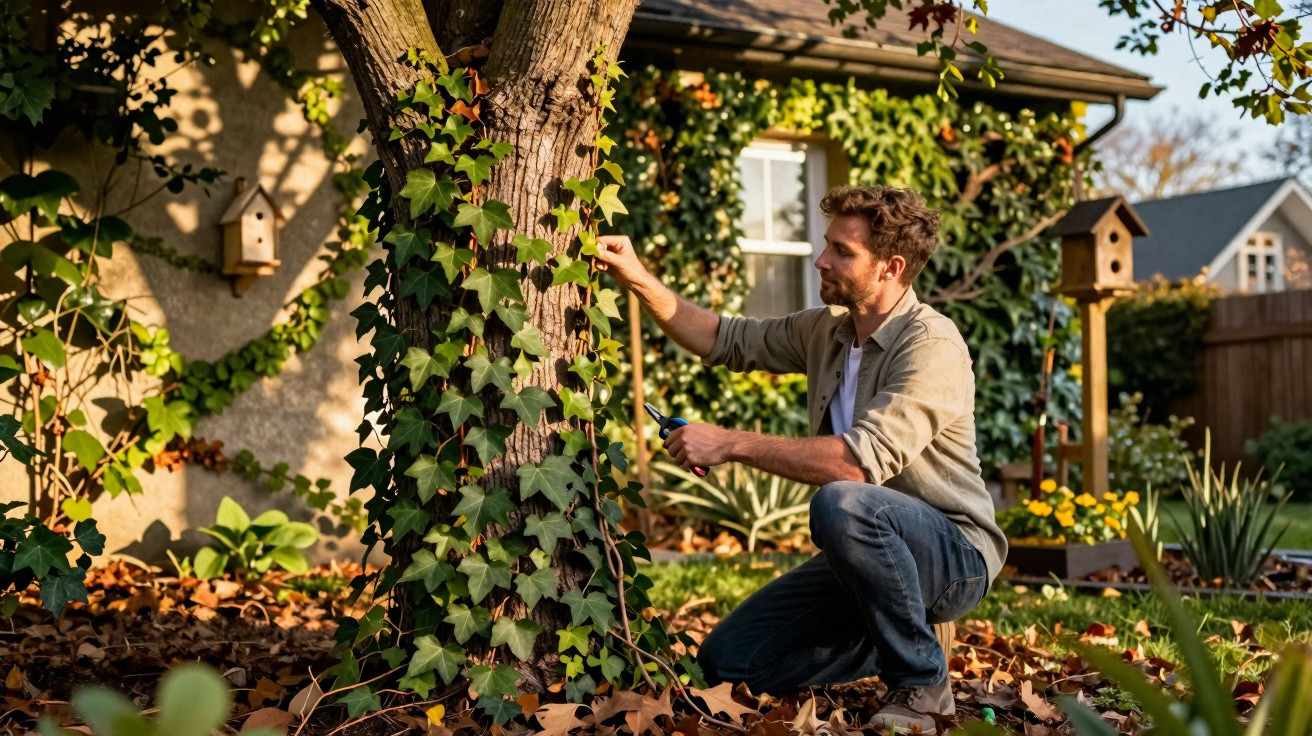
In front gardens and along house walls, the same thing happens every autumn: as soon as ivy starts to climb, out come the secateurs. It is seen as a “greedy invader” that smothers trees and damages walls. Yet recent studies and practical experience from horticulture and conservation present a far more nuanced picture – and radically challenge some common gardening habits.
Why ivy is not really a “parasite”
Anyone who confuses ivy with mistletoe is mistaken. Mistletoe taps into its host tree’s water and nutrient system through its haustorial roots. Ivy does not do this.
Ivy keeps its roots in the ground. The clinging roots on the trunk are supports, not feeding tubes.
This has implications for the tree’s health:
- The trunk supplies ivy with neither water nor nutrients.
- A vigorous tree will generally not lose strength because of ivy.
- The green covering acts more like a coat than a parasite.
If shoots are ripped away forcefully, it is often the bark that ends up injured – and therefore the tree that was meant to be protected.
Ivy on trees: a protective coat rather than an enemy
On a healthy, sturdy tree, ivy works like natural insulation. Its leaves cushion temperature changes and deflect rainfall.
Experts identify several benefits:
- Protection from extreme weather: The layer of foliage shields bark from sun, frost and hail.
- Higher humidity around the trunk: The surface dries out less, giving microorganisms and mosses more stable conditions.
- Habitat for wildlife: Birds nest in dense ivy, small mammals hide within it, and countless insects use its flowers and leaves.
- Ground cover: Around the base of a tree, ivy reduces erosion, retains moisture and suppresses weeds.
For this reason, many local authorities and conservation groups regard ivy as an important contributor to biodiversity in built-up areas – particularly where hedges and old fruit trees are absent.
When ivy becomes a problem for trees
Despite these advantages, there are circumstances in which ivy can make life harder for a tree. This is especially true for trees that are already weakened or still very young.
Trees in the garden that need protection from ivy
Garden specialists advise caution with:
- old trees becoming decayed, with rotten branches
- young trees, especially newly planted fruit trees
- trees with visible disease or major bark damage
- trees that are leaning or poorly rooted
In these cases, ivy can:
- heavily shade the trunk and crown, meaning young shoots receive less light
- conceal cracks, fungal infection or rot, so damage is noticed too late
- add extra weight when it grows into the crown
- substantially increase the surface exposed to wind during storms
Covering an already weak tree entirely in ivy risks it being brought down by the next storm.
How to tell whether you should intervene
A quick inspection of the garden is often enough to assess the situation. Ask yourself three questions:
| Question | Sign that action is needed |
|---|---|
| Is the trunk still clearly visible? | If ivy is spreading into the crown, it is best to restrict it. |
| Does the tree appear stable and healthy? | Reduce the ivy if there are brittle branches, fungal growth or a lean. |
| Is it a young tree? | During the first few years, allow no ivy, or only a small amount, on the trunk. |
Ivy on house walls: risk or natural climate protection?
Ivy on façades often causes disagreement: some people love a green wall, while others fear cracks and damp. The truth lies somewhere in between.
On an undamaged façade with sound pointing and crack-free render, ivy can be remarkably protective:
- The leaves create a kind of screen against driving rain.
- Temperature fluctuations directly at the wall are reduced, relieving pressure on the masonry.
- The façade stays cooler in summer, while slightly less heat escapes in winter.
- Some dust and fine particulate matter is caught by the leaves, making the air around the house a little cleaner.
On a sound wall, ivy is more natural insulation than a destructive force.
When ivy growth really harms a façade
It becomes problematic where the masonry is already compromised. Clinging roots exploit every weak point to gain a hold.
The main risk areas are:
- crumbling pointing and porous bricks
- hairline cracks in render or open gaps around window reveals
- unmaintained gutters in which ivy can grow
- old façades that have never been renovated and already show damp damage
If ivy enters such cracks, wind and moisture can force the joints further apart. Rain can penetrate the masonry more easily, individual bricks may loosen, and insulation performance declines. Over time, this can lead to costly repairs, particularly in older properties.
How to manage ivy on trees and walls properly
Garden professionals recommend neither demonising ivy nor leaving it entirely unchecked. Managing the plant delivers far more benefit than risk.
Practical advice for trees
- Check the tree’s condition: Look at trunk diameter, stability and the crown before reaching for a saw.
- Keep ivy on vigorous trees: Ivy can generally remain on a healthy trunk, but cut it back every two to three years.
- Keep the crown clear: Remove shoots that reach the upper crown so the tree receives sufficient light.
- Relieve weak trees: Accept ivy as ground cover around the base, but greatly reduce or cut it back in the crown.
Practical advice for façades
- Repair before allowing growth: Check pointing, seal cracks in render and secure loose bricks.
- Keep building services clear: Inspect gutters, downpipes and ventilation openings regularly, removing any shoots.
- Restrict it around windows: Do not allow ivy to grow over window frames or roller-shutter boxes.
- Cut it back in good time before renovation: Before façade work, sever the main stems at ground level, allow the ivy to die back, then remove it carefully.
Why ivy is so valuable for biodiversity
Many people underestimate how strongly ivy can boost wildlife in a garden. It often flowers very late in the year, when few other nectar sources remain. Bees, hoverflies and wasps can then find one of the last abundant feeding stops before winter.
Its dense growth provides:
- nesting sites for blackbirds, wrens and other songbirds
- overwintering shelter for insects and spiders
- hiding places for hedgehogs and other small mammals in areas where it forms ground cover
Anyone who removes ivy completely takes away an important source of shelter and food from many animals – especially in sterile gravel gardens.
Common removal mistakes – and better ways to proceed
Much of the damage to trees and walls is not caused by ivy itself, but by hasty work with saws and scrapers.
Common mistakes include:
- pulling shoots from a trunk by force and tearing off bark in the process
- attacking a façade with a scraper or pressure washer and damaging large areas of render
- removing every shoot at once, abruptly taking habitat away from birds and insects
A gentler approach is to cut the shoots close to the ground, wait several months for the plant to die back, and only then carefully loosen the clinging remnants or simply allow them to weather away naturally. Meanwhile, the condition of the tree or façade can be checked calmly and repaired if necessary.
When ivy is especially worthwhile
Its value is particularly clear during hot summers. A greened house wall heats up far less than bare render. Indoor temperatures are often noticeably lower, even without air conditioning.
An ivy screen also improves the microclimate in densely built residential areas: it stores some moisture, filters dust and reduces noise reflection from bare walls. Combined with other plants – such as a mixed hedge, flowering strips and a few fruit trees – an otherwise plain plot can quickly become a diverse, resilient habitat.
Anyone who sees ivy not as an enemy but as a tool can enhance the ecological value of their property without endangering the structure of trees or the house. The key is not radical removal, but careful observation and targeted pruning at the right time.




Comments
No comments yet. Be the first to comment!
Leave a Comment