
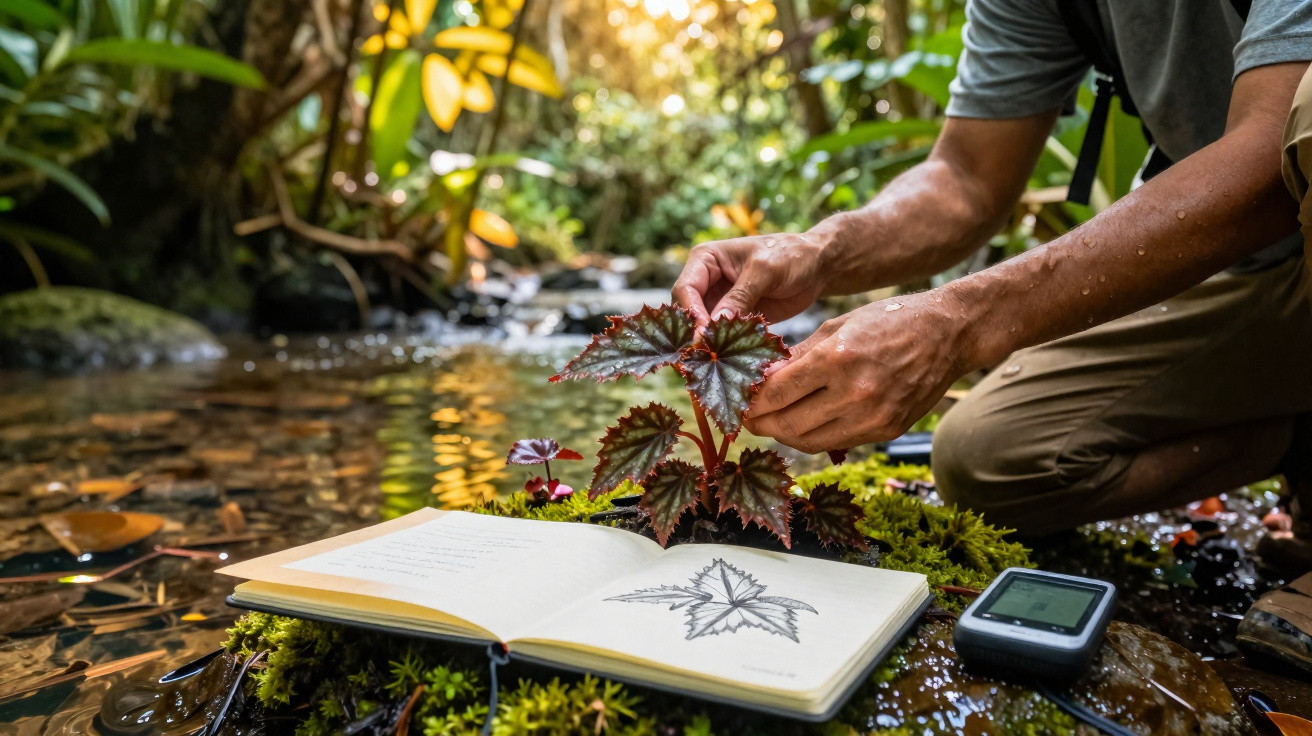
Scientists have documented a previously unrecognised begonia species in the southern Philippines. This newly described flowering plant is identifiable by its small stature, maroon hairs and distinctively formed reproductive parts.
The discovery confines the species’ known range to one vulnerable site, immediately highlighting how little scope it has to survive.
Discovery at a single stream
Across one section of Mount Malindang in the southern Philippines, plants repeatedly appeared with the same low-growing form and dark hairs.
Mark Arcebal K. Naive of Xishuangbanna Tropical Botanical Garden compared these features with those of related plants and found that no previously described species matched them.
After verifying its leaf form and unusually unequal fruit wings, Naive and his co-authors named the plant Begonia occidentalis.
This was significant because every specimen came from one restricted site, making the formal description as much a conservation alert as a naming exercise.
How this begonia differs
The new species is most similar to Begonia copelandii and Begonia rubrifolia, Philippine species that share some structural characteristics.
However, the combination of a hairy leaf stalk, smaller flower clusters and a lightly branched flowering stalk distinguishes it.
Its dried seed capsule is also larger than that of Begonia copelandii, while its wings are more uneven than those of the peninsula species Begonia anisoptera and Begonia sebodensis.
Any single feature might be misleading, but together they formed a sufficiently clear pattern to support recognition as a separate species.
Why classification is significant
Begonia is among the largest genera of flowering plants, meaning that unfamiliar species can remain concealed among similar-looking forms.
Taxonomists separate such look-alikes by determining whether a set of connected features remains stable throughout a living population.
Within this framework, section Baryandra – a subgroup of Begonia – comprises related species from the Philippines and Southeast Asia.
Assigning the species to this section connects it with a broader evolutionary lineage and improves future comparisons throughout the archipelago.
A western outlier
Western Mindanao lies beyond the Philippine areas better known for their rich begonia diversity, helping to account for why this plant went unnoticed for so long.
The specific name occidentalis derives from the Latin term for west, directly referring to its regional origin.
A regional assessment also identified western provinces in which biodiversity records had become sparse for decades.
That extended lack of records makes thorough surveys in the region particularly important, since no records do not mean no life exists.
The fragility of the habitat
Mount Malindang Range Natural Park, an ASEAN Heritage Park, contains thick forest, waterfalls and a crater lake.
For a plant growing beside streams and cliffs, this protected environment determines the light, moisture and shallow soil in which its roots can take hold.
The authors state that this is the first begonia in section Baryandra recorded from the park and the third from the Zamboanga Peninsula.
Its isolation and novelty together help show why even limited disturbance could have disproportionately severe effects.
Small populations, greater risk
Researchers observed fewer than 50 mature plants, all at one known location in western Mindanao.
For this reason, the authors assigned it a provisional Critically Endangered status, the highest Red List threat category before extinction in the wild.
Unregulated tourism, trampling and habitat degradation may seem minor, but they become serious threats when a species occupies just one delicate site.
When a population is so small, a storm, landslide or careless clearing of a path could wipe out years of evolutionary history.
The role of maroon hairs
One of the most obvious identifying features occurs along the leaf edges, where striking maroon hairs contrast with the green tissue.
These hairs enable botanists to identify the species swiftly because they occur consistently alongside its other features rather than in isolation.
Its smaller size overall and unusually trapezoid seed capsule also help distinguish the plant from regional relatives.
Such visible features are valuable in conservation work, as field teams frequently make initial assessments before laboratory analysis can begin.
Why formal recognition matters
Without a formal name, a plant may be overlooked by legislation, surveys and park-management plans, as though it were already known.
Once a species has been described by botanists, land managers can map its distribution, evaluate its risk and monitor changes over time.
Although this documentation may appear routine, it converts scattered sightings into evidence that governments and conservation organisations can use.
For a species recorded at only one site, formal recognition may mean the difference between attentive protection and an unrecorded disappearance.
The search for other species
The find also suggests a wider prospect: other neglected plants may still occur in the less studied forests of western Mindanao.
Begonias frequently occupy highly restricted habitats, requiring botanists to examine individual streams, cliffs and ravines.
This painstaking approach explains why a protected area may appear familiar until a careful comparison suddenly redraws the picture.
Every new record can expose both previously unseen biological richness and the limited space remaining for some species.
This one begonia reveals western Mindanao as a region that is both botanically diverse and exceptionally vulnerable.
Protecting its streamside habitat, reducing disturbance and surveying neighbouring forests now appear as important as formally naming the species.





Comments
No comments yet. Be the first to comment!
Leave a Comment