
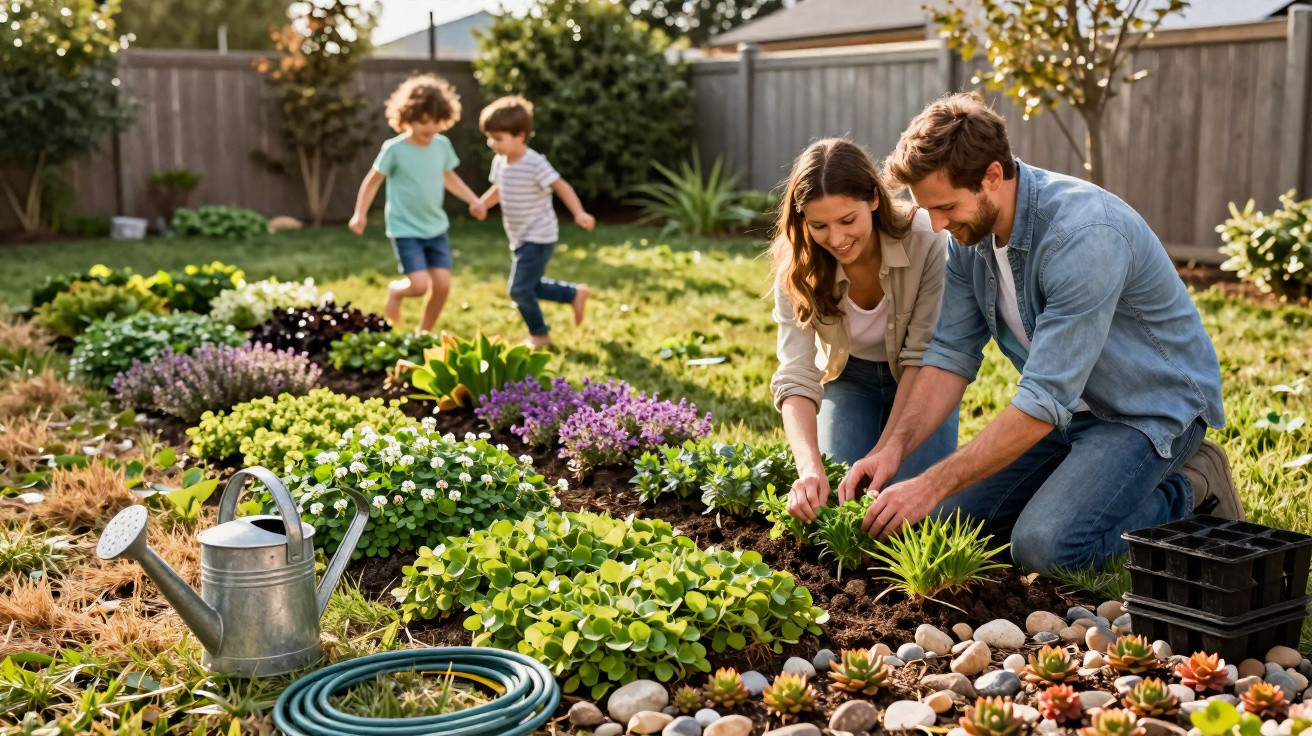
More and more homeowners are looking for an alternative that can be walked on normally yet needs less maintenance, barely any water and considerably less fertiliser. Foot-traffic-tolerant ground cover offers precisely that: a resilient green carpet that looks attractive while also supporting bees and other insects.
Why conventional lawns are becoming increasingly problematic
A lush green lawn looks wonderful in photographs. In practice, however, it mainly consumes resources. Regular mowing, watering, fertilising and scarifying are needed - and when summers become hotter and drier, the surface soon turns patchy and scorched.
“Switching to resilient ground cover can save water, reduce mowing and still provide a walkable green surface.”
Unlike lawn grass, many ground-cover plants create a dense, permanent cushion. They suppress weeds, shield the soil from drying out and require far less attention. Some varieties can even manage for weeks without additional watering once they have established themselves.
Before making the change, assess three factors realistically:
- How many hours of sunshine does the area receive each day?
- What is the soil like? Is it heavy and damp, or light and dry?
- How much foot traffic will it get? Will it only be used on the way to a sun lounger, or for the children’s daily football games?
Only this combination reveals which plants will genuinely cope, and which would fail after the first summer.
The 5 best foot-traffic-tolerant ground covers to replace a lawn
1. Gazon des Mascareignes (Zoysia tenuifolia): the hard worker
For an area that receives plenty of foot traffic, Zoysia tenuifolia is an almost automatic choice. This fine grass forms exceptionally dense, soft cushions and withstands heavy use far better than ordinary lawn grass.
- highly tolerant of foot traffic
- requires only around one or two cuts per year
- needs substantially less water once established
Visually, Zoysia resembles a miniature golf course rather than a typical domestic lawn. Its blades grow slowly and remain low, which explains the minimal mowing requirement. It is a very suitable option for anyone wanting to reduce maintenance dramatically.
2. Lippia (Phyla nodiflora): a carpet with drought tolerance
Lippia, botanically known as Phyla nodiflora, produces an extremely low, dense carpet that closes over quickly and can be walked on regularly without difficulty. Once rooted in, this plant copes surprisingly well without water for extended periods.
Experience in many gardens shows that, after its initial establishment phase, Lippia can tolerate two to three months without irrigation, provided the soil is not entirely sandy. Its small flowers attract insects and give the area a lively, subtly Mediterranean feel.
3. Microclover: family-friendly and self-fertilising
Microclover is already included in lawn seed mixes in many countries, and for good reason. Its leaves are much smaller than those of standard clover, so the finished surface appears calmer and more lawn-like.
“Microclover fixes nitrogen from the air and feeds it into the soil - significantly reducing the need for fertiliser.”
Microclover is particularly appealing for families:
- very resilient under walking and play
- quickly usable again after rain
- often requires less watering than a standard lawn
Anyone concerned about bees in a play area should pay attention to the chosen variety, or manage flowering periods through mowing intervals so that fewer flowers remain.
4. Creeping thyme and similar plants: fragrant cover for dry positions
In sunny locations with relatively poor soil, ground-cover thyme varieties come into their own. Typical choices include wild thyme (Thymus serpyllum) and woolly thyme. They form a low, fragrant cushion that bees find irresistible.
These cushions readily tolerate occasional footsteps, such as on paths to a seating area or between stepping stones. They are not suitable for constant running and play, however. Anyone using thyme as a lawn replacement should reserve it mainly for ornamental and relaxation areas, where people may take a few barefoot steps but will not be playing football.
5. Turquette and foot-traffic-tolerant Sedum varieties: minimalists for challenging sites
Herniaria glabra, often sold as Turquette, is an option for very poor, dry soils, such as on slopes or between stones. Once established, it forms a low, dense cushion that requires very little water.
Certain foot-traffic-tolerant Sedum varieties work in a similar way. They are particularly suited to:
- areas between stepping stones
- path edges
- slopes and wall tops
Where lawn seed only establishes poorly and soon burns off again, these succulents often remain remarkably stable and green.
How to replace a lawn with a ground-cover carpet
Simply planting into an existing lawn wastes much of the potential. The site needs a proper fresh start. First, remove the old turf completely: either lift it, use a turf cutter, or cover it with an opaque material for several weeks.
Then loosen the soil to a depth of around 15 to 20 centimetres. A garden fork is preferable to a spade, as it prevents the soil layers from being completely turned over. Work plenty of well-rotted compost into the ground while loosening it:
- heavy, clay-rich soils become better aerated
- light, sandy soils retain moisture for longer
- microorganisms get off to a better start
Spring and autumn are especially suitable planting periods because natural rainy spells support young plants. By contrast, losses rise sharply in the height of summer.
First-year care: water less frequently, but thoroughly
Watering is the biggest source of mistakes. Many people reach for the watering can constantly, but only water briefly. This encourages shallow roots. A better approach is to water infrequently but deeply. The roots will then grow further down into the soil, enabling plants to tolerate dry spells more effectively later on.
“A long, infrequent watering achieves more than daily ‘dampening’.”
Hand weeding is worthwhile during the first few months. It is easiest to weed when the soil is slightly moist. Once the ground-cover area has filled in densely, unwanted growth reduces substantially by itself.
Later, maintenance is limited to occasional trimming, perhaps a light nutrient application and, for Zoysia, one or two mowing sessions a year. A mixture has proved useful in heavily used areas: microclover combined with hard-wearing grasses, or, in zones subject to intense use, additional woodchip paths.
What homeowners should consider before deciding
People accustomed to the traditional image of a lawn may need time to adjust to the new appearance. Thyme, Lippia and microclover look different from an English lawn - often more colourful and lively, with flowers and a slightly irregular texture.
In return, ongoing costs are reduced: lower water use, less fertiliser, less frequent use of mowing equipment and therefore less noise. At the same time, the garden’s ecological value increases. Flowering ground covers provide pollen and nectar, while structurally varied areas give small creatures places to shelter.
It makes sense not to convert the entire lawn area all at once. Anyone unsure should begin with a trial patch, for example ten to twenty square metres, and observe for one to two years how the selected plant performs in their own microclimate.
Especially at a time of rising water prices and more frequent heatwaves, an intelligent mix can make a garden far more future-proof: resilient ground cover in sunny, dry areas, potentially shade-tolerant alternatives beneath trees, and conventional lawn only where it is genuinely needed - such as a small play area for children.

Comments
No comments yet. Be the first to comment!
Leave a Comment