
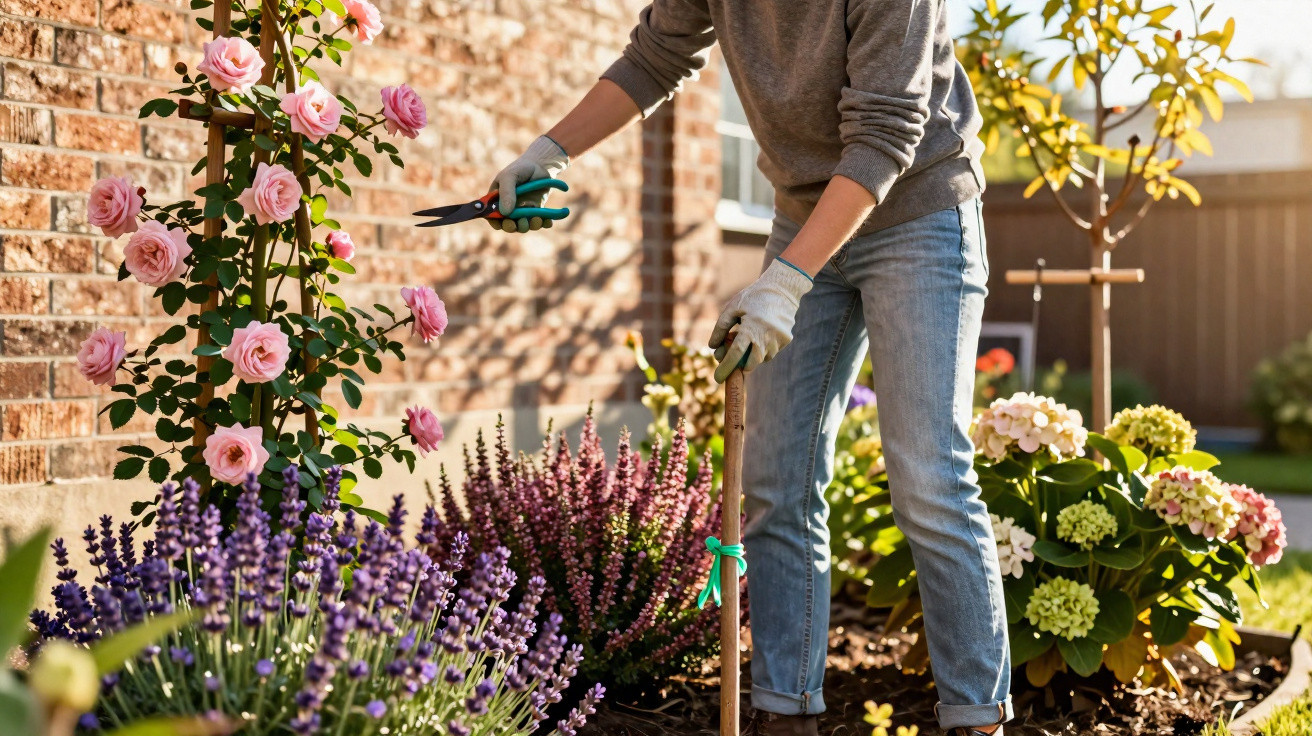
Picking up the secateurs now can give shrubs, roses and trees a real boost in growth. Many popular garden plants need a purposeful prune in March to stay compact, produce healthy new growth and flower abundantly. A few straightforward rules of thumb can achieve a great deal, even without professional knowledge.
Why March pruning matters so much
By March, winter is nearly over, the harshest frosts have passed and many plants are about to start growing. This is precisely when they cope particularly well with a firm prune. Cuts heal quickly, fresh shoots emerge vigorously, and flowering later in the year becomes noticeably more prolific.
“Pruning properly in March lays the foundations for a dense crown, strong shoots and a long flowering season in summer.”
The plants’ structure is also still easy to see: which branches cross, which shoots grow inwards, and where old or dead wood remains. All of these can now be removed with precision.
Training espalier trees and screening plants into shape
Many front gardens are bordered by espalier limes, plane trees or evergreen cherry laurels used as privacy screens. The period up to the end of March is ideal for restoring their shape.
Tying in young espalier trees correctly
With young trees, the priority is to establish the crown. Retain the stronger shoots that are well positioned, then secure them to the frame with tree ties or similar material. Do not cut these branches back; tie them in neatly so that they form a dense screen over time.
- Remove drooping, weak shoots.
- Take out shoots growing inwards or backwards.
- Cut only enough to ensure the basic shape remains clearly visible.
Two approaches for established espalier trees
Once an espalier tree has been in place for several years, there are essentially two options:
- Cut back to older branches: Cut all young shoots close to the older, thicker branches. This encourages plenty of new growth and maintains a defined structure.
- Prune into a hedge shape: Trim it as a dense, block-shaped hedge. This is especially popular for plane trees and evergreen species such as cherry laurel.
Vigorous cherry laurel varieties that work well as green walls are currently popular. They also tolerate harder pruning.
Roses in March: prune low for abundant flowers
Roses may appear delicate, but they cope remarkably well with pruning at the start of the season. Being overly cautious can result in long, ageing shoots and fewer flowers.
Floribundas, shrub roses and standard roses
Remove old, brown and heavily woody shoots. Cut back the younger, stronger growth firmly, usually to just above an outward-facing bud. This is the small bud on the shoot that points away from the centre rather than inwards.
Although this pruning can seem drastic, it promotes fresh, healthy growth. The same applies to standard roses: remove ageing branches from the crown and shorten young shoots substantially.
Climbing roses: select and arrange rather than cut back hard
Climbing roses need a slightly different approach. Choose three to four strong main stems to form the framework. Fasten them horizontally or at a gentle angle against a wall or trellis. The side shoots growing from these stems should then be shortened to a few buds.
Cut out dry, dead shoots completely. This keeps the plant open and allows the flowers to spread attractively across the surface later on.
Lavender and heather: compact cushions instead of woody bushes
If left unpruned for years, lavender tends to become woody from the base and fall open. March is the perfect time to prevent this.
Cutting back lavender properly
Lavender should receive a firm trim every year, to around 10 to 15 centimetres above ground level. It is important not to cut into entirely bare old wood, but to prune just above it. This allows the plant to grow back densely and evenly rounded.
This applies to both traditional lavender and French lavender. Anyone reluctant to prune risks ending up with tall, unstable plants and bare stems over time.
Heather: the variety makes a difference
Heather stays green throughout the year, but it also needs pruning to stop it becoming open and straggly. Two groups are particularly important:
- Summer heather (Calluna): Prune in March, around 8 to 12 centimetres above the ground and just above the leafy area.
- Winter heather (Erica): Cut back after flowering in summer, not now.
Always prune just above the bare wood, leaving green growth behind. This keeps the mats dense and free-flowering.
Hydrangeas: each type has its own pruning rules
After winter, hydrangeas often look rather forlorn, with brown flower heads and dry stems. Before making any cuts, check which variety you have, as their responses to pruning vary considerably.
Mophead hydrangeas, lacecaps and similar types
These familiar varieties generally flower on older wood. Remove only some of the thick, older stems – around one fifth. Carefully cut off the old flower heads just above the buds. Pruning too low may leave the plant with hardly any flowers for a year.
Panicle, ball and oakleaf hydrangeas
Other types are much more tolerant of pruning:
- Panicle hydrangeas can be cut back to around 40 centimetres.
- The well-known variety with large white ball-shaped blooms can be cut back to around 10 centimetres.
- Oakleaf types can be shortened to 10 to 20 centimetres, provided they are not intended to remain tall as specimen plants.
Prune striking specimen plants more conservatively: remove old flowers and awkward shoots while retaining their overall form.
Treat climbing hydrangeas patiently
Climbing hydrangeas flower on shoots formed in the previous year. Cutting them back hard in March removes countless developing flower buds. The rule here is simple: prune only after flowering. Then thin the plant and shorten overly long shoots.
Butterfly bush, ivy and more: firm pruning pays off
Butterfly bush: a harder cut brings more flowers
Butterfly bush produces flowers on the current season’s shoots. It can therefore be cut back decisively in March, to around 30 to 50 centimetres above ground level. Dwarf varieties may be cut even lower, to approximately 15 centimetres.
Make each cut just above small buds or emerging shoots. The shrub will then regrow compactly and produce long flower spikes full of blooms that attract insects.
Keep ivy under control
Ivy grows more slowly in autumn and winter, but it does not stop altogether. March is a good time to rein in sections that have spread too far. Cut back loose shoots that are working their way into gaps and folds in timber. Remove runners along the ground as well, otherwise ivy can quickly take over entire beds.
A defined edge along the ground and walls stops it spreading unnoticed. Regular trimming maintains a neat, dense green covering.
Keep St John’s wort low
A hard prune helps St John’s wort form low, closed cushions. Cut it back to around 20 centimetres; it will then put on fresh growth and leave little room for weeds.
Mediterranean favourites: olive tree and oleander
Thin and shape an olive tree
An olive tree readily develops a somewhat untidy appearance if left alone. In March, remove dead branches along with shoots growing inwards or crossing one another. The aim is an open crown with plenty of light reaching through it.
Once the basic structure is right, shape the tree to suit your preference, from rounded to cloud-like forms. Olives tolerate a surprising amount of pruning and usually produce new growth promptly.
Oleander: do not be afraid to prune
Oleander responds robustly, even when frost damage is visible at the tips. Remove damaged or brown sections and cut the whole plant back by up to half. The result is denser, bushier growth and plenty of new flowers.
As every part of the plant is poisonous, wear gloves while pruning. Its milky sap can irritate the skin, and children and pets should not come into contact with freshly cut shoots. After pruning, it is best to place container-grown plants briefly out of reach.
| Plant | Prune in March? | Recommended height after pruning |
|---|---|---|
| Espalier lime / plane tree | Yes | Depends on the shape; cut young shoots back firmly |
| Shrub rose / standard rose | Yes | To a few buds on each shoot |
| Climbing rose | Yes | Side shoots to 2–3 buds |
| Lavender | Yes | Approx. 10–15 cm |
| Summer heather | Yes | Approx. 8–12 cm |
| Panicle hydrangea | Yes | Approx. 40 cm |
| Butterfly bush | Yes | 30–50 cm; dwarf forms 15 cm |
| Ivy | Yes | According to the desired area |
| Olive tree | Yes | According to crown shape |
| Oleander | Yes | Cutting back by up to 50% is possible |
Practical advice: tools, weather and common mistakes
Clean cuts require sharp, clean secateurs. Blunt blades crush shoots, which can encourage disease. After pruning heavily affected plants, it is worth disinfecting the tools briefly.
Choose a dry day without frost for pruning. Wet wounds dry more slowly, giving fungi an easier opportunity to establish. If you are unsure, prune slightly less and watch how the plant responds. Many species will still tolerate a second, light corrective trim later in spring.
It also helps to be clear about your aim: more flowers, less height, a denser hedge or a more open crown. With that picture in mind, each cut becomes easier – and the garden will reward the work done in March with a noticeably stronger season.

Comments
No comments yet. Be the first to comment!
Leave a Comment