
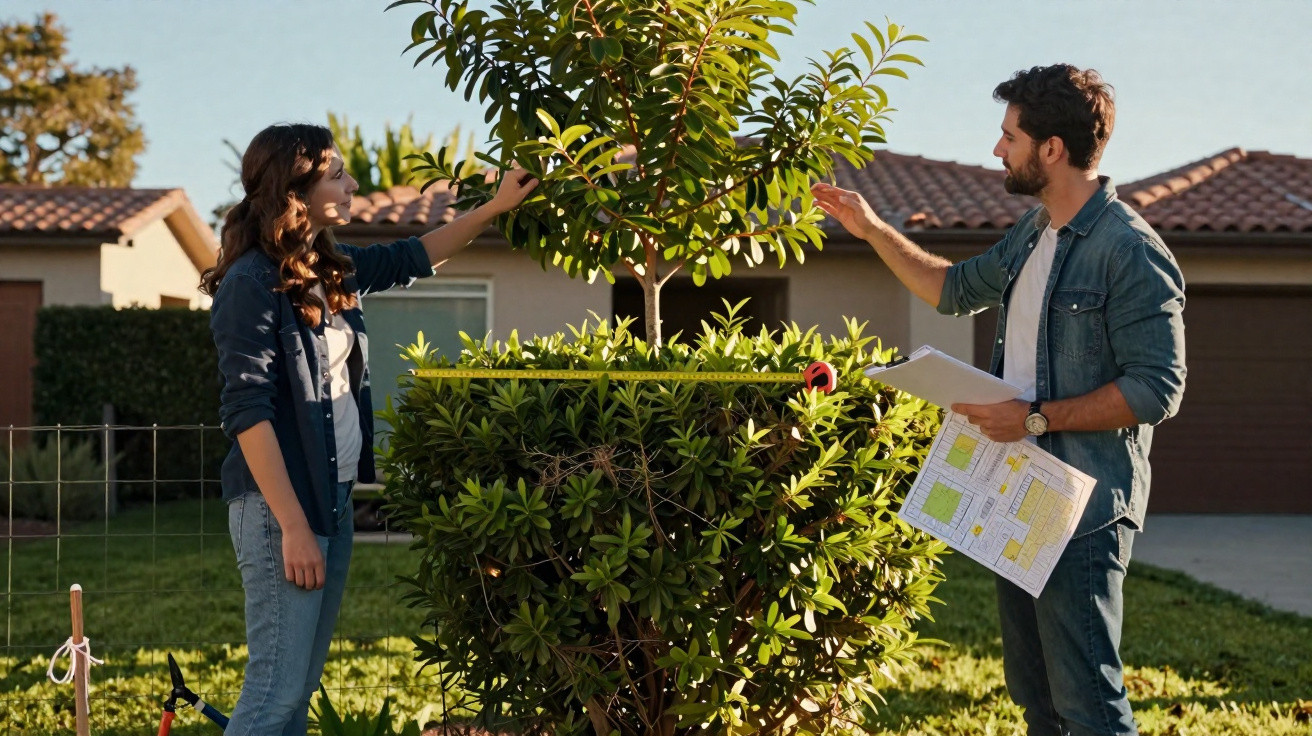
Anyone intending to plant trees or shrubs along a property boundary needs to consider more than appearance and the price at the garden centre. Required distances, eventual height and neighbours’ rights are clearly regulated. Ignoring them can lead to costly pruning work, even court proceedings – and lasting bad feeling in the neighbourhood.
Why a hedge at the boundary can quickly become a problem
The familiar scenario is this: planting is done quickly in spring, then a few years later the hedge shades a neighbour’s patio, branches press against the fence and roots lift paving slabs. This is precisely where the legal rules come into play.
“Planting close to a boundary is not merely a matter of neighbourly relations; it is a clearly regulated area of law, with duties and rights on both sides.”
Many European countries, including Germany, have provisions in state neighbour-law legislation, local development plans and, in some cases, municipal tree-protection regulations. Two factors are particularly important: the plant’s distance from the boundary and the height it is expected to reach.
Legal basics for hedge and tree distances and heights
Typical required distances
The precise figures vary from one German state to another, but the underlying principle is similar:
- Low hedges and shrubs (up to around 2 metres high) can usually be planted closer to the boundary.
- Taller trees and large shrubs require substantially more space, often at least 2 metres or more.
- The relevant measurement is generally the distance from the boundary to the centre of the trunk.
Where the minimum distance is not met, a neighbour can in many cases demand that the plants are cut back or even removed. This may apply years after planting, provided no limitation period applies.
Special case: a hedge directly on the boundary
If a hedge stands exactly on the boundary, it will generally be treated as a jointly owned hedge. The plants then belong to both parties, with all that entails:
- both neighbours have rights to use it;
- both must contribute to maintenance costs;
- both may decide on pruning, within the agreed framework.
Such arrangements can work very peacefully if the parties set out in writing, in advance, who will do what and who will pay. Without a clear agreement, every pruning job can swiftly become a subject of debate.
Choosing suitable plants near a property boundary
Species that can be managed well at the boundary
Not every tree or shrub is suitable for planting close to a property boundary. Anyone wishing to avoid disputes should look several years ahead when making a purchase.
For narrow hedges that are easy to control, suitable options include:
- cherry laurel and privet (quickly become dense, yet are easy to prune);
- hornbeam or field maple (hardy and readily shaped into formal hedging);
- evergreen hedge mixes made up of smaller conifers.
For trees planted near a boundary, smaller or medium-sized species with a limited crown spread are generally preferable:
- small-crowned maple varieties;
- ornamental cherries;
- field maple or hawthorn.
Problem species should be kept away from the boundary
Some species almost inevitably cause conflict when planted too close to a fence or wall. Examples include:
- poplars and willows – very vigorous root systems and high water demand;
- plane trees and horse chestnuts – large crowns, substantial leaf fall and heavy shade;
- enormous conifers such as spruces or firs – which significantly darken neighbouring land.
“When in doubt, planting a metre further inside the boundary buys peace of mind – and avoids high later costs for tree climbers and specialist contractors.”
Step by step: planning planting close to a boundary correctly
Establish the boundary line and check the documents
Before the first spadeful of soil is moved, the exact position of the property boundary should be confirmed. Old fences or hedges are surprisingly often located slightly within the “wrong” area. If there is any doubt, it helps to:
- inspect the land register and cadastral plan;
- locate boundary markers or have them installed;
- if necessary, instruct a surveying practice to establish the boundary.
It is also worth checking:
- the local development plan or local rules;
- any design requirements for the development or subdivision plan;
- any municipal tree-protection regulations.
Speak to the neighbour before planting
A brief visit next door can prevent many disputes. Explaining what is to be planted, where the hedge will run and how tall it may be allowed to become in the long term demonstrates consideration. It can also open up useful options:
- a jointly owned hedge directly on the boundary, with shared costs;
- a written agreement allowing smaller distances;
- a coordinated choice of plants that suits both sides.
Importantly, these arrangements should ideally be recorded in writing, dated and signed by both parties. That is the only reliable way to establish later what was agreed.
Maintenance duties: overhanging branches, roots and shade
Who has to prune – and what may the neighbour do?
As a basic rule, an owner must maintain their trees and hedges so that they do not cause an unreasonable interference to a neighbour. Typical areas of dispute include:
- branches extending over the fence and hanging above the neighbour’s patio;
- roots spreading into the neighbouring garden and damaging paths or utility lines;
- dense, tall planting that blocks light and sunlight to an extent considered unreasonable.
Many sets of rules provide that the owner must cut back overhanging branches. A neighbour will normally be permitted to cut only roots, climbing growth or small shoots at the property boundary themselves if these affect their land – and even then only within clearly defined limits.
When hedge trimming becomes a point of dispute
Regular pruning keeps a hedge in shape and within the legally compliant range. Difficulties arise when plants are allowed to grow unchecked for years. A single drastic cut is then often insufficient to restore compliance with every requirement, and it can damage the plant. Many owners therefore delay action – while the neighbour considers their rights infringed.
“Anyone who maintains their hedge two to three times a year saves not only work, but also stress in dealing with the neighbouring property.”
What to do when a dispute already exists
From a polite request to court proceedings
If conflict does arise, owners should take a structured approach:
- Seek a conversation: Raise the issue calmly and factually, ideally with specific proposals.
- Send a written request: If discussion does not help, follow up with a friendly but clearly worded letter setting a deadline.
- Use a conciliation service or mediator: Many municipalities offer conciliation services free of charge or at low cost.
- Go to court: Legal action should be the final option, after every other attempt has failed.
Anyone forced to take this route should gather evidence: dated photographs, notes of conversations, copies of letters and, where appropriate, quotations from gardening or tree-care firms documenting the required pruning.
Useful additional information for property owners
Limitation periods and “old” hedges
Many owners inherit established situations: the hedge has been there for decades and no one knows exactly who planted it. Depending on the legal position, a neighbour’s claims may be time-barred if they have taken no action for a long period. That does not mean, however, that every interference must be accepted indefinitely. Different rules apply where there is an immediate risk, such as branches that are likely to break.
Practical examples from neighbouring properties
A typical case is a thuja hedge planted 15 years ago, 50 centimetres from the fence, which has now reached 3 metres in height. The original choice of plant was simply too tall for that location. Limiting growth early and switching to a lower-growing species in good time can ultimately avoid complete removal being ordered by a court.
Another scenario involves a newly planted cherry tree that appears to stand in the middle of its owner’s land. Only later does it emerge that the boundary follows a different line. With an up-to-date survey plan, the tree could simply have been planted two metres further in – and the dispute would never have begun.
Risks, costs and the benefits of careful planning
Arguments about hedges and trees cost not only peace of mind, but money too. Removal, professional pruning, survey fees, and legal and court costs can add up quickly. By contrast, anyone who allows generous distances, selects suitable species and speaks to their neighbour early on can create a durable green boundary with manageable maintenance needs.
When properly planned, hedges and trees offer many benefits: greater privacy, improved noise reduction, cooler temperatures on hot days and an attractive living environment. The key is to think ahead from the first turn of the spade – considering not just one’s own garden, but also the outlook and rights of the people next door.


Comments
No comments yet. Be the first to comment!
Leave a Comment