
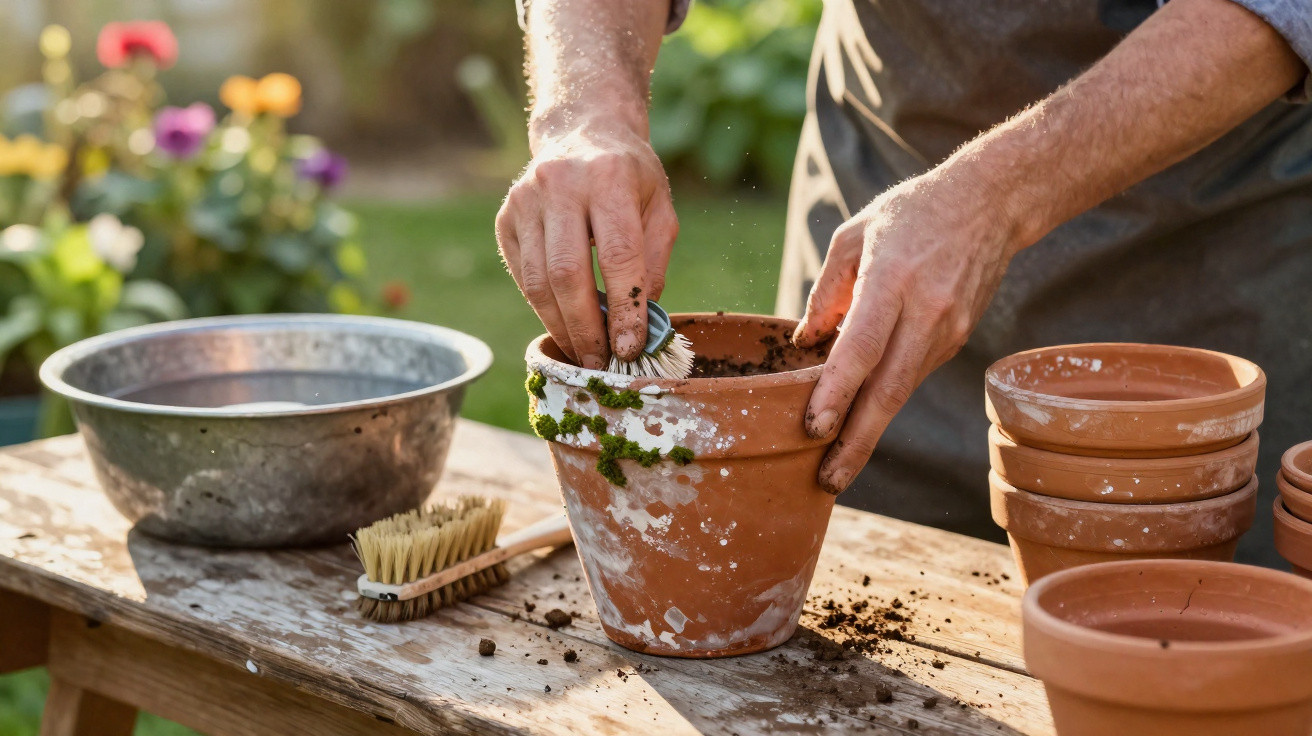
The autumn wind whistles across the balcony, and the summer flowers have long since faded. Among the dried-up stems, they stand out: those dull white crusts on your terracotta pots. A light bloom that looked “rustic” in spring now appears more like neglect. You pick up a pot, turn it over in your hands, and suddenly notice the fine cracks around the rim and the green coating inside. You can almost hear the clay quietly grate as your fingernail runs across it. The season is over, certainly. But what if this is precisely when the next one begins? Clean them once. Care for them once. Take a proper look before everything disappears into the cellar. Terracotta pots have a better memory than we tend to think.
Why terracotta pots “age” – and what their condition tells you
When people buy new plants in spring, they look at the flowers, foliage and variety names. Very few inspect the pots themselves closely. That only changes once roughened rims, white streaks and green marks start to show. Terracotta pots are like small archives of the past gardening year: they retain limescale, fertiliser residues, waterlogging, sunshine and frost. They also reveal, without mercy, how we have treated them. A pot with fine white deposits points to hard tap water. One with a chipped rim recalls a winter spent half in water and half in ice. Take a moment to read these signs and a pattern soon emerges.
A scene from a city allotment: for the third time, Sabine stacks her terracotta pots behind the shed in October “just for a moment”. A few still contain compost, some are full of dead roots, and others are half-filled with rainwater. In March, she is surprised by how many have broken. Two have split along the side; another contains a large clump of algae and moss, almost like a tiny marsh habitat. “Strange, they were still fine,” she says as she throws the shards away. Later, she does the sums: replacing them would easily cost her £50. A year afterwards, she photographs the same pots – this time after cleaning and storing them. Not one is damaged. Simply because she stayed an hour longer in autumn.
This is not about perfectionism; it is about physics and time. Clay is porous: it breathes, absorbs water and releases it again. If the pot wall remains wet all the time, moisture penetrates deep into the material. When frost arrives, that water expands inside and creates stress cracks. Limescale and fertiliser salts settle in the pores, altering the surface and making it more brittle. Then there are micro-organisms, algae and fungal spores – a combination new plants do not necessarily appreciate. If you do not clean your pots, you plant into the past every year. Then you may wonder why fresh compost feels as tough as old chewing gum.
How to get your terracotta pots ready – step by step
The ideal time to prepare terracotta pots for the next season is when the last plant has moved out. First, knock out all the compost and remove every root, including the fine ones. A wooden stick or an old spoon is useful for reaching the grooves. Next, put the pots into a warm soapy bath: use a tub or large bucket of water with a few squirts of environmentally friendly washing-up liquid. Let them soak thoroughly for 30 minutes, or longer if needed. Then scrub both the inside and outside with a stiff brush until the coating has gone, or at least looks noticeably lighter. For limescale marks, use a 1:1 mixture of water and vinegar; leave it briefly, then brush again. Finish by rinsing everything with clean water.
Many people miss the most important stage afterwards: drying them properly. Pots must dry out completely before going into the cellar, garage or a storage box. Do not stack them straight away in a dark, damp corner. Instead, stand them up first – ideally upside down on wooden slats or old newspapers. We all know that moment when you want to put everything away “really quickly”. Let us be honest: nobody actually does this every day. Yet this intermediate step determines whether mould and unpleasant smells develop. Anyone who has smelled a musty pot knows just how persistent that odour can be.
At the same time, it is worth giving your terracotta pots a brief “health check”. Small cracks around the rim? A slightly hollow sound when tapped? These are warning signs. Cracks often widen over winter as the material shifts. Some gardeners tap each pot lightly: if it sounds solid, they keep it. If the sound is dull and brittle, it is removed from use.
“A good terracotta pot stays with you for ten, fifteen years. If you treat it as a tool rather than packaging,” says an older gardener at an allotment site, almost tenderly running his hand over an old, scarred pot.
- Remove all compost and roots, including those in the drainage hole.
- Soak pots in warm soapy water and scrub them thoroughly.
- Loosen limescale marks with a water-and-vinegar mixture, then rinse well.
- Allow them to dry completely before stacking or storing them.
- Set aside damaged pots or repurpose them as decoration, saucers or drainage shards.
When terracotta pots tell stories – and why you should keep writing them
At some point, the way you view your terracotta pots changes. They are no longer simply “containers” that happen to hold compost. They become constants among all the changing plants: familiar shapes that return year after year. Cleaning, sorting and stacking your pots with intention creates a small system of your own. Large ones go at the back, narrow ones at the front; some are reserved for tomatoes and others for herbs. Not only does the garden grow, but so does your routine. Suddenly, the beginning of a new season feels less chaotic. More like a reunion.
And yes, clay can sometimes reflect everything that received too little attention during the gardening year. Heavily encrusted rims suggest too much fertiliser; mossy interiors point to constant watering without checking the compost. There is no point feeling ashamed. The more interesting question is this: what will change next spring? Perhaps you will collect rainwater after all, fertilise less, or use your fingers to check the compost more often before tipping the watering can. Gardening is rarely glamorous; mostly, it is quiet adjustment. Terracotta pots are remarkably honest partners in that process.
Perhaps there is a stack of half-forgotten terracotta pots somewhere in your home right now. Dusty, battered and a little neglected. You could ignore them, buy new ones and add more plastic to the cycle. Or you could spend an hour brushing, rinsing and sorting them, seeing the entire story of recent years in the damp clay. There is something calming, almost meditative, about it. It also creates a surprisingly clear starting point. The next season does not begin when the first tomato plants appear at the garden centre. It starts the moment your terracotta pots are clean, dry and waiting for their next job.
| Key point | Detail | Benefit for the reader |
|---|---|---|
| Cleaning with a system | Remove compost, use a soapy soak, scrub, and dissolve limescale with a vinegar solution | Extends the life of the pots and creates healthier conditions for new plants |
| Thorough drying | Stand pots upside down and let them dry completely before storage | Prevents mould, odours and frost damage during winter storage |
| Mindful maintenance | Check for cracks, set aside damaged pots or repurpose them | Saves money, reduces waste and helps build a dependable set of pots |
FAQ:
- How often should I clean terracotta pots? Once a year is usually enough – ideally after the season, when the pots are emptied. If plants have been diseased, an additional clean immediately after removing them is worthwhile.
- Is hot water enough, or do I need cleaning products? Hot water and a brush will achieve a lot, but mild soap removes grease and fertiliser residue more effectively. For stubborn limescale marks, use a water-and-vinegar mixture, leave it briefly, then rinse thoroughly.
- Do I need to disinfect terracotta pots? Only if plant diseases or pests were involved. After cleaning, you can briefly immerse them in very hot water or wipe them with a weak vinegar solution, then allow them to dry thoroughly.
- What is the best way to store terracotta pots over winter? Keep them dry, frost-protected and well ventilated. Ideally, stack them upside down, do not leave them standing in water, and avoid sealed plastic bags so any remaining moisture can escape.
- What should I do with badly damaged pots? Cracked or broken pots can still be used as drainage shards at the base of larger containers or as decorative fragments in a flower bed. For new planting, severely damaged pots are generally too risky.

Comments
No comments yet. Be the first to comment!
Leave a Comment