
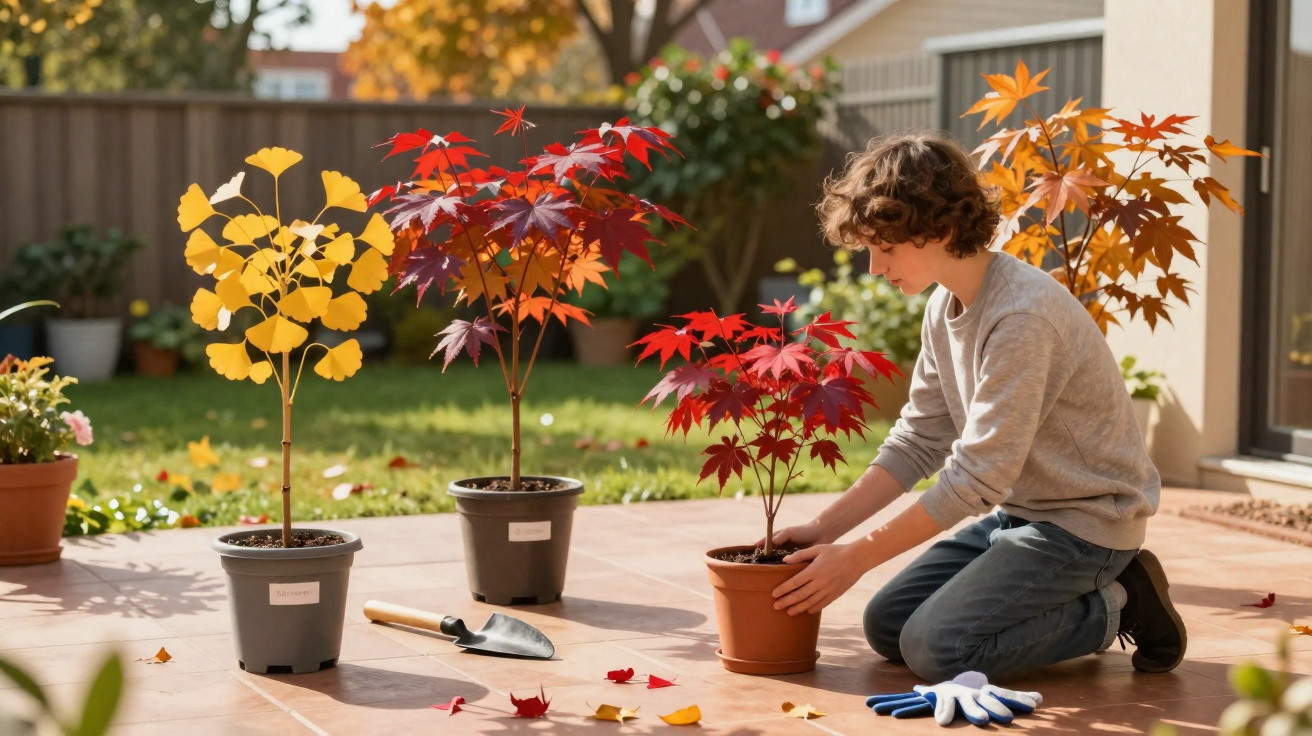
When the garden begins to lose the vitality of spring and summer, certain trees take centre stage with golden, red, orange and ochre foliage. These are decididuous species, shedding their leaves in winter, but first turning autumn into a visual display. Among the most prized are Acer palmatum, ginkgo biloba, pin oak, liquidambar and ash, all valued for the intensity of their seasonal colour.
Why do some trees become so colourful in autumn?
The shift in colour occurs as shorter days and lower temperatures cause trees to reduce their chlorophyll production, the pigment that gives leaves their green colour. As the green fades, hues that were already present but concealed, or become stronger within the leaf, emerge as yellows, oranges, reds and browns.
This is not simply a decorative transformation. It forms part of the natural cycle of trees preparing for cold weather, conserving energy and renewing their foliage in the following growing season.
1. Acer palmatum: delicate, compact and ideal for small spaces
Acer palmatum is one of the most sought-after trees for small gardens, courtyards and even large pots. According to specialists, it can grow to around 7 metres in both height and spread, while retaining a modest size compared with larger shade trees. Its serrated leaves change from red to orange-red, while its fruits are also pinkish or reddish in colour.
Because of its delicate appearance, it is widely used in oriental-inspired gardens. It looks particularly striking as a focal point near paths, water features or patios, where its changing colours can be appreciated at close range.
2. Ginkgo biloba: autumn’s most striking yellow
Ginkgo biloba stands out for both its history and its colour. Considered a highly ancient species, its lineage dates back more than 180 million years, and its fan-shaped leaves become an intense yellow in late autumn.
This tree can reach a substantial size, growing to roughly 20 metres in height and spread. One important consideration is to choose male specimens where possible, as female trees produce seeds that release a strong, unpleasant smell as they ripen.
3. Pin oak: intense red and a sculptural presence
Pin oak, or Quercus palustris, is a tree with considerable landscaping impact. It may reach 25 metres in height and 20 metres in spread, with a pyramidal crown and horizontal branches that create a highly ornamental silhouette. In autumn, its leaves turn reddish and orange-red before darkening to brown in winter.
It is a good option for large gardens, parks and spaces where it can grow without conflicting with buildings. The effect is at its best when there is enough room to see the entire crown.
4. Liquidambar: one tree with several colours in its crown
Liquidambar is renowned for its range of autumn colours. The same tree can carry red, burgundy, orange and purple leaves, producing an effect that looks almost hand-painted. When mature, the species can grow to around 20 metres tall and 15 metres in spread.
Despite its beauty, it requires careful planning. As it develops vigorous roots, it is not recommended for positions too close to houses, walls, pavements or pipework. In large gardens, however, it is among the most dramatic trees for marking the arrival of colder weather.
5. Ash: the first to signal the change of season
Ash, from the genus Fraxinus, is often among the first trees to indicate that autumn has arrived. Its compound leaves take on a yellow-ochre shade, and its winged fruits, known as samaras, remain on the tree for a long time, including after it has lost some of its foliage.
With a medium-sized habit of around 12 to 15 metres in height and approximately 6 metres in spread, it can work well in larger gardens and urban settings. Its dense, rounded crown provides shade during warmer months and, in autumn, delivers an elegant colour change that is less dramatic than that of liquidambar or Acer palmatum.
How do you choose the right tree for your garden?
The decision depends less on colour than on the available space. Acer palmatum suits smaller areas and large pots; ginkgo and pin oak need spacious gardens; liquidambar needs to be planted away from buildings; and ash works well where shade and yellow autumn colour are desired.
Another important point is not to regard fallen leaves as waste. They can be composted or used as a natural mulch over beds, helping to protect the soil from the cold and return organic matter to the garden. In this way, a tree does more than add colour to the landscape: it also supports the life cycle of the green space itself.
Comments
No comments yet. Be the first to comment!
Leave a Comment