
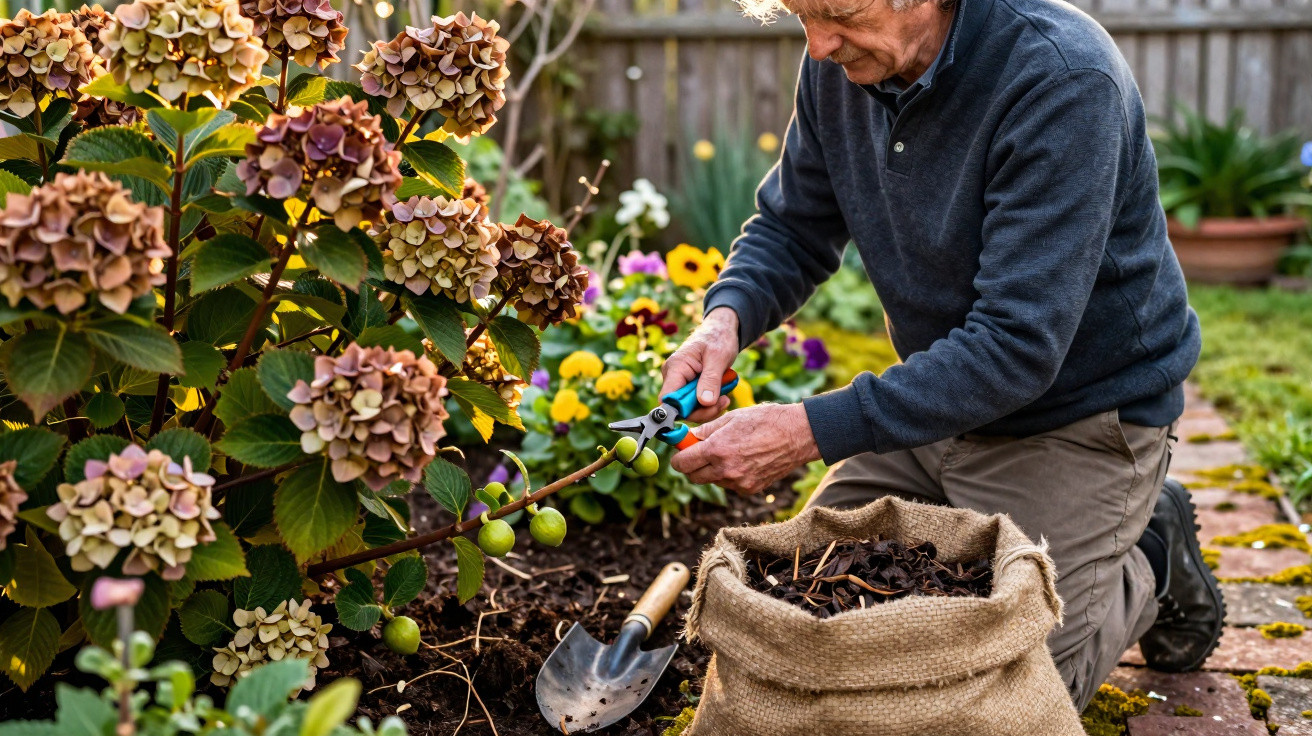
Many hydrangeas look disappointingly sparse in summer, yet the issue is often simply incorrect pruning in spring.
Anyone seeing fewer flowers on the shrub each year will recognise the frustration: the hydrangea looks healthy and produces fresh green growth, but its spectacular display of blooms never arrives. British television gardener Monty Don relies on a straightforward March routine to address precisely this problem, using just a few cuts and a layer of mulch.
Why March determines hydrangea flowers
Hydrangeas are considered easy-going plants. They cope well with partial shade and can even forgive the occasional missed watering. Even so, a few careless actions in late winter can cost them almost their entire floral display.
In particular, traditional bigleaf hydrangeas (Hydrangea macrophylla) with rounded “mophead” flowers form their flower buds on what is known as old wood. In other words, the shoots due to flower in summer have already produced their buds during the previous year. Throughout winter, these buds sit on the branches like small, plump-looking eyes.
Gardeners who carry out a thorough tidy-up in January or February and remove the dried flowers often cut off these very buds. Although the shrub may then look neat, it will produce only a few isolated flower heads in summer.
The crucial point is not what is cut off, but when the cut is made and how close it is to the bud.
Monty Don has turned this into a simple principle: wait until winter has genuinely ended, then work methodically.
How Monty Don prunes hydrangeas for more flowers
Monty Don makes a clear distinction between pruning and simply removing old flowers, known as deadheading. Many amateur gardeners treat the two as the same task, then wonder about the results.
Deadheading involves removing only the faded flower head without damaging the buds beneath it. According to Monty Don, this requires just one precise cut:
Each old flower is cut off immediately above the highest healthy pair of buds. The dried cap is removed, while the supporting shoot remains.
Those buds are exactly what will grow in spring and produce that year’s flowers. By March, frost has lost much of its harshest force, while the buds are more visible and easier to identify.
Monty Don and Alan Titchmarsh’s March checklist
The advice from Monty Don and his television colleague Alan Titchmarsh creates a straightforward routine that can be completed on a mild morning:
- Wait until the final spell of frost has passed and the buds are visibly swelling.
- Cut every dried flower just above the highest healthy pair of buds.
- Remove dead, damaged or very thin shoots at their base.
- Leave strong green shoots in place, as these will carry the summer’s flowers.
Importantly, most stems should remain on bigleaf hydrangeas that flower on old wood. Monty Don postpones major reshaping until immediately after flowering in late summer. A harder prune at that point will not harm the buds for the following year.
The mulch trick: unremarkable but highly effective
Alongside careful cutting, Monty Don uses a second measure that is often underestimated: mulching. For him, a thick layer of mulch in winter or very early spring is as much a part of hydrangea care as using secateurs.
His approach is to give shrubs a generous blanket of organic material around their root area when they look like bare sticks in January. Suitable options include:
- well-rotted garden compost,
- mushroom compost,
- bark mulch, preferably pine bark for slightly acidic soil.
Monty Don recommends at least five centimetres of mulch, ideally twice that depth - do not be stingy; be generous.
Spread the layer around the plant without piling it directly against the stems. It keeps the root area warm, helps soil retain moisture for longer and considerably reduces temperature fluctuations. That is a clear benefit for hydrangeas, which are sensitive to dry conditions.
When to apply the mulch
The best time is on a frost-free but cool day in January or early March. The soil should be:
- unfrozen,
- not completely saturated or waterlogged,
- largely free from weeds.
Before mulching, it is worth carrying out a quick check: clear away old plant debris, pull out shallow-rooted weeds and expose the base of the shrubs. Only then should the compost be spread over the area.
Common mistakes that cost flowers
Many gardeners want to get everything neat and tidy in winter, but make exactly the wrong choice for their hydrangeas. The main errors can essentially be reduced to three points:
- Pruning too early: Cutting back hard in December or January removes the flower buds that the plants have already formed.
- Applying too much mulch directly against the stem:


Comments
No comments yet. Be the first to comment!
Leave a Comment