
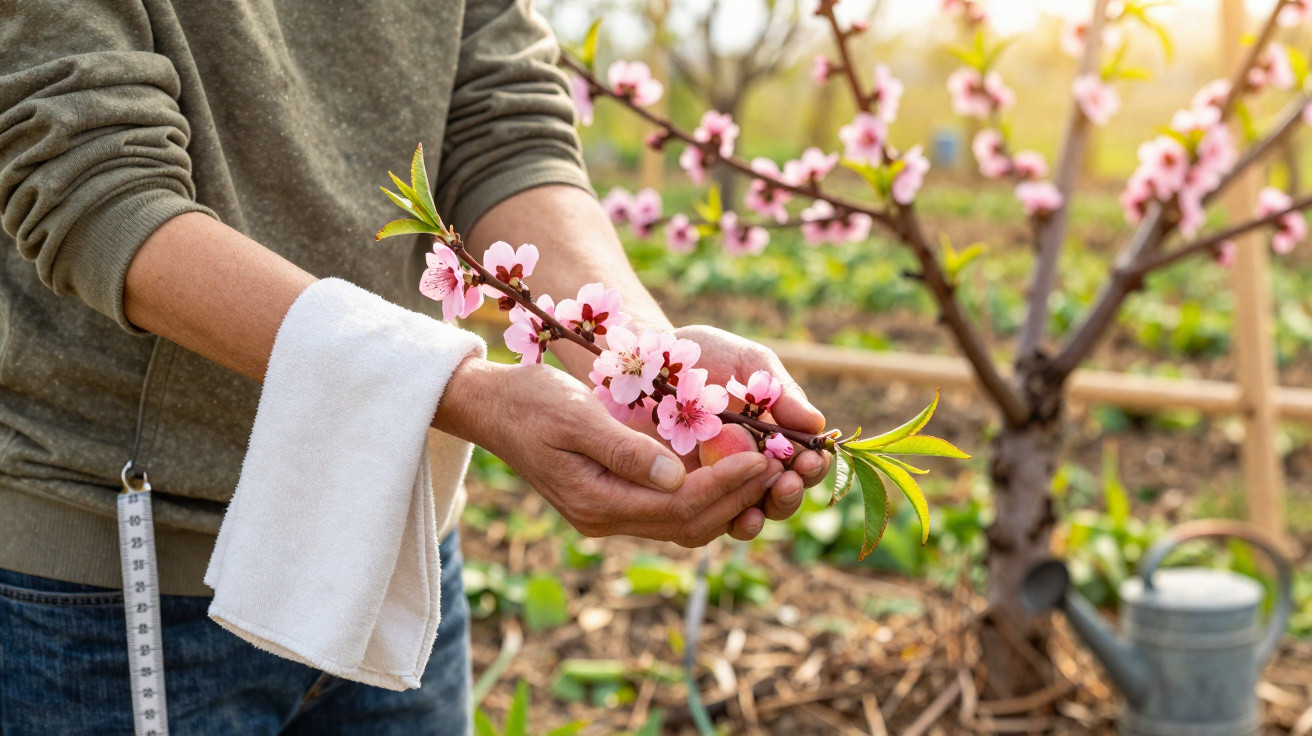
Peach trees flower early and are unforgiving of delays. From spring onwards, a few well-timed actions determine the quality of the summer crop.
In many gardens, the peach tree draws attention with its pink blossom, sometimes from as early as March. Yet this attractive display also signals a demanding time for fruit-tree owners. Overnight frost, prolonged damp, leaf disease and an excessive number of young fruits can all severely reduce the harvest. A calendar alone is not enough: monitor the tree, its flowering stage and local weather conditions.
The peach tree begins its season before many other trees
The peach tree comes out of winter dormancy quickly. Sap starts to rise, buds swell and flowers open while nights can still be cold. This early start is what makes it vulnerable. A frost spell at the wrong time may destroy the flower’s reproductive parts and prevent peaches from setting.
Flowers damaged by cold commonly have a brown or black centre. They may remain attached for several days, appearing perfectly healthy, before drying out without producing fruit. Trees trained against a south-facing wall flower even earlier: they benefit from extra warmth, but are also more exposed if cold weather returns.
“A clear, dry and still night deserves particular attention: in these conditions, temperatures can drop sharply around dawn.”
Protecting peach blossom on cold nights
A lightweight horticultural fleece can raise the temperature by a few degrees around a small peach tree or one trained as an espalier. Put it in place before nightfall, taking care not to bind the shoots tightly, then remove it once temperatures rise. If a cover is left on for too long, moisture becomes trapped and young shoots lack air.
For a tree grown in a pot, the easiest option is often to move the container closer to a sheltered wall. Pots transfer cold to the roots very rapidly. Applying mulch around the base also helps prevent sharp fluctuations in soil temperature.
- Check overnight forecasts throughout the flowering period.
- Prioritise protection for young, low-growing and container-grown trees.
- Do not prune immediately before a forecast cold spell.
- Remove damp covers as soon as milder daytime weather returns.
Peach leaf curl needs early monitoring
Peach leaf curl is one of the most common diseases affecting this tree. It is caused by a fungus that thrives particularly well in a mild, wet spring. Leaves become distorted and thickened, take on a reddish or greenish colour, then eventually fall.
The issue goes beyond the appearance of the foliage. If the tree loses a substantial proportion of its leaves, it builds up fewer reserves. Its fruit develops poorly, and the peach tree is weakened for the following season.
What to do when leaves become blistered
Remove the worst-affected leaves as soon as they appear, and collect any that have fallen to the ground. Do not leave them in the mulch beneath the tree. This will not cure leaves that are already diseased, but it reduces the number of spores around the peach tree.
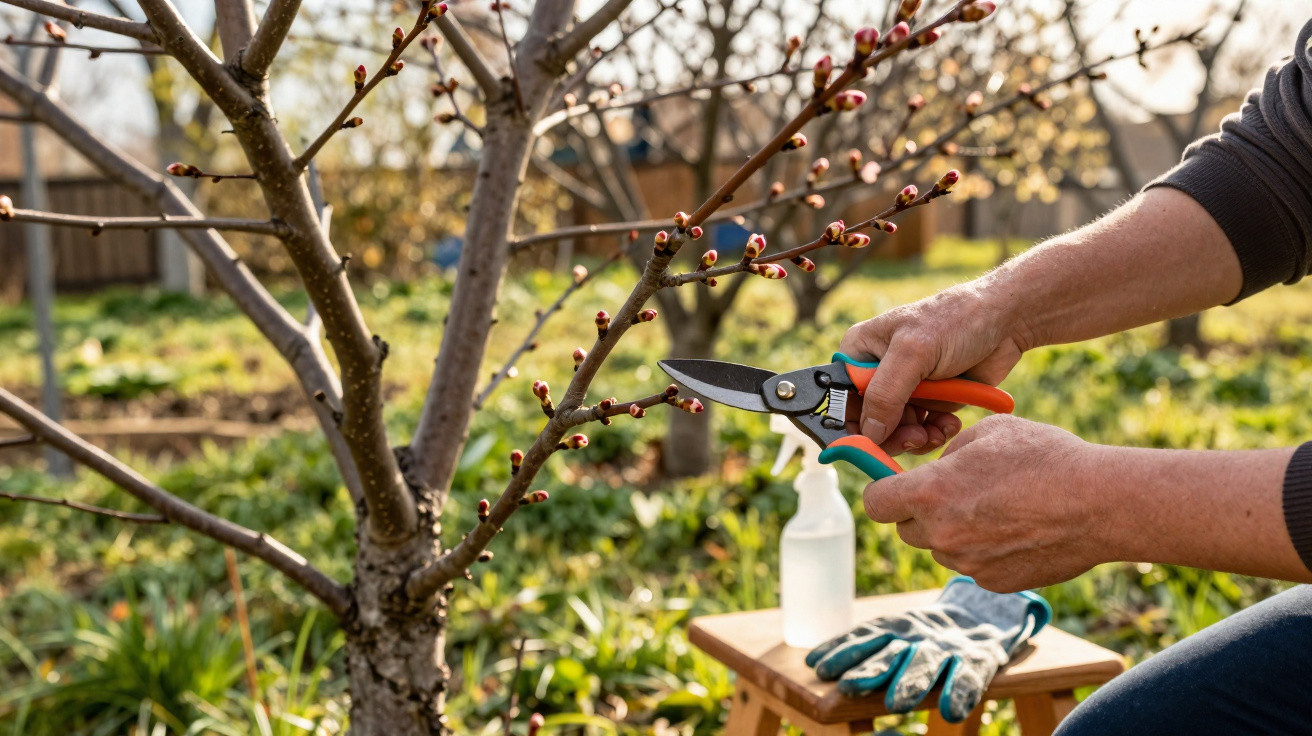
Preventative treatments are generally scheduled outside the growing season, before buds break, in accordance with authorised products and their instructions for use. In spring, spraying any mixture on a flowering tree can harm pollinators or scorch the foliage. Light pruning that allows air to move freely between branches remains a helpful, low-risk measure.
“With peach leaf curl, the aim is not to save every affected leaf: it is to slow the spread and help the tree produce healthy new foliage.”
Thinning young fruit affects peach size
Once fertilised flowers have turned into small peaches, it is tempting to leave every one in place. However, this is one of the most frequent mistakes. A shoot covered in fruit cannot feed each peach properly. The peaches stay small, are less sweet and can sometimes become misshapen. Their weight may also break a branch in the height of summer.
The right time depends on the climate and variety. Thinning becomes necessary after some young fruit has dropped naturally, usually between late spring and early summer. On a particularly early tree, the first selection can begin sooner, as soon as the fruits are easy to identify.
The practical 15 to 20 centimetre rule
Leave one peach every 15 to 20 centimetres along vigorous shoots. Keep fewer on a thin or still-young branch. Start by removing fruits that are damaged, marked, misshapen or pressed against one another. Hold each small peach between two fingers and ease it away gently, without pulling off the stalk of the neighbouring fruit.
- Begin at the tips of shoots, which are often overloaded.
- Remove fruits that touch each other or are completely hidden.
- Retain the best-positioned fruits, rather than favouring only one side of the tree.
- Check that branches are strong enough before finishing the pruning session.
This may seem severe, but it brings a very practical advantage: the tree concentrates its water and sugars on a sensible number of peaches. At maturity, the fruits are larger, more fragrant and easier to pick.
Water and soil also matter during fruit swelling
A peach tree does not tolerate extreme swings between drought and heavy watering. Once the fruit begins to swell, water slowly at the base rather than wetting the foliage. Soil kept moist with a mulch of dry leaves, thoroughly dried grass clippings or wood chippings loses less water through evaporation.
Avoid heavy applications of nitrogen-rich fertiliser in spring. They encourage very soft new growth, which is more prone to aphids and disease, at the expense of the fruit. In a family garden, a thin layer of mature compost spread around the root zone is often enough.
A heavily laden branch may need support
Even after thinning, some shoots bend sharply as summer approaches. Place a stake or wooden fork beneath the heaviest branches, with fabric between the support and the bark to prevent injury. A break provides an entry point for gummosis and other infections.
A fully ripe peach is not identified by its red colour alone. Check the shaded side: when it changes from green to a yellow or cream shade, the fruit is nearing the right stage. A gentle press close to the stalk should reveal flesh that yields slightly, without being overly soft.

Comments
No comments yet. Be the first to comment!
Leave a Comment