
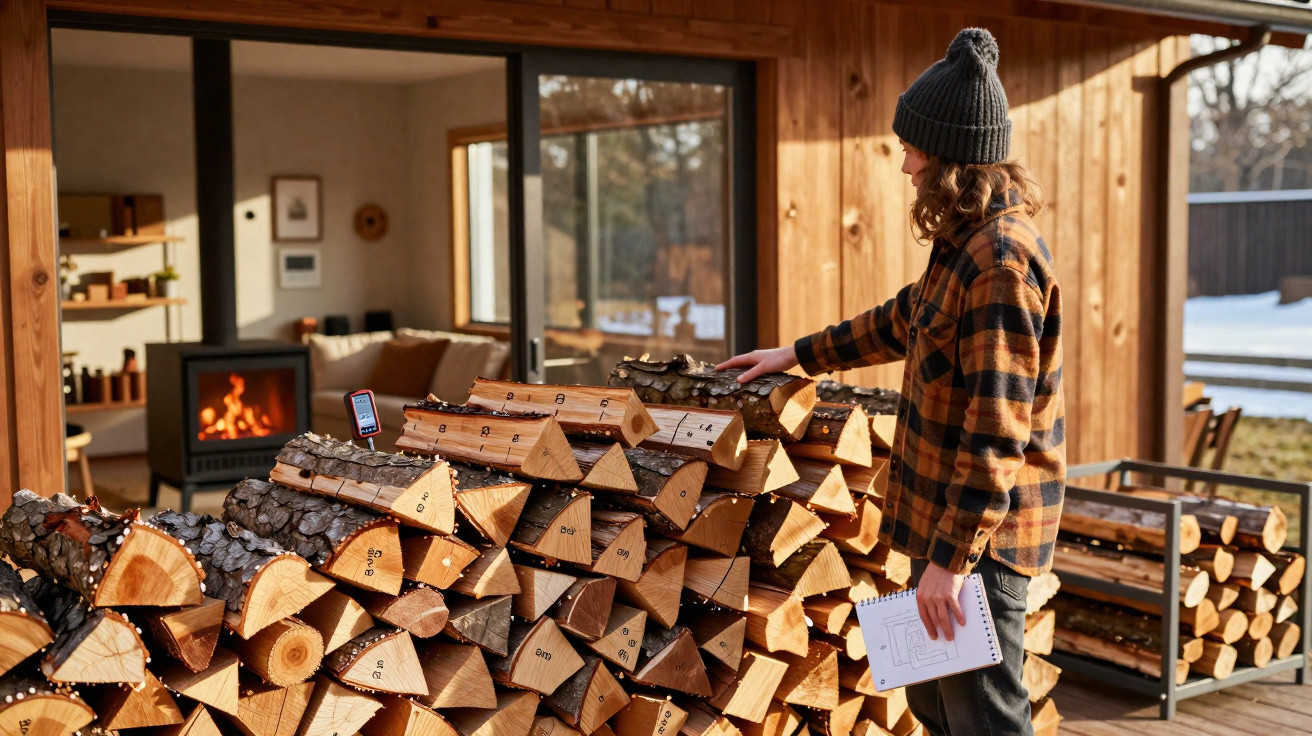
If you rely on a wood-burning stove or inset fire to get you through the colder months, the same question comes round every year: will the amount of logs you’ve ordered actually last, or will the wood store be empty halfway through February? The right answer isn’t determined solely by your home’s floor area, but by a whole set of factors that are often underestimated.
What a Raummeter of wood really means
Before looking at any figures, it helps to pin down the term itself. In the firewood trade you’ll often come across the unit “Raummeter” (also called Ster in some regions). It refers to one cubic metre of logs stacked on a base of 1 m² to a height of 1 m.
In real life, there’s an important catch: a Raummeter is based on 1 metre lengths. If those logs are cut down to 50 cm, 33 cm, or 25 cm, they can be stacked more tightly. The stack looks smaller, even though the actual quantity of wood is unchanged.
"If you order wood in shorter lengths, you get less ‘air’ and more actual wood stored for the same Raummeter price."
When you’re comparing suppliers, it’s worth checking the log length every time and asking whether the merchant charges in Raummeter or Schüttraummeter. Schüttraummeter means wood tipped in loosely-there’s noticeably more empty space between the pieces.
The most important factors affecting firewood consumption
How much wood a household burns in a heating season varies widely. The points below have the biggest impact on usage.
Floor area and room volume
A compact mid-terrace of 90 m² with standard ceiling heights will typically get through far less wood than a detached older property of 160 m² with open gallery spaces. It’s not just the floor space that matters, but the total volume of air that needs heating.
Insulation quality
If you live in a well-insulated newer home with triple-glazed windows, you’ll need far less energy to feel comfortable than in a house with older, draughty frames. Modern efficiency standards can often cut firewood demand by 30 to 50 percent compared with an unrefurbished building.
Type of appliance and its efficiency
A modern wood-burning stove with clean combustion and secondary air makes far better use of the fuel than an open fireplace. While up-to-date appliances achieve efficiencies of over 80 percent, most of the heat from open fires disappears straight up the flue.
Wood species and quality
Hardwoods such as beech, oak, or ash are dense and provide a lot of energy per log. They burn steadily and for longer. Softer conifers like spruce or pine catch quickly and produce a burst of heat, but they’re used up faster.
"If you heat with wood long-term, properly seasoned hardwood is usually better value, even if the purchase price per Raummeter is higher."
Just as critical as the species is the moisture level. Only seasoned wood with under 20 percent residual moisture burns cleanly and efficiently.
Climate and personal preferences
Consumption is naturally higher in snowy areas with long, cold winters than in milder regions. Your own comfort level also plays a part: some people are happy at 19 degrees, while others only ease off the stove at 23 degrees.
How many Raummeter does a household need per winter?
Based on practical experience from energy advisers and stove fitters, it’s possible to give broad rules of thumb. They don’t replace a tailored calculation, but they’re a reliable starting point.
Occasional use for atmosphere
If you mainly light the stove at weekends or on especially miserable evenings, the requirement is usually modest.
- Occasional use: about 1 to 3 Raummeter per heating season
That’s enough for plenty of cosy nights by the fire without putting too much strain on the household budget.
Regular use as a top-up to central heating
Many homes use the stove to reduce the load on gas or electric heating. In particular, the living area can be largely covered by the stove, while other rooms are heated in the usual way.
- Day-to-day supplementary heating: around 3 to 6 Raummeter per winter
The exact amount depends heavily on how well insulated the property is and how far you turn down the rest of the heating.
Wood as the main heat source
If the stove or inset fire supplies all-or almost all-of the living space, the required volume increases significantly.
- Wood as the primary heat source: roughly 5 to 12 Raummeter per season
In a modern, well-insulated detached house, 5 to 7 Raummeter is often sufficient. In older buildings with little refurbishment, it can quickly become 10 or more.
Tips to noticeably reduce your firewood use
Following a few basics can reduce the amount you burn, cut down on effort, and be kinder to your appliance.
- Use dry logs: Only wood with low residual moisture burns cleanly. Freshly cut wood should be seasoned for at least two summers, depending on the species.
- Service the stove regularly: Remove ash, check seals, and clean the glass-well-maintained stoves run more efficiently.
- Have the chimney swept at the proper intervals: The required sweep isn’t just a legal tick-box; it also improves draw and therefore combustion.
- Light it the right way: Top-down lighting with dry kindling reduces smoke and makes better use of the logs.
- Upgrade insulation where possible: The top floor/loft and the ceiling of the uppermost storey often offer especially large savings.
"Every additional centimetre of insulation saves firewood for years-often far more than many homeowners expect."
Store your firewood properly so it actually heats
How you store your wood can influence its heat output almost as much as the species itself. If you stack logs on damp ground and wrap the whole pile tightly in a sheet, you may get an unpleasant surprise when you try to light it.
The ideal storage spot
- airy, with good exposure to moving air
- protected from direct rain and snow
- slightly raised, for example on pallets, bricks, or a slatted base
- an open front or sides so air can circulate
A roof or cover is sensible, but fully sealing the stack with tarpaulins causes problems: it traps moisture and slows drying.
Real-world examples of winter firewood needs
To get a feel for typical volumes, it helps to look at common scenarios:
| House type | Stove use | Estimated requirement |
|---|---|---|
| Mid-terrace 100 m², well insulated | Supplementary heating in the living area | approx. 3–4 Raummeter |
| Detached house 140 m², average insulation | Main heating with a central wood-burning stove | approx. 6–8 Raummeter |
| Older property 160 m², hardly upgraded | Wood as the most important heat source | approx. 9–12 Raummeter |
These numbers will of course vary-if you ventilate for long periods or leave windows constantly on the latch, you’ll burn noticeably more wood.
What many people overlook when it comes to firewood
Ordering early usually saves both money and stress. Prices tend to rise in autumn, and delivery times get longer. Buying in spring or summer often means better rates and enough time to let the wood dry further.
It also makes sense to include a small buffer. If you plan too tightly each year, you can end up with an empty store during the third cold snap. Keeping half to a full Raummeter in reserve makes planning far more relaxed.
It’s also worth considering how a modern heating system can work alongside a wood-burning stove. Many people use the stove strategically when energy prices are high to take pressure off the main system. With sensible control, you can cut costs without losing comfort-for example, heating the living area with wood while bedrooms are kept at a moderate level via central heating.
If you’re new to all this, a simple approach works well: in the first season, budget for 1 to 2 Raummeter more than you think you’ll need, track what you actually burn, and adjust the following year. Over time, you’ll build an accurate picture of your own wood requirement-and keep the house warm without panic buying in frost and snowstorms.

Comments
No comments yet. Be the first to comment!
Leave a Comment