
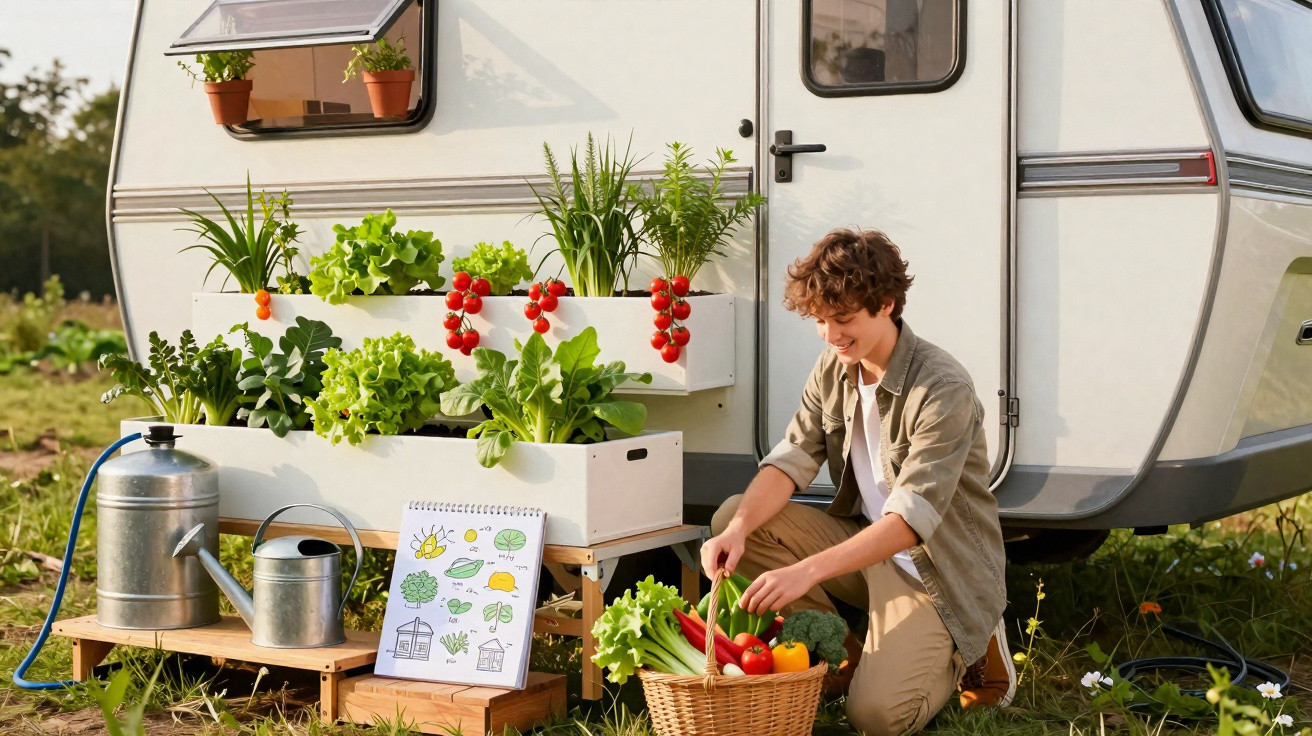
In her mobile home, one resident has turned a few outdoor square metres into a productive little vegetable garden, whatever the season.
Living in a caravan means working around limited space, possible moves and carefully managed water use. For this 42-year-old gardener, however, these restrictions have not prevented regular harvests. Over the months, she has set up easy-to-move containers, selected suitable plants and learnt to make the most of every patch of sunshine.
A vegetable garden designed to move with the caravan
Gardening beside a caravan is very different from tending a garden at a house with its own plot. Soil may not be available, the pitch can be temporary, and the area outside the door must remain accessible. Growing directly in the ground is therefore rarely the easiest option.
Three large containers with drainage holes, several deep pots and a small shelf are enough to create a well-organised growing area. Their key benefit is that they can be moved. When it is time to leave, smaller containers can be loaded into a vehicle or temporarily left with someone nearby. Heavier planters can remain in place when the stay is extended.
“The garden does not depend on a large plot: it relies mainly on containers, light and regular organisation.”
A caravan can also provide a useful feature: its walls may act as a windbreak. Pots placed against a well-exposed side benefit from heat stored throughout the day. This position is especially suitable for culinary herbs, lettuces, radishes and certain Mediterranean plants.
Harvests spread across all twelve months
Gardening continuously does not mean growing tomatoes in the middle of winter without protection. Instead, it means matching planting to the season. In spring and summer, quick-growing, sun-hungry crops fill the containers. In autumn, leafy vegetables and hardy root crops take over.
The easiest crops to grow
- Cut-and-come-again salads, which regrow after partial picking.
- Radishes, often ready within three to five weeks depending on the weather.
- Parsley, chives, thyme and mint, all useful for everyday cooking.
- Spinach and lamb’s lettuce, which suit cooler periods.
- Cherry tomatoes, best kept for deep containers in very sunny spots.
- Strawberry plants, which can grow for several years in the same container.
In winter, simple protection can make a real difference. Horticultural fleece stretched over hoops, a mini greenhouse or a transparent cold frame can reduce the impact of frost and driving rain. Lamb’s lettuce, spinach, certain Asian cabbages and young leaves tolerate low temperatures fairly well, provided that their roots are not sitting in water.
Keeping crops in rotation also prevents containers from standing empty. As soon as one crop has finished, another can replace it. A few radishes after salads, lamb’s lettuce after tomatoes, then herbs when spring returns: the system is straightforward, although it requires regular checks on the pots.
Water: the main issue around a mobile home
Watering is often the most delicate aspect. In a caravan, water supplies may be restricted, particularly away from campsites with facilities. The vegetable garden must therefore remain manageable. Ten carefully tended plants will yield more than a collection of containers left forgotten in the sun.
Mulching helps to reduce water requirements. Dry leaves, untreated wood chips, cut-up brown cardboard or straw spread over the compost slow down evaporation. This covering also shields roots from major temperature changes, which are common in small containers.
| Situation | Useful action | Intended effect |
|---|---|---|
| Hot weather | Water early in the morning and mulch | Reduce water loss |
| Prolonged rain | Check the drainage holes | Prevent roots from suffocating |
| Planned departure | Group pots in light shade | Limit drying out |
| Frost forecast | Move containers closer to the caravan and cover them | Gain a few degrees |
A small space that needs a method
Potting compost in containers becomes depleted faster than garden soil. Roots have little room, while watering gradually carries some nutrients down to the bottom of the planter. Adding mature compost at the start of each season helps keep the growing medium fertile and full of life.
Drainage is the removal of excess water. In a container, it depends first on the holes underneath the pot or planter. A layer of clay pebbles is not always needed, but airy compost and unobstructed openings are essential. Without them, roots may rot, particularly during wet weeks.
“In a mobile vegetable garden, success depends less on the number of containers than on monitoring them: moisture, exposure, leaf condition and the sowing schedule.”
Being so close to the caravan also makes this daily attention easier. When she steps out to make coffee or close the blinds, the gardener can immediately see whether a lettuce needs water, a tomato stem needs tying up, or slugs have been active overnight.
Harvesting close to home, even in a small area
This vegetable garden does not replace food shopping. It offers something different: a few fresh leaves, herbs ready to pick, crisp radishes and the pleasure of preparing a meal with produce grown just steps from the door. Herbs are particularly worthwhile in this type of arrangement. A thyme or chive plant can be used for many months.
Companion planting is also useful in small spaces. Basil can be planted at the base of tomatoes in summer. Radishes can fill the surface between still-young lettuce plants. Edible flowers, such as nasturtiums, attract certain pollinating insects and add colour to the containers.
It is still important to check the rules at the place where the caravan is set up. Some sites, campsites or private areas allow pots but prohibit permanent structures, greenhouses or planting in the ground. Clean, removable containers that do not inconvenience neighbours are often the easiest option to have accepted.
As the seasons pass, this arrangement turns the outside of the caravan into a living space. A few seeds sown at regular intervals are then enough to maintain modest but tangible harvests, even as the days grow shorter.

Comments
No comments yet. Be the first to comment!
Leave a Comment