
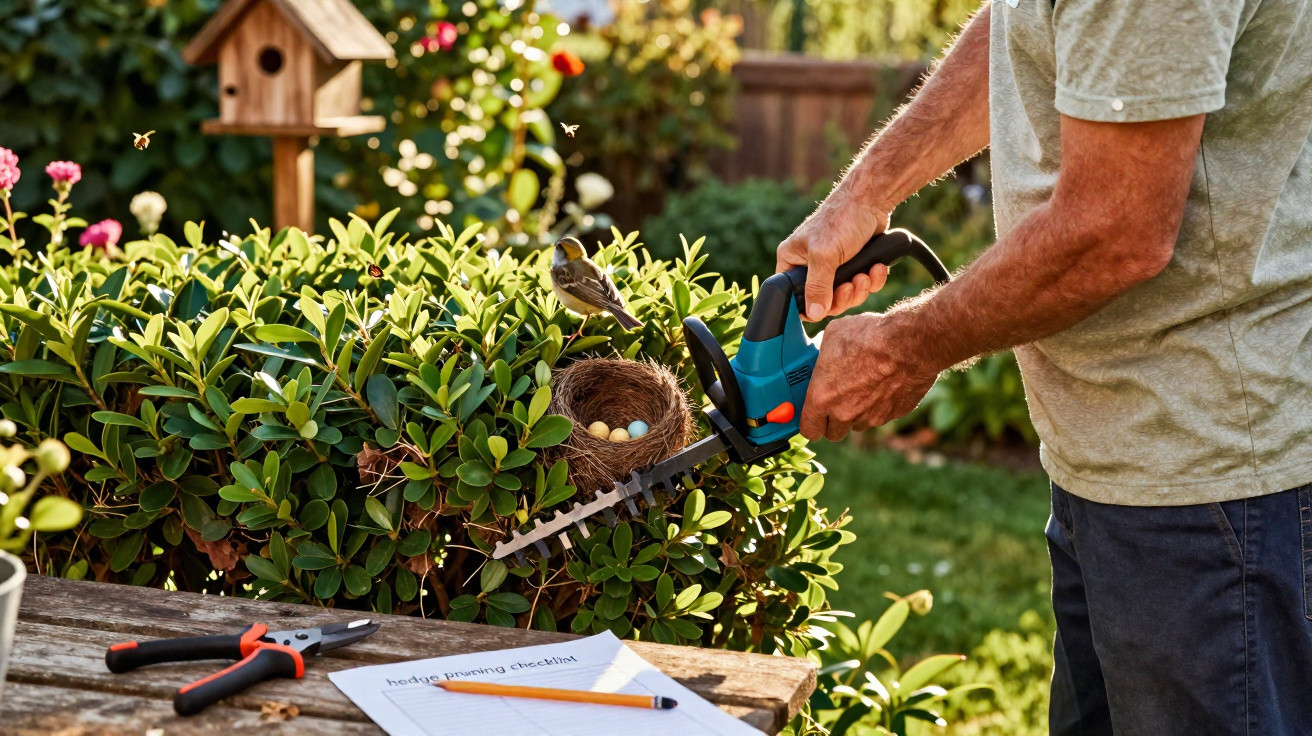
Every year, the same pattern returns: temperatures rise, the sun stays out for longer and keen gardeners everywhere feel the urge to get started. The hedge looks untidy, the privacy screening has gaps – so it is tempting to give it a thorough trim straight away. From now on, however, that can be a sensitive matter for many people. Birds’ breeding season is beginning, bringing clear protection for their habitats.
Cutting hedges: when it must stop and who it affects
Strict rules for farmers
Agriculture is subject to clear requirements. Hedges, field copses and certain features in the farmed landscape receive special protection during the breeding season. In many EU countries, including France, which leads the way under the regulation cited, farms are prohibited from radically cutting hedges and field copses from 1 April to 31 July.
“During the breeding season, hedges serve as nurseries for numerous bird species – every use of a chainsaw can mean the loss of an entire nest.”
These requirements form part of the Common Agricultural Policy (CAP). Failing to comply can lead to more than a warning from the authorities. Penalties may include substantial fines, while particularly serious cases can even result in several years’ imprisonment – a clear indication of how seriously nesting-site protection is treated.
For farmers, this means in practical terms:
- No hedge clearance or heavy hedge cutting between 1 April and 31 July
- Gentle maintenance trimming only where areas can demonstrably be shown to be free of breeding birds
- Breaches may result in reductions to support payments
- Major interventions in protected habitats may lead to criminal proceedings
Rules for private gardens
The position is somewhat different in private gardens. There is not, everywhere, a single nationwide rule that completely bans hedge cutting from mid-March onwards. Even so, conservation organisations send an unambiguous message: wherever possible, leave hedges and shrubs undisturbed from around the middle of March.
Many towns, councils and districts also introduce their own regulations. These can impose further limits on severe pruning or set specific closed periods. Anyone unsure should check with their local council before reaching for the hedge trimmers.
“Anyone who wants to play it safe should treat their own hedge in spring like an occupied block of flats – please do not simply start sawing at the façade.”
Even where there is no explicit closed period, nests receive strict protection. Destroying an occupied nest may be a criminal offence, whether it is in a field or the garden of a terraced home.
The right time to cut a hedge
Best periods: late winter and late summer
Anyone wishing to maintain a hedge properly while protecting birds should broadly work within two time windows:
- Late winter (February to early March): Plants are slowly emerging from dormancy, while birds have generally not yet begun breeding. This is an ideal time for shaping cuts.
- Late summer (late August to September): The breeding season is largely over and most young birds have fledged. A light follow-up trim restores a neat outline.
Flowering shrubs require particularly careful consideration. Many species produce their flower buds during the previous year. Pruning too early or at the wrong time can remove the entire display of flowers.
How to prune flowering shrubs correctly
For ornamental and flowering woody plants, one simple rule of thumb applies:
- Spring-flowering shrubs (for example, forsythia, blackthorn and flowering currant): prune them immediately after flowering.
- Summer-flowering shrubs (for example, hibiscus and butterfly bush): cut them back in late winter or very early spring.
Observing these timings does more than keep a hedge healthy: it also creates a colourful, nectar-rich setting for insects, another building block for greater biodiversity in built-up areas.
Why hedges are so vital for birds
Breeding season: March to July is peak time
From spring through to midsummer, hedges are exceptionally busy places. Blackbirds, robins, finches and many other songbirds use dense vegetation as shelter. They build nests there, lay eggs and raise their young.
Cutting during this period can have several consequences at once:
- Nests containing eggs or young birds can be destroyed
- Cover from cats, martens and birds of prey can be lost
- Adult birds can be disturbed while feeding chicks and incubating eggs
“A single radical cut in April can destroy an entire brood – often unnoticed among the cut branches.”
For many species, every successful brood matters. Just a few successive years of losses can cause local populations to collapse.
More than privacy screening: hedges as mini ecosystems
Hedges do not provide habitat for birds alone. Their dense structures also support insects, spiders, small mammals and, in some cases, amphibians. They use a hedge as:
- A hiding place from predators
- A food source, supplying berries, insects and buds
- Winter shelter among leaf litter and dead wood
A mature hedge therefore functions like a small nature reserve beside the home. Keeping it relentlessly shaped into a “green wall” and trimming it constantly removes these refuges for many species.
How garden owners can directly support birds
Feed birds sensibly
Feeding stations can help many birds survive cold spells in winter. Bird feeders and fat balls can be useful from November to March. Once insects are active again and natural food is available, feeding stations should be reduced or removed. At that point, birds chiefly need variety in the garden rather than a permanent supply from a feeder.
Nest boxes and suitable plants
Those wanting to offer birds more should prioritise structure over perfection. Nest boxes, wildlife hedges and a little deliberate “messiness” in the garden can make a remarkable difference.
| Plant | Benefit for birds |
|---|---|
| Rowan (mountain ash) | Berries provide winter food, while dense growth offers protection |
| Elder | Flowers and berries, plus richly structured branches for nesting |
| Privet | Berries for many species and well suited to hedging |
| Rosehips | Rosehips are an energy source, while dense thorns provide protection |
| Holly or firethorn | Evergreen cover, thorns to deter predators and berries in autumn |
Combining these species creates garden areas that are not only visually interesting, but also provide a permanently used habitat for birds and insects.
Common hedge-cutting mistakes – and how to avoid them
Too drastic, too frequent, at the wrong time
Three mistakes occur repeatedly:
- Pruning in April or May, when breeding is already under way
- Cutting a hedge right down completely instead of maintaining it carefully over several years
- Total tidy-ups that remove dead wood, piles of leaves and dense corners
A staggered approach works better: schedule major work outside the breeding season, cut sections of the hedge at different times so that it is never all bare at once, and deliberately retain a few wilder corners.
A practical checklist before cutting
Before undertaking any substantial pruning, a quick check is worthwhile:
- Check the calendar: are we between March and the end of July?
- Inspect the hedge slowly: are there nests, adult birds flying out or loud chirping?
- Read local authority requirements or ask the council’s enforcement department
- Cut only areas that are clearly free of breeding birds – it is better to skip one session than destroy a nest
Combining garden maintenance and wildlife conservation
A well-kept garden does not rule out biodiversity. People who view hedges as living structures rather than sterile green lines can have both order and nature. One option is to shape privacy hedges around the patio only lightly, while consciously allowing wilder areas along property boundaries to grow.
Such green corridors are becoming increasingly important, particularly in densely built-up neighbourhoods. For many bird species, private gardens have long become one of their last refuges. Leaving a hedge alone from mid-March supports them – and ultimately brings more birdsong to the window.


Comments
No comments yet. Be the first to comment!
Leave a Comment