
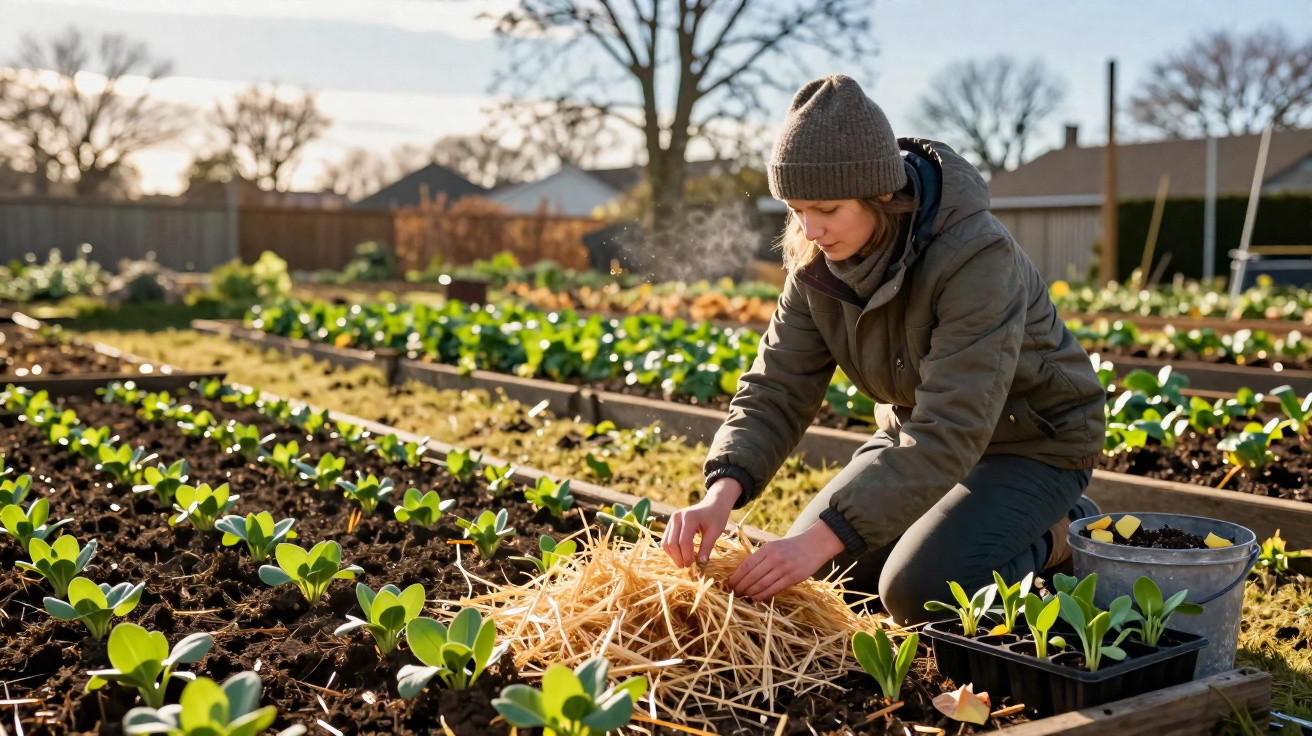
The first frost had barely glazed the lawn when the garden’s soundtrack began to change.
There was less insect hum, more of a crisp sound beneath your boots, and an expectant stillness across the beds. Plants that had been exuberant in July had become limp and drained of colour, while the soil looked exhausted, as though it had spent the night working overtime to nourish every crop. It is hard not to feel that the space should do more than lie dormant through winter. Nursery-order emails are already arriving, and the prospect of potting on in lifeless, compacted ground makes your shoulders tighten.
Outside, the wind presses a drift of leaves against the fence. All at once, they no longer look like clutter but like mulch. Green manures, straw layers and heel-in trenches begin to form a calm but determined plan in your mind. Winter need not be an interruption.
Mulching: making cold beds into a slow compost heap
Walk through a flourishing winter garden and one detail is immediately clear: its beds are covered up. They are not bare or excessively neat, but wrapped in straw, leaves, woodchip or partly decomposed compost. That uneven, slightly untidy surface is the living skin of the soil at work through winter. Each piece of mulch acts as a small insulating layer, retaining warmth, softening the force of rain and sheltering worms and microbes.
Winter mulching is not especially glamorous. It involves hauling bags of leaves from the pavement, pushing squeaking wheelbarrows and ending up with hands carrying a faint fungal scent. But that is precisely when the change begins. Although the growing season appears finished, everything beneath the mulch is simply moving into another gear. Roots ease off, fungal networks extend, and soil gradually changes from compacted brick into something with the texture of chocolate cake.
The principle of mulching in winter is starkly straightforward. Uncovered soil loses energy: rain batters its surface, cold air draws away heat and wind carries off still more organic matter. A protective layer disrupts this damaging sequence. Organic mulches work as a flattened, slow-release compost heap, supplying food from above while roots and microbes work below. Water enters the ground more softly, nutrients remain where they are needed, and freezing and thawing become beneficial rather than destructive. You are doing more than safeguarding existing soil; you are creating the soil you want to plant into in three, six or nine months’ time.
Green manures and heeling-in: making winter a working nursery
Imagine a bed in late October that many gardeners would simply “tidy up and leave”. Instead, sow field beans or winter rye into the vacant areas, rake them in and leave them to it. Within a few weeks, that apparently empty space becomes a low, living cover that keeps the soil intact. Its roots weave through the soil profile, capturing nutrients that rain would otherwise wash away. Above the ground, a gentle green canopy takes the edge off the cold and sustains every microbe still active in November.
Elsewhere on the plot, you may have lifted young fruit trees from an overcrowded area. They are now bare-root, exposed and waiting for a permanent home. Dig a shallow trench in a sheltered bed, place the trees at an angle with their roots spread out, then refill it with crumbly soil. This straightforward act of heeling-in creates a temporary nursery from a vulnerable bundle of roots, keeping them sufficiently warm and moist until planting time.
Green manures function as mobile production units. Rye, vetch, clover and phacelia each offer a particular benefit, whether that is nitrogen-fixing nodules or deep taproots capable of breaking through compacted layers. Rather than adding fertility from a bag, you capture sunlight and convert it into root exudates, plant material and future mulch. Heeling-in is a quiet but valuable part of this approach. Keeping young trees and shrubs in living soil, rather than pots or cold sheds, maintains their direct connection with microbes, mycorrhizae and reliable moisture. Your entire nursery operates more effectively because its “stock” never truly leaves the soil food web.
Practical winter jobs for living soil
Begin with the simplest winter task: place a breathable organic covering over every bare bed. Use chopped leaves, rough compost, old hay, or any combination of these. Apply it 5–8 cm deep: enough to conceal the soil, but not so much that it forms a dense mat. Consider it a slow-release breakfast for the life below the surface.
Where possible, mulch soil that is damp rather than saturated. In this way, soil life is already active when the covering is applied. Perfection is unnecessary. A pile of partly decomposed leaves over a slightly rough bed is invariably better than a pristine patch of bare soil exposed to the sky. The goal is not neatness – it’s continuity of life.
Green manures require slightly better timing, though they are more robust than many people assume. Rye, field beans, winter tares and crimson clover can be sown in autumn wherever summer crops have finished. Scatter the seed loosely, rake it in gently and allow the weather to take over. Even a sparse crop is worthwhile: every root creates another route for air and water, and another thread in the underground network. Treat these plants as your winter workforce, quietly doing the night shift while you remain indoors with a mug of tea.
This is where many gardeners encounter their first obstacle: they delay for too long. Beds sink into a grey, compacted condition, and the opportunity to sow green manures ends with the first severe frost. Others make the opposite mistake, applying mulch so deeply and wetly that slugs thrive beneath it and the ground struggles to dry in spring.
If your garden has already reached that point, you are far from alone. On a damp November afternoon, few people want to spread another wheelbarrow of leaves with chilled hands. The answer is to work in small stages: one bed each week, or half an hour with a rake and a bucket of seed. Across a month, this can turn a lifeless, crusted rectangle awaiting the rotavator in April into a thriving patchwork.
Let us be honest: nobody truly does this every day. Gardening calendars often act as though you are outside with a clipboard and stopwatch. Real life includes children’s homework, delayed trains and dark evenings when even locating the torch feels like work. That is why winter soil care must be straightforward, forgiving and divided into jobs you can complete whenever life leaves room. Dig a quick heel-in trench for shrubs delivered too late. Sow one strip of rye along a long bed. Spread half a compost bin as an uneven but entirely useful mulch.
“Winter is not your enemy, it’s your unpaid intern,” an old market grower once told me, standing in a field that looked almost asleep. “Give it clear jobs to do, and it will quietly set you up for spring.”
This perspective changes the way you view every heap and neglected corner. Fallen leaves become useful material rather than an unwanted task. Stale seedbeds are not wasted ground but fresh opportunities for a quick cover crop. The “temporary” trench used to heel-in roses may become the part of the plot with the finest tilth by March, simply because roots and soil organisms have spent a season undisturbed together.
- Make use of available materials: leaves, straw, shredded prunings and unfinished compost.
- Give priority to beds needed earliest in spring, using lighter mulches that break down quickly.
- Heel-in bare-root plants that cannot yet be planted in their final positions.
- Sow hardy green manures in beds that will remain uncropped until late spring.
- Retain some roughness and “mess” – it provides habitat for the unseen helpers.
Let winter do the hard work for spring
The unusual thing about winter soil care is how little seems to happen initially. You step outside beneath a low sky, spread mulch, push a few lines of rye into cold soil, settle young trees into a heel-in trench and then leave. For weeks, there appears to be no change. The beds remain quiet and unimpressive while the rest of life carries on among central heating and electric light.
Then, on a day in late winter, you push a hand into a mulched corner and feel the contrast in your palm. In place of solid clods, there is crumbly soil. Rather than sour, dead coldness, there is a mild earthy sweetness and a remarkable number of small moving creatures. Green manure roots lift like fine hair, each marking a former channel for air, water and fungi. Trees that were heeled-in come out of their trench with plump, moist roots, prepared to establish without the delay often associated with bare-root planting.
Throughout this time, winter has been quietly carrying out its own slow housekeeping. Frost and thaw open up dense soil. Mulch cushions these changes and prevents the new pores from closing again. Green manures feed sugars into the rhizosphere, then leave channels and organic residues when they are cut down. Heeling-in keeps nursery plants rooted in the same living process instead of disrupting it with pots or bags. By spring, the combined outcome is speed: quicker establishment, earlier crops, fewer inputs and less emergency work. You enter the season with beds, trees and microbes that have already spent months preparing in silence.
| Key point | Detail | Benefit for the reader |
|---|---|---|
| Winter mulching | Organic covering 5–8 cm deep on every bare bed | Protects soil, feeds microbes and improves spring structure |
| Green manures | Rye, beans, clover and similar crops sown in autumn | Prevents nutrient loss, creates biomass and reduces compaction |
| Heeling-in | A temporary trench for bare-root trees and shrubs | Keeps roots alive and active until final planting time |
FAQ:
Can I mulch beds that are already a bit weedy?
You can, but first cut weeds off at ground level and leave their roots where they are. Add a thicker mulch afterwards. For deeply rooted perennial weeds such as couch grass, remove as many roots as possible before covering.What’s the best cheap material for winter mulching?
Autumn leaves collected and mixed with a little garden compost are difficult to better. They are free, easy to move and will decompose into excellent leaf mould by the following year.Will green manures steal water and nutrients from my soil?
They consume some resources as they grow, but return most of them as plant material and root residues. Across a full season, they generally raise available fertility instead of lowering it.How long can I keep trees heeled-in before planting?
Most bare-root trees and shrubs can remain heeled-in for several weeks or even a few months, provided that the soil around their roots stays moist without becoming waterlogged.Do I need to remove all the mulch before planting in spring?
No. Draw it aside only in the precise places where you intend to sow or plant, leaving the remainder to feed and protect the soil around your crops.





Comments
No comments yet. Be the first to comment!
Leave a Comment