
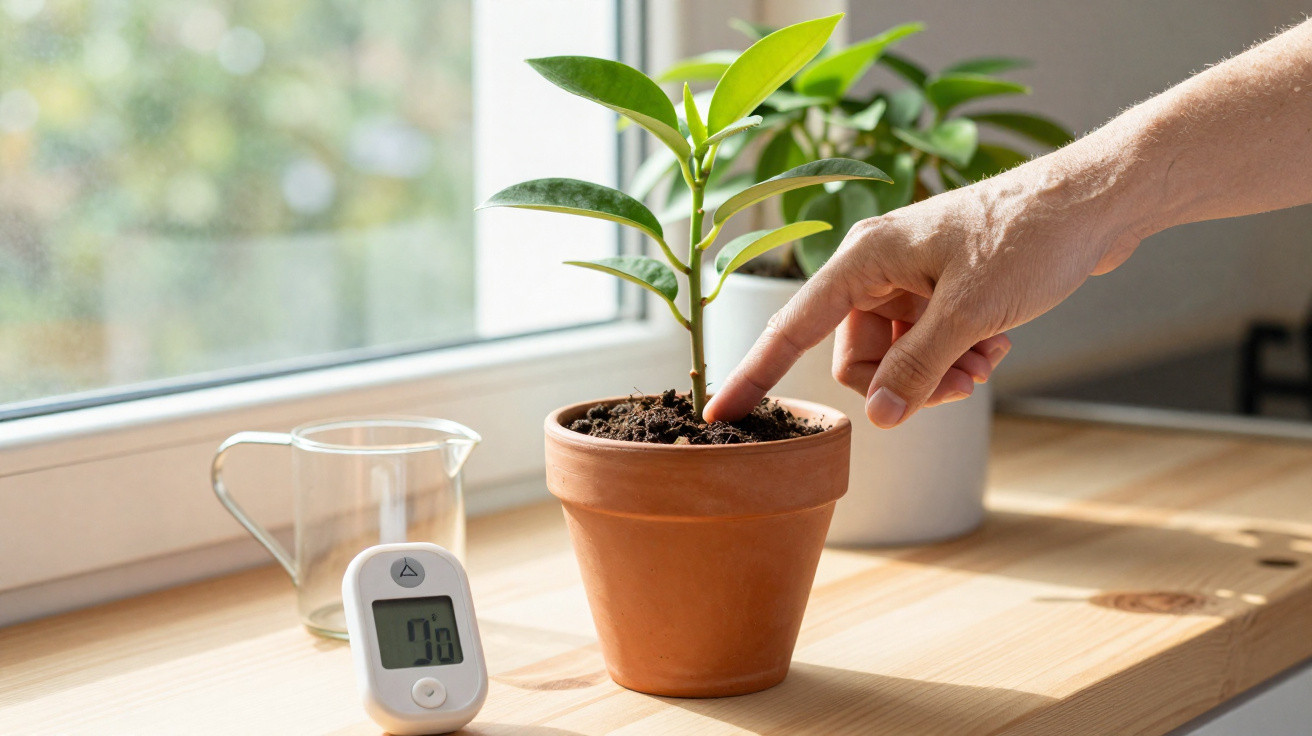
The soil surface looks dusty, the leaves seem healthy, and a moisture meter you bought but hardly touched is probably hiding in a drawer. Guessing when to water is an easy way to turn a thriving plant into a sulky one. The answer is easier than using a gadget and quicker than searching online for advice.
On the first warm Saturday, I knelt by a line of tomatoes and went through the familiar routine: tapping the soil, studying the leaves and wondering whether I was about to drown them or leave them parched. A neighbour came over, compost staining his hands, and watched me worrying. Without saying a word, he pushed a finger into the soil and smiled. The surface was dry, yet lower down it felt as cool as a river stone. I felt foolish, then reassured. We have all had that moment when the penny drops. Your hand can already tell you what is happening. That is why I started using my knuckle.
What your fingers reveal that a gadget cannot
Soil communicates through its temperature, texture and subtle shifts. A breeze can dry out the top centimetre while the root area below remains comfortably moist. This is why a dry surface can trick you into watering a plant that does not need it. Test a little further down and you will discover what the roots are experiencing.
I found this out the difficult way beside an allotment path. At midday, the bed appeared dry and grey, but 5 cm down the soil was cool and slightly sticky. I decided not to water. By evening, the tomatoes were standing more upright rather than drooping. Studies often show that most feeder roots sit between 5 and 15 cm deep; that is where the watering decision should be made. Surface-level drama does not produce fruit.
It comes down to straightforward physics and plant biology. Sunlight and wind draw water from the upper soil, while capillary action brings moisture upwards from deeper layers. In containers, the difference between surface and root-zone moisture is sharper and changes more quickly, with drainage influencing the pattern. Heavy clay holds onto moisture, whereas sandy compost can lose it as though it were never there. Check the place where roots drink: at knuckle depth.
The knuckle-depth test: step by step
Push your index finger directly into the soil as far as your second knuckle. Test near the plant’s drip line rather than immediately beside its stem. Wait for five seconds. Notice both the temperature and texture: warm, dusty soil means “thirsty”; cool soil with a faint grit means “fine”; and a slick or muddy feel means “wet”. This is the knuckle-depth test.
Test several spots, particularly in garden beds or large pots, as moisture is not evenly distributed. Morning is an ideal time because there is less heat distortion and the reading is more reliable. When the surface is bone dry but the soil is cool at 5 cm down, do not water; check again tomorrow instead. If it is dry at that depth as well, water gently until a small amount runs out, then stop. Let’s be honest: no one actually does that every day.
Common mistakes include testing too near the stem, compacting the surface crust or judging the soil too quickly. Slow down. Allow your finger to adjust to the soil temperature and pay attention to the difference as it goes lower. A scratchy, gritty feeling indicates dryness; a soft cling suggests moisture. If the soil feels wet and has a slightly sour smell, you have been generous with the watering recently-ease off and allow some air back in.
“The top always lies,” Bill told me, brushing compost off his nail. “Roots live where your knuckle sits. Listen there.”
- Depth guide: second knuckle ≈ 4–5 cm (1.5–2 in)
- Dry: warm, crumbly, with no soil clinging to your skin
- Moist: cool, slightly clingy and darker in colour
- Too wet: slick, muddy smear and an earthy-sour smell
- Where to test: near the drip line, not at the stem
Beyond the finger: 30-second cross-checks
Treat your knuckle as the headline and these checks as the supporting details. Pick up the pot, because its weight reveals more than its colour. A properly watered container feels unexpectedly heavy, while a thirsty one becomes almost feather-light. Lightly scratch the surface with a stick: flying dust means you should check deeper, while clumping soil usually means all is well.
Leaves offer clues too, though they can be rather dramatic. On a hot day, a midday droop is often a response to heat rather than a need for water. Wilted leaves early in the morning, together with dry soil at knuckle depth, signal genuine thirst. Early-morning wilting when the soil is wet points instead to root stress or overwatering. Plants communicate differently, so assess the foliage and the soil together.
Soil type and container size also alter the rules. Terracotta loses water more rapidly than glazed ceramic, and a shallow tray dries sooner than a deep pot. Clay-heavy beds retain moisture longer than sandy areas. If compacted soil stops your finger, first make a narrow opening with a dibber, then test inside that small pilot hole. Also, water the root zone rather than the leaves. Direct the water low, slowly and evenly until the soil is moist at knuckle depth, then stop.
Here is the part that makes the real difference: once your finger confirms that the soil is “dry at depth”, water properly. Do not merely mist the surface and walk away. Pour slowly until the soil darkens and the container feels heavier. Then pause. Waiting matters just as much as watering.
| Key point | Detail | Why it matters to the reader |
|---|---|---|
| Depth that matters | The second knuckle (4–5 cm) is the root-zone checkpoint | Bases watering decisions on where roots take up water |
| What “dry” feels like | Warm, crumbly, with no soil clinging to your skin | Provides a simple, repeatable sign without a meter |
| When to water | Dry at depth? Water slowly until evenly moist | Helps prevent root stress and overwatering |
FAQ:
- How deep is “knuckle depth” for most adults? Roughly 4–5 cm (1.5–2 inches), reaching the second knuckle. This is close to the depth of many feeder roots in pots and shallow beds.
- Does this work in clay, sand, and potting mix? Yes, but with some variation. Clay remains cool and moist for longer; sand dries rapidly; peat-free mixes can feel springy. Compare how the soil feels on a known “wet” day and a “dry” day to calibrate your hand.
- What about cacti and succulents? Allow them to dry more deeply and for longer. At knuckle depth, the soil should feel completely dry before watering; then soak it and let it drain. Between waterings, they prefer air in the growing medium.
- Can I trust leaf wilt to decide? Not by itself. A midday droop may be heat stress. Early-morning drooping with dry soil at depth means the plant is thirsty; early-morning drooping with wet soil suggests overwatering or root problems.
- Best time to test and water? Morning. You get a more accurate moisture reading, and the plant has the entire day to use the water. If evening is your only option, water the soil rather than the leaves, and keep the flow steady instead of splashy.
Comments
No comments yet. Be the first to comment!
Leave a Comment