
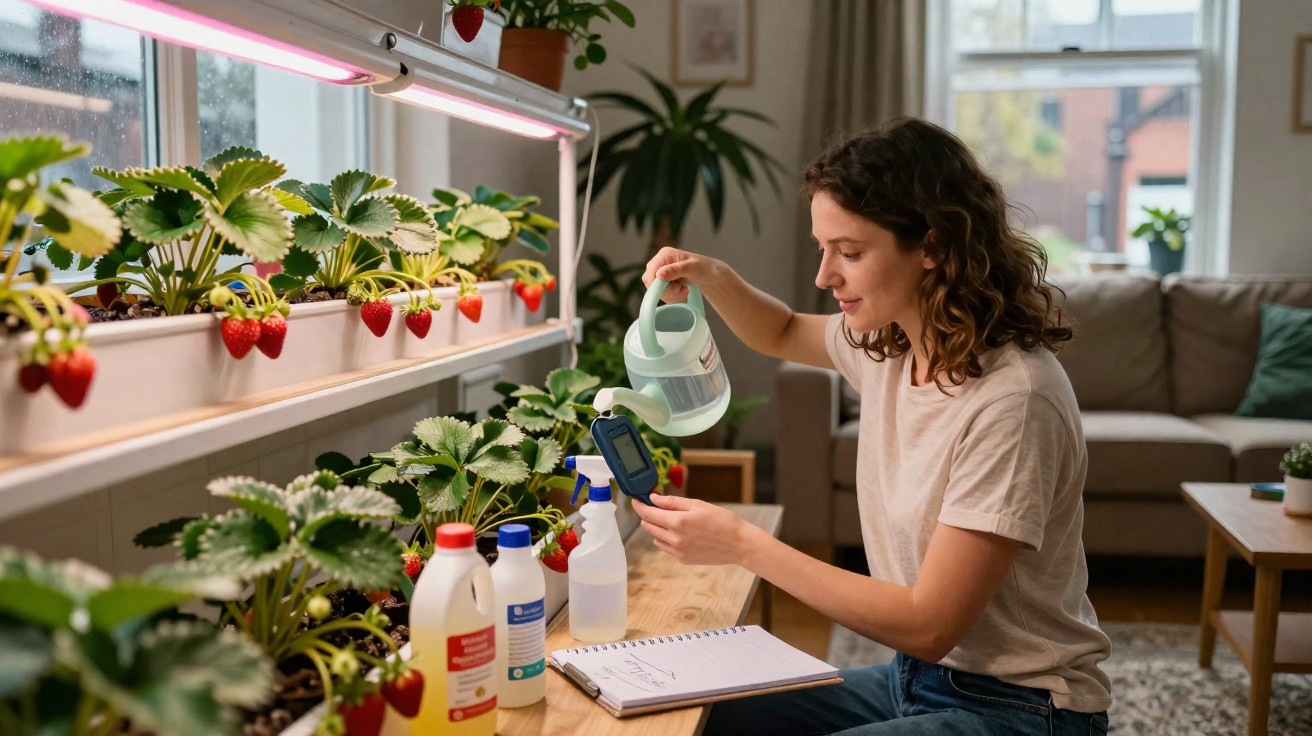
In a modest Bishopston flat, Lara makes winter feel uncannily like June. LED bars emit a low hum above glossy leaves, while a tiny bee-shaped brush waits in a jar for its turn as a pollinator. She moves calmly among the pots, her fingertips lightly green-stained, before picking a heart-shaped berry that is ripening into sweetness. The room is warm, subtly floral and faintly electric.
Before breakfast, the flat already carries the scent of jam. When a neighbour asks whether they are “legal plants,” Lara laughs and offers them a strawberry so fragrant it seems almost unreal. The fruit gives with a gentle snap, its seeds gleaming like brass pins as juice spills out like a promise. In one corner sits a plumbing timer; on a shelf, a pH pen; and beside it, a notebook bearing one plain label: fruit.
Two figures are circled in pencil inside that notebook: 5.9 and 1.6. Lara makes no attempt to conceal them. “It’s not magic,” she says, shifting a tray a couple of centimetres nearer to the LEDs. Her flat may be compact, but the harvest is reliable, and the routine has a surprisingly calming quality. The answer to the mystery is sitting on the shelf beside the lights.
LED daylight in a Bristol living room
Lara grows her strawberries on a metal shelving unit that previously supported books and a noisy printer. It has become a vertical garden of day-neutral cultivars, including ‘Albion’ and ‘Mara des Bois’, both of which will fruit happily under consistent lighting. She uses 3500K full-spectrum LED bars with an added touch of deep red at 660 nm, recreating the character of gentle summer sunshine. Suspended on adjustable ratchets, the lights sit around 25–35 cm above the canopy, producing shadows sharp enough to look crisp even at midday.
For Lara, lighting is a crop input rather than a source of atmosphere. Using an inexpensive PAR meter app, she adjusted the output to approximately 250–400 µmol/m²/s at leaf level, an intensity strawberries handle well. The lights come on at 7 a.m. and switch off at 10 p.m., creating an unhurried 15-hour “day”. Temperatures remain at 20–22°C, while a small fan moves air over the flowers to stop pollen becoming sluggish. Another fan runs quietly at night to prevent moisture lingering.
Pollination is entirely hands-on. Every other morning, she brushes each flower with a soft paintbrush or gently vibrates the blooms using an old electric toothbrush. The task takes only a minute, costs nothing and avoids the dreaded cone-shaped, poorly formed fruit. Her growing medium is straightforward: 70% rinsed coco coir and 30% perlite in quick-draining 9-litre fabric pots that allow the roots to breathe. Beneath the shelf, trays collect the run-off like a neatly contained rainfall.
What goes in the watering can
This is where Lara’s notebook proves its value. She feeds in small, frequent doses, maintaining an EC she knows by heart. During vegetative growth, as new runners establish themselves, she mixes a feed at EC 1.2–1.4 and pH 5.8–6.0. When the first flowers emerge, she moves to EC 1.6–1.8 and keeps the pH close to 5.9. The figures may sound clinical, but their results are satisfyingly visible: leaves retain a gentle sheen, fresh growth stays upright and berries develop full rather than pithy.
Her nutrient formula is accurately measured but built from salts that are readily available. For every 10 litres of water, she uses 6 g calcium nitrate, 2 g potassium nitrate, 1 g monopotassium phosphate at early bloom (then 0.5 g after set), 2 g magnesium sulfate (Epsom salt), and 0.5 g of a chelated micro mix containing iron as EDDHA or DTPA. When using a commercial “A+B” strawberry fertiliser, she follows the label instructions to reach the same EC. In either case, she always dissolves the calcium nitrate separately before mixing everything together.
Trace elements matter too. Without a little boron and a dependable iron source under LEDs, strawberries become unhappy. Her micro mix supplies both, so there is no need to experiment with chemistry. She brings the water to room temperature, stirs it until it is clear, then checks it with a handheld pH pen bearing more coffee stains than she would care to acknowledge. Let’s be honest: nobody really does that every day. She calibrates it weekly because drift genuinely happens, and plants are not open to negotiation.
Small rituals that make big berries
Lara’s timetable could pass for a household chore list, yet she finds it meditative. In coco, she feeds with every watering, two or three times weekly, applying enough solution for a modest 10–15% run-off. Every fortnight, a flush with plain water at pH 5.9 removes accumulated salts, while she monitors leaf tips closely for the faint tan edge that signals excessive feeding. She lightly prunes day-neutral cultivars by removing old leaves and cutting off most runners, directing energy towards fruiting trusses that hang like chandeliers.
She adjusts light height through experience and by reading the leaves. If leaf tips claw downwards, she reduces the intensity or raises the bars slightly. If petioles stretch and flowers seem reluctant, she lowers the lights or adds 30 minutes to the day length. Humidity stays between 45–60%, as saturated air encourages botrytis while overly dry conditions make flowers reluctant to perform. We have all had that moment when a flawless berry goes mouldy overnight and it feels somehow personal. It is not. It is airflow.
Experience taught Lara not to pursue sweetness by adding phosphorus alone. Strawberries need potassium and calcium in balance, rather than a flood of phosphorus. Berries firm up and flavour intensifies when potassium rises slightly during fruit swell, while calcium stays steady to prevent tip burn. Her flowering mix provides that balance without unnecessary guesswork, and she adds supplements only when the leaves indicate a need.
“The plant tells you,” Lara shrugs, holding a leaf to the light. “If the veins go pale, I add iron. If edges crisp, I check the salts and back off. The best tool is time spent looking.”
- Target pH: 5.8–6.0 in coco/hydro; 6.2–6.5 in peat-based potting mixes.
- EC guide: 1.2–1.4 for veg; 1.6–1.8 for bloom; back to 1.4 if tips burn.
- Distance to LEDs: 25–35 cm, aiming for 250–400 µmol/m²/s at canopy.
- Temperature: 18–24°C day; 15–18°C night; keep a light breeze.
- Pollination: brush or buzz every other day during peak bloom.
The human bit behind the method
There is a reason this approach works in a city such as Bristol. Rain arrives just when you have planned to pick, slugs seem organised, and small balconies offer little room for error. Indoors, Lara swaps the weather for controls and settings. LEDs remove the uncertainty of changing seasons, the nutrient mix delivers consistency, and the flat follows a schedule that fits around work shifts and bus journeys. The berries taste like a choice she made, not luck she caught. Friends lean closer, take a bite and, for a brief and wonderful moment, the room falls silent.
| Key point | Detail | Benefit for the reader |
|---|---|---|
| LED spectrum and timing | 3500K full-spectrum with 660 nm red; 15-hour day | Recreates summer light for reliable indoor fruiting |
| Nutrient recipe | Per 10 L: 6 g CaNO3, 2 g KNO3, 1→0.5 g KH2PO4, 2 g MgSO4, 0.5 g micros | A clear, repeatable mix for sweet, firm berries |
| Environmental targets | EC 1.6–1.8 in bloom, pH ~5.9, 20–22°C, 45–60% RH | Straightforward figures that avoid common indoor failures |
FAQ:
- Can any strawberry variety fruit under LEDs? Day-neutral types such as ‘Albion’, ‘Seascape’ and ‘Mara des Bois’ perform particularly well indoors because flower production does not depend on day length.
- How far should the lights be from the plants? Keep them roughly 25–35 cm away, targeting 250–400 µmol/m²/s at the canopy; raise them if leaves taco or their tips curl.
- What pH and EC should I shoot for? For coco/hydro, use pH 5.8–6.0; aim for EC 1.2–1.4 in veg and 1.6–1.8 in bloom. In peat mixes, allow the pH to run slightly higher.
- Do I need to hand-pollinate? Yes, indoors. Using a soft brush or an electric toothbrush around the flowers every other day helps berries form fully and evenly.
- Can I use a one-bottle fertiliser instead of salts? Absolutely. Choose a strawberry or fruiting blend, then mix it to the same EC and pH targets. The plant values balance, not branding.
Comments
No comments yet. Be the first to comment!
Leave a Comment