
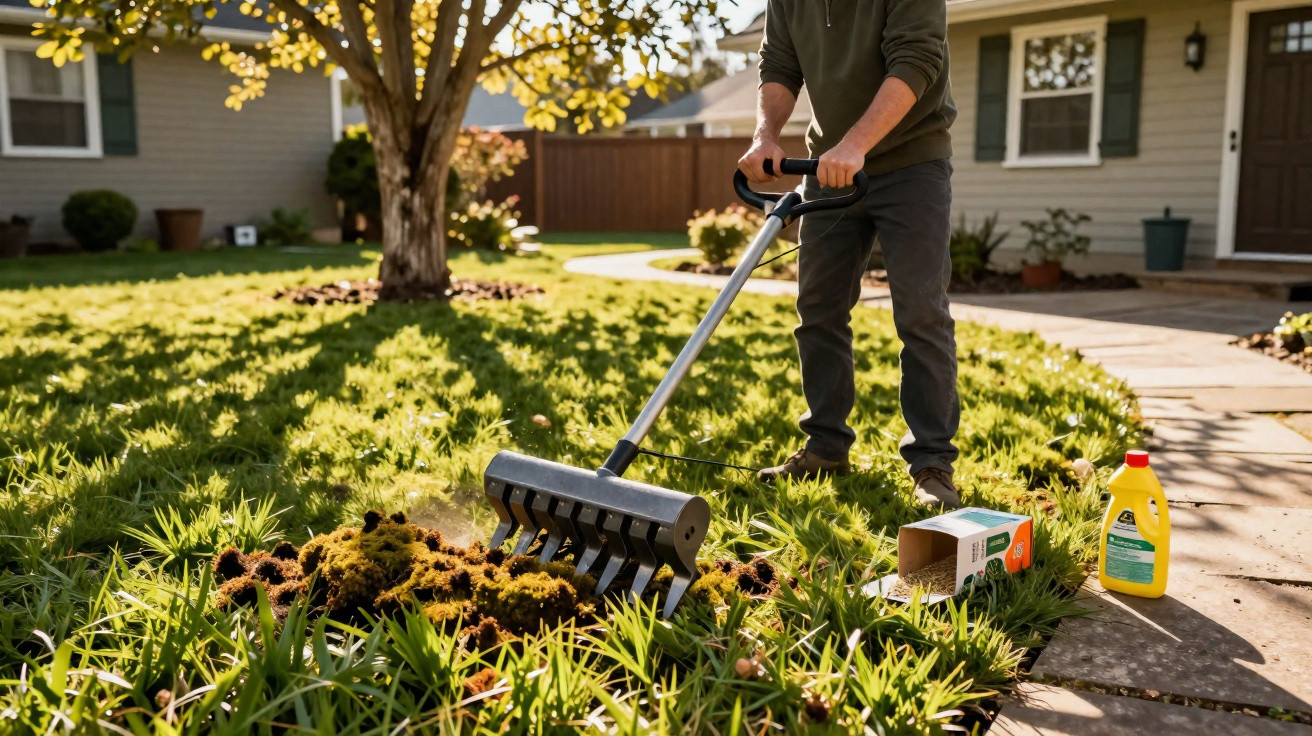
After the first warm days, attention turns back to the lawn. Instead of the lush green surface you want, you may suddenly find a patchy, dark-green carpet of moss. A simple household tip is doing the rounds online and is said to work instantly. Experts warn that this very impulse often makes the issue worse.
Why moss appears throughout the lawn after winter
The same pattern emerges in principle every year. Winter has been wet and dark, while the soil has become heavy. Grass barely grows during this period, becomes weakened and thins out. At the same time, other plants find ideal conditions – moss above all.
Typical trouble spots in the garden are particularly affected:
- beneath trees with dense canopies
- alongside hedges and walls
- in dips where water collects
- on heavily walked areas with compacted soil
Soil and lawn-care specialists explain that moss is not a sign of an “unkempt” garden, but a symptom. It indicates that conditions are poor for grass and ideal for moss. Dense, poorly aerated soil, a lack of nutrients and limited light hold grass back, whereas moss copes extremely well with these conditions.
Moss is not the real enemy. It shows that the lawn is weakened – and that is exactly where you need to start.
Anyone who does little lawn maintenance in autumn, scarifies only rarely or never loosens the soil will notice the consequences especially clearly in spring: moss fills the gaps left by the grass.
The popular washing-up liquid idea – and why it harms the lawn
As frustration grows, so does the temptation to try supposed “secret tips” from the internet. Near the top of the list is mixing washing-up liquid with water, pouring it over affected patches and waiting for the moss to die. It sounds cheap, straightforward and quick – but it is precisely the wrong approach.
The problem is that washing-up liquid is designed to remove grease and dirt from pans, plates and glasses. These substances have no place in soil or around plant roots. Its surfactants can damage the fine root hairs of grasses and alter the structure of the soil.
Continually experimenting with household remedies like this can cause several problems at once:
- grass roots become weakened or damaged
- important soil organisms die or retreat
- the soil’s crumb structure suffers, making it even more compacted
- residues can reach deeper soil layers and groundwater
Landscape gardeners and environmental authorities repeatedly caution against using such “everyday chemicals in the garden”. They may create a short-term visual result, but they undermine the very stability a healthy lawn requires.
Anyone using washing-up liquid against moss is not tackling the cause – they are gradually ruining their soil.
The result is a turf that becomes even patchier, soil that is increasingly depleted and moss that returns more quickly. What seems like a clever money-saving solution turns into a persistent problem.
The straightforward professional method: mow, rake, scarify and overseed
The good news is that a hard-wearing lawn with little moss does not require magic or harsh products. Gardeners and greenkeepers rely on a fairly simple routine – but apply it consistently.
Step 1: Mow the lawn short
At the start of spring, cut the lawn relatively short once. This allows air to reach the base of the plants and exposes the moss cushions. Depending on the lawn type, the cutting height should be around 3 to 4 centimetres.
Step 2: Rake thoroughly
Use a rake straight afterwards. A sturdy leaf or lawn rake can comb out surprising amounts of moss and dead plant material. This initial “clean-up” removes the dense thatch from the lawn and creates room for young grass plants.
Step 3: Scarify areas with heavier moss growth
Where a proper carpet of moss has already formed, raking alone is no longer enough. This is where a scarifier is needed – either a hand tool for smaller areas or a powered machine for larger gardens.
Its blades or tines score the soil surface by a few millimetres, pulling out moss, lawn thatch and old grass while also loosening the top layer. Immediately after scarifying, the lawn often looks dreadful: brown sections, bare patches and debris made up of moss and thatch.
Many gardeners are alarmed after scarifying – yet this very “shock moment” marks the start of a much denser lawn.
Over the following weeks, the grass responds to improved aeration with stronger growth, while water and nutrients can once again reach the roots more effectively.
Step 4: Overseed for dense turf
Fresh seed belongs wherever gaps have appeared. An overseeding or lawn-repair mix is well suited to well-used areas. Scatter the seed thinly, rake it in lightly and – most importantly – keep it evenly moist during the first few weeks.
Only when the turf closes over again will moss have fewer chances of returning in the long term.
When moss already dominates: what else can help
In some gardens, moss has had free rein for years. The surface feels soft like a sponge, with grass visible only in places. In this situation, scarifying alone is sometimes no longer sufficient.
One traditional treatment is iron(II) sulphate, often sold as a moss killer. It causes moss to darken and die within a few days, after which it can be removed relatively easily with a rake.
Even so, experts advise using such products sparingly. Excessive doses can alter the soil in one direction and shift its pH values. The same rule applies here: without soil preparation and overseeding, the success remains merely visual and short-lived.
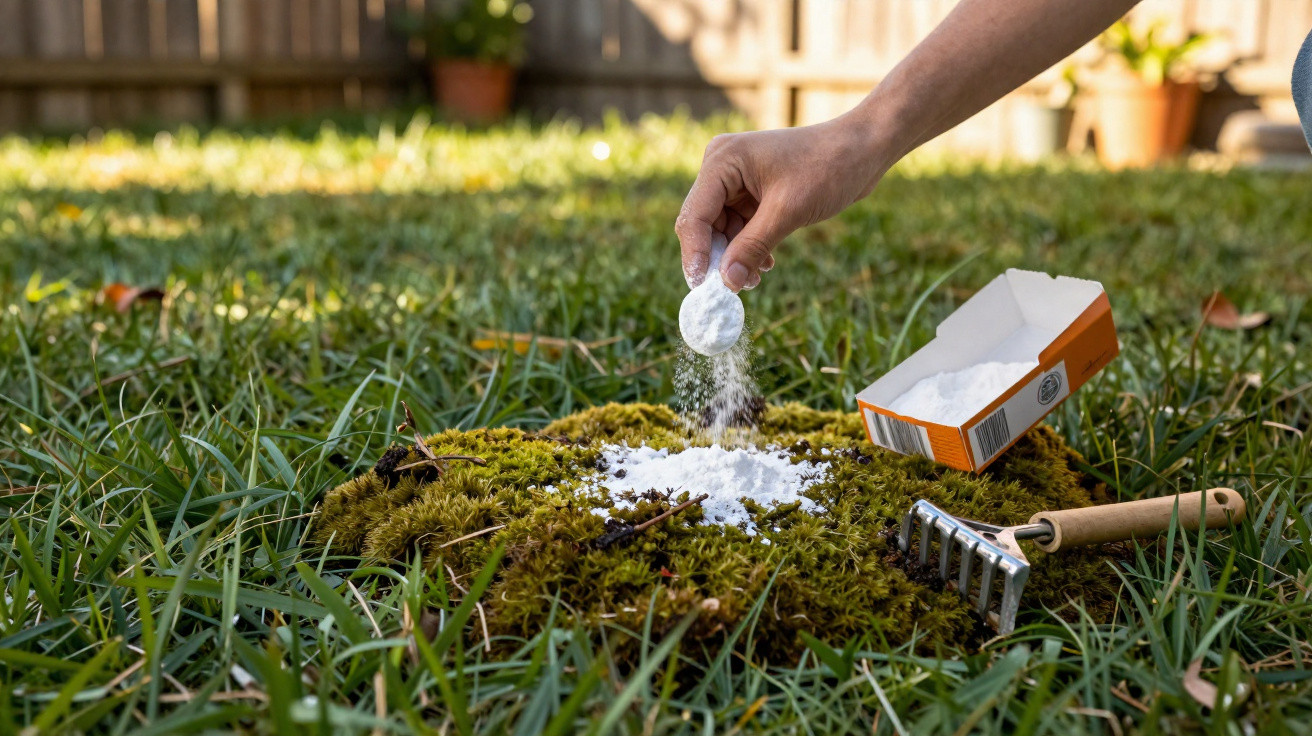
More “natural” alternatives, such as wood ash or bicarbonate of soda, are also often mentioned. They may work in individual cases, but their effects depend heavily on the soil already present: what works in one garden can make conditions worse in another.
How to prevent fresh moss growth in the lawn
In the long run, a healthy, dense lawn is the best protection against new moss. By changing a few habits, you will have to deal with the problem far less often.
Loosen the soil and prevent waterlogging
Heavy clay soils or severely compacted ground are magnets for moss. The following measures can help:
- aerate regularly by making holes, for example with lawn aerator sandals or hollow tines
- work sand into the soil to improve drainage
- improve water run-off and level out dips
- create paths or lay stepping stones to take pressure off heavily used areas
Fertilise properly and mow correctly
Grass needs nutrients to form a closed, resilient covering. If you never fertilise, you exhaust the soil instead of building it up. A nitrogen-rich spring fertiliser gives growth a boost, while a later application containing potassium strengthens plants for winter.
When mowing, it is better to cut regularly and moderately than infrequently and drastically. Keeping the lawn extremely short all the time weakens the grasses and creates new gaps for moss.
Think differently about shady areas
Some corners will never become a perfect show lawn. Very dense trees or deep hedges simply allow too little light through. In these places, a Plan B is worthwhile:
- sow a specialist lawn mix for shady conditions
- use ground-cover plants such as ivy, sweet woodruff or epimedium
- apply bark mulch and create a path or seating area instead
Accepting that not every spot can become an “English lawn” saves a great deal of frustration and chemical use.
What many people do not realise: moss is not only an enemy
However annoying it may look in a lawn, moss itself is not poisonous. It retains moisture, provides a habitat for tiny organisms and can even prevent erosion in hard-to-reach places. In gaps between paving, on old walls or in a wildlife garden, it can remain where it does not cause a problem.
It becomes troublesome mainly where you want a durable surface for walking and playing. Then every square centimetre of healthy grass counts. Families with children and dog owners in particular benefit from a robust lawn that withstands feet and rough play without immediately developing bare patches.
By avoiding aggressive household remedies and instead loosening, mowing and fertilising regularly, as well as scarifying purposefully in spring, you build up this resilience step by step. The work is spread across the year – but in return, the lawn remains hard-wearing not only in March, but throughout the season.
One final practical tip: keep a simple garden diary. Note when you scarified, fertilised and overseeded, what the weather was like and how severe the moss growth appeared. After two or three years, you will see clearly which measures genuinely benefit your soil – and the myth of the washing-up liquid trick will disappear from your toolkit for good.




Comments
No comments yet. Be the first to comment!
Leave a Comment