
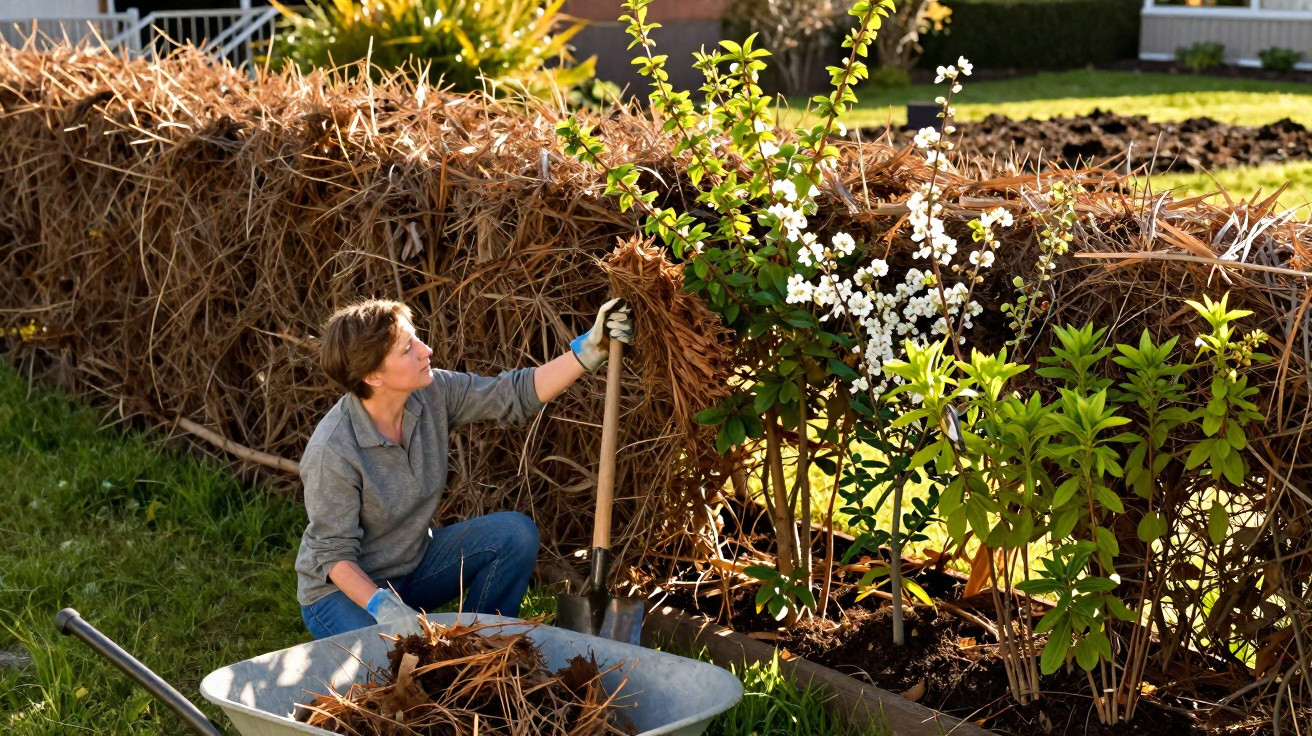
The mood is now turning: specialists are warning of serious consequences for gardens.
Across many residential areas, a familiar sight is currently disappearing: dark-green walls of arborvitae are developing gaps, turning brown and gradually dying back. Once viewed as the ideal answer for privacy screening and plot boundaries, these hedges are proving troublesome for water management and biodiversity as the climate changes. Agronomists and landscape architects are now speaking with striking clarity: the era of the Thuja hedge is ending – more quickly than many amateur gardeners want to admit.
How the Thuja became a garden favourite – and why it is now failing
The classic Thuja hedge was perfectly suited to the housebuilding boom of the 1970s and 1980s: inexpensive, fast-growing and dense throughout the year. Anyone wanting peace and privacy ordered 20, 30 or 50 plants, set them out in a row, and had an instant green barrier.
Today, that very concept is causing problems for the shrub. Thuja has one major weakness: its root system remains extremely shallow. During prolonged dry spells, it can barely access water from deeper soil layers.
Specialist bodies report that Thuja hedges can draw up to around 60 percent more water than hedges made up of native woody plants – a genuine problem, especially in summer.
Anyone who spends days each year watering a hedge with a hose, only to see brown patches appear anyway, experiences this dilemma first-hand: heavy water use without dependable privacy screening.
Why this green wall is an ecological mistake
Alongside the water issue, there is a second, less visible concern: the ecosystem behind the hedge. Compared with mixed or native hedges, Thuja is considered almost “lifeless”.
- Hardly any insect species use Thuja as a food plant.
- Its dense, uniform foliage provides suitable nesting sites for only a small number of bird species.
- Soil beneath established hedges is often depleted, compacted and lacking in life.
Many local authorities are already responding. A number of development plans now include restrictions on hedges made entirely of Thuja, and in some cases their planting is effectively prevented. Some towns and councils even support their removal by offering grants for taking out old Thuja rows and planting diverse, “living” hedges instead.
Stress, beetles and total loss: what is causing Thuja stocks to collapse
As drought becomes more frequent, these already thirsty hedges come under severe stress. Weakened plants release chemical signals that effectively attract pest insects. One particularly problematic culprit is a specialised boring beetle that focuses on Thuja and related species.
Its larvae tunnel beneath the bark, feed through the plant's transport tissue and thereby interrupt its water supply. At first, this may look like harmless browning in isolated sections, while the damage inside is already progressing rapidly.
Once a Thuja hedge is heavily infested by boring beetles, specialist bodies consider the plants virtually beyond saving – reliable treatments for the concealed larvae are not available.
Affected shrubs then die back slowly “from the inside out”. Brown sections spread, shoots become brittle and holes develop, until eventually there is more dead material than living green growth.
Reading the warning signs: when a Thuja hedge has no future
Many garden owners continue hoping that their hedge will “somehow recover”. However, there are clear signs for which specialists recommend a radical solution:
- large brown patches spreading from the inside towards the outside
- shoots that are completely dried out but still covered in brown scales
- visible feeding tunnels beneath the bark when the outermost layer is lifted
- no fresh growth at all on older, woody sections
One key point is that Thuja produces virtually no new growth from old wood. Once a gap has formed, it will usually remain permanently. A hedge that once screened views completely then becomes an uneven patchwork.
Anyone wishing to avoid taking away birds' breeding sites should choose the removal period carefully. Authorities recommend avoiding extensive removal of woody plants during the main nesting season – broadly from mid-March to the end of July.
How to remove Thuja hedges properly – and restore the soil
Once the decision has been made, difficult work lies ahead. The hedge should be removed completely, rather than merely being cut down close to ground level. The root stumps must also be taken out; otherwise, the soil remains heavily threaded with old roots that obstruct new plants.
After digging everything out:
- Loosen the soil deeply and break up compacted layers.
- Work in plenty of mature compost or well-rotted manure.
- Leave the ground undisturbed for several weeks so that soil life and structure can stabilise.
In many cases, it is worthwhile raising the soil level slightly with loose soil, particularly in heavy, compacted clay soils. This allows new shrubs to root more easily and reduces waterlogging after heavy rainfall.
What to use instead of Thuja: living alternatives for privacy screening
Landscape gardeners now recommend mixed or near-natural hedges almost unanimously. They may be slightly less perfectly straight, but they are more resilient in extreme weather and far more valuable for wildlife.
Examples for a mixed hedge
| Plant | Characteristic |
|---|---|
| Laurustinus (Viburnum tinus) | Semi-evergreen, with white flowers in winter and spring |
| Photinia | Red new foliage, year-round privacy screening |
| Privet | Tolerates pruning very well and is popular with birds |
| Hornbeam | Tolerant and sometimes retains brown leaves as a winter privacy screen |
| Hazel | Nuts for squirrels and birds, with an open growth habit |
| Dogwood species | Colourful bark and berries for birds |
| Hawthorn | Thorny, ideal protection for birds, with abundant blossom |
| Miscanthus & other ornamental grasses | Break up the appearance, gain height quickly and need little maintenance |
Such mixed hedges do not need to be rigidly planned. Three to five species are enough to create a substantially more resilient mini-ecosystem. Many of these woody plants need less water and can shade the soil more effectively.
Measurements show that near-natural, diverse hedges can retain considerably more soil moisture during heatwaves than a dense belt of Thuja – in some cases around a third more.
What a new hedge offers the climate, wildlife and neighbours
Giving up a row of Thuja can be difficult for some garden owners, as it was seen as reliable, tidy privacy screening – with barely any fallen leaves, hardly any flower debris and a crisp outline. The good news is that a well-planned alternative brings gains on many fronts.
Mixed hedges:
- lock up more CO₂ through their different growth forms
- provide insects with pollen and nectar from spring through to autumn
- create nesting places and food for songbirds
- break the wind more effectively because they do not act like a solid wall
- protect the soil against drying out and erosion
For neighbours, a varied hedge can even be more pleasant because it lets through more light and appears less imposing. At the same time, privacy remains intact when species with varying heights and dense growth are combined.
Who benefits most from a radical cutback
Anyone living in an area affected by regular water shortages, watering bans or strict garden-design requirements should assess their Thuja hedge realistically. Older stands that are already weakened consume a great deal of water while no longer providing reliable privacy screening. In these cases, decisive removal may even make more financial sense than investing in watering and emergency pruning every year.
The hedge is often also the biggest opportunity for people looking to adapt their garden more closely to climate protection and species conservation. Instead of a single conifer species, replanting creates a structurally rich area that positively attracts small mammals, birds and insects.
One further point is frequently underestimated: children learn far more about nature from a living hedge that flowers and bears fruit than from a monotonous conifer wall. Anyone who sees their garden in future as a small habitat rather than simply a bounded plot will find more enjoyment in the new hedge with every season – and will eventually not miss the old row of Thuja.



Comments
No comments yet. Be the first to comment!
Leave a Comment