
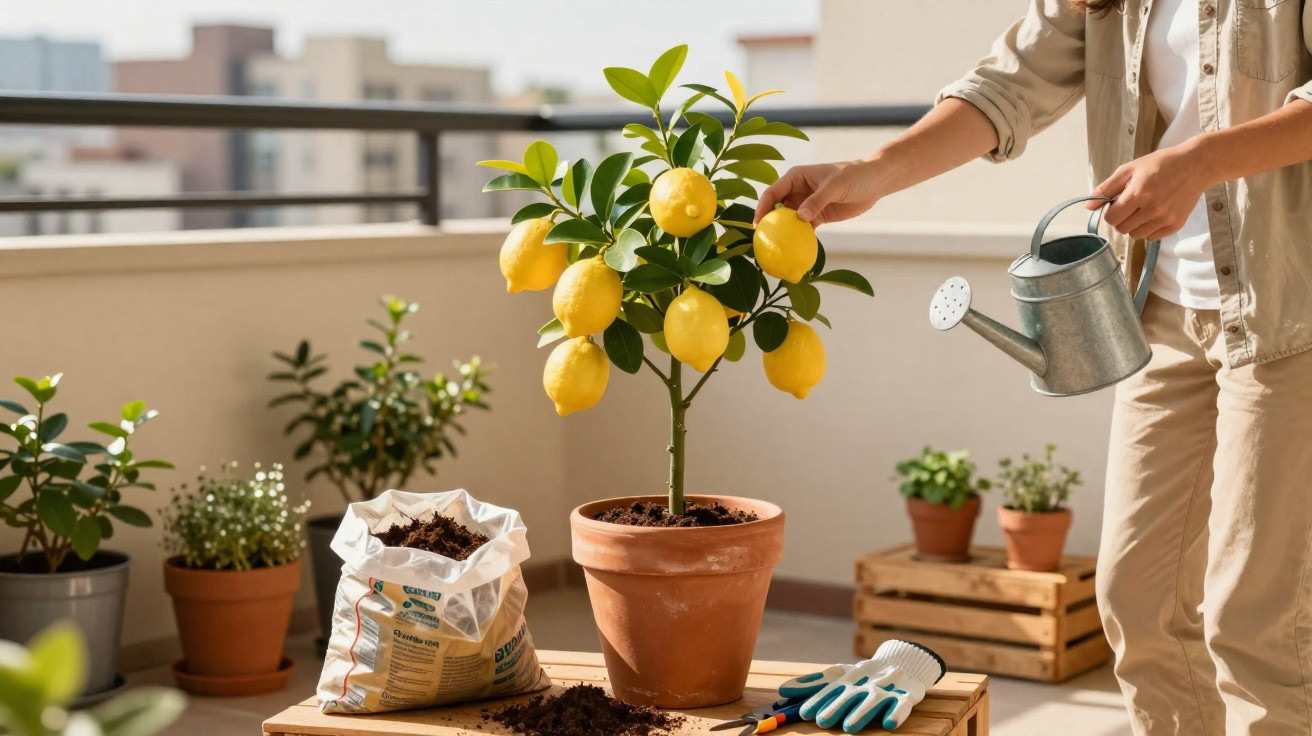
The dwarf lemon tree is a compact fruit tree suited to small gardens, sunny balconies and large pots. With a canopy that can be kept under control, minimally invasive roots and a good crop of lemons, it adapts well to restricted spaces without endangering pavements, patios or nearby structures.
Why does a dwarf lemon tree suit small homes?
A dwarf lemon tree grows less vigorously than a standard lemon tree, and light pruning can keep it at a low height. This makes it easier to grow in narrow areas, where a larger tree could cast excessive shade, reach the roof or take up much of the garden.
Its root system is another key consideration. A dwarf lemon tree does not generally develop aggressive roots when it has sufficient room, free-draining soil and balanced watering, reducing the likelihood of lifting paving, paths or bed edging.
Does it really produce fruit throughout the year?
A dwarf lemon tree can crop in several cycles over the year, particularly in warm regions with plenty of sunshine. The number of fruits varies according to the variety, the age of the young tree, feeding and how consistently it is watered.
To encourage more regular production, several measures make a difference from planting onwards:
- Choose a healthy grafted young tree with firm leaves and no pests.
- Plant it where it will receive at least a few hours of direct sunlight each day.
- Use light, fertile, well-draining soil.
- Water regularly, without allowing the soil to become waterlogged.
- Feed with organic matter and nutrients formulated for citrus trees.
How do you plant this tree in a pot or garden?
When grown in a pot, a dwarf lemon tree needs a large container, drainage holes in the base and a drainage layer to prevent water collecting around the roots. The growing medium should remain moist but never saturated, as citrus trees suffer when their roots are deprived of oxygen.
In the garden, it is best to leave space between the tree and walls, drains or pipes, even though its roots are not especially invasive. This clearance allows the canopy to develop properly, makes harvesting easier and enables pruning without pressing the plant against the house structure.
What care keeps a dwarf lemon tree healthy?
A dwarf lemon tree is straightforward to maintain, but it should not be neglected. Yellowing leaves, dry branches, dropped flowers and small fruit may signal a nutrient shortage, overwatering, insufficient light or pests such as scale insects and aphids.
A simple routine helps keep the tree in good condition:
- Water when the surface layer of soil begins to dry out.
- Prune dead, crossing or very low-growing branches.
- Clear fallen leaves from the pot or planting bed.
- Check the undersides of leaves to spot pests early.
- Increase feeding in spring and during fruiting periods.
Is a dwarf lemon tree worth choosing for a small garden?
A dwarf lemon tree is worthwhile when the aim is to combine light shade, useful fruit for the kitchen and green foliage without using too much space. It works well for small homes because its height can be managed, it can be grown in a pot and its roots are less troublesome than those of large ornamental species.
For successful results, choosing the young tree and planting position matters as much as the species itself. With direct sunlight, proper drainage, light pruning and regular feeding, this fruit tree can keep the garden productive, attractive and safe for patios, paths and walkways.
Comments
No comments yet. Be the first to comment!
Leave a Comment