
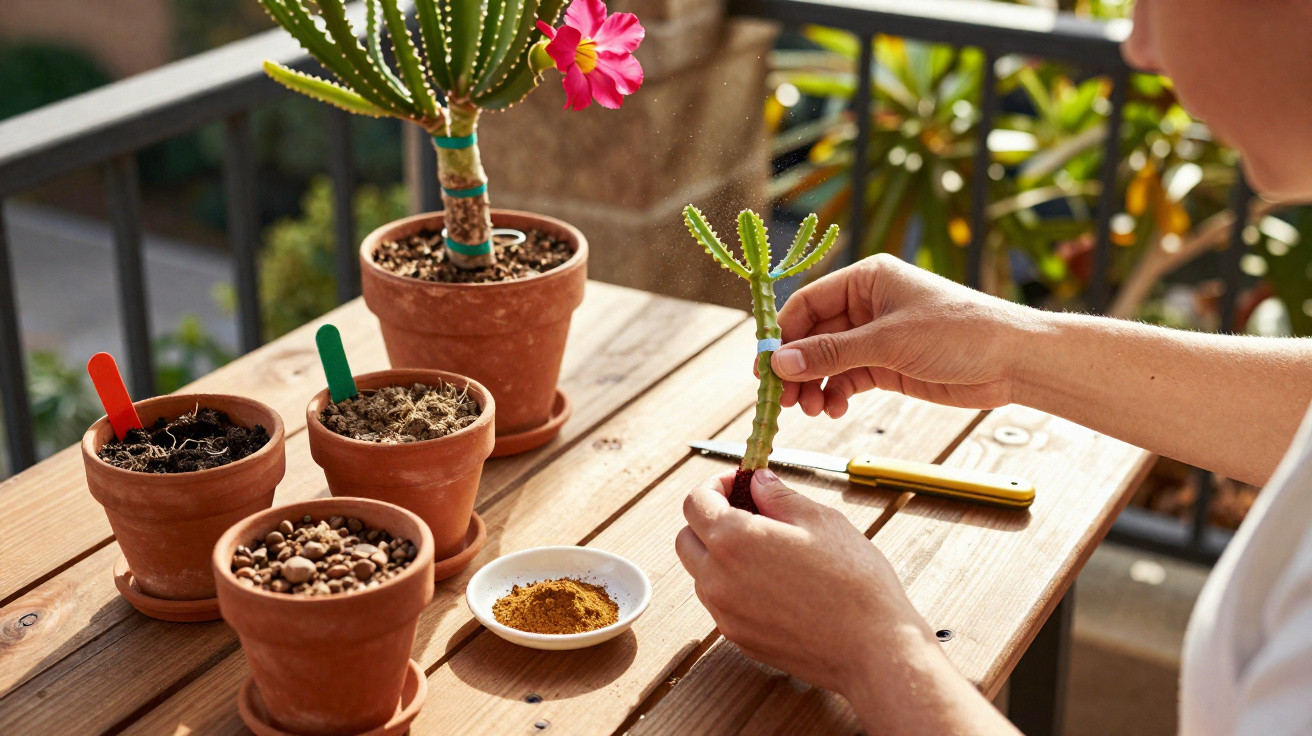
The desert rose is among the most admired ornamental plants, valued for its lavish flowers and its swollen trunk, known as the caudex. As well as growing it, many gardening enthusiasts look for ways to propagate their specimens. Taking cuttings and grafting are among the most common methods, and both techniques can be carried out at home if a few basic precautions are followed.
How to propagate desert rose plants from cuttings
One of the simplest ways to produce a new plant is to use a healthy desert rose branch. Choose a mature, disease-free stem measuring roughly 15 to 20 centimetres long. Once it has been cut, leave the end to dry in the shade for a few days, allowing the wound to heal before planting.
When the cut has healed, place the stem in a light, free-draining growing medium formulated for succulents. Water moderately during the first few weeks to prevent the cutting from rotting while it forms new roots.
Watch a video on the YouTube channel Horta e pomar em vaso demonstrating how to plant desert rose from cuttings:
What trick can improve the chances of rooting?
A widely used tip among growers is to allow the cut surface to heal fully before putting the cutting into compost. This waiting period limits fungal entry and lowers the likelihood of rot, one of the main challenges when propagating desert rose.
Another essential measure is to keep the young plant somewhere bright but sheltered from strong sunshine during its first days. Once it shows signs of rooting, it can gradually be acclimatised to full sun, which supports its growth.
- Sterilised pruning shears
- A healthy branch from the plant
- Compost for cacti and succulents
- A pot with effective drainage
- Gardening gloves
- Ground cinnamon or a suitable plant wound-sealing product, if desired
How to graft desert rose
Grafting is a technique used to combine one flowering variety with another, already rooted plant. It involves joining a small branch from the chosen variety to the rootstock, which will provide the base from which the new canopy develops.
After making matching cuts, join the two sections and secure them with grafting tape or suitable plastic. Keep the plant protected from excessive sun and rain until the tissues fuse, a process that may take several weeks.
- Use sterilised tools
- Select healthy plants
- Make clean, accurate cuts
- Secure the grafted sections firmly
- Shield the graft from heavy rain
- Wait for complete healing before taking off the tape
What care helps ensure successful cuttings and grafts?
Avoid overwatering after planting or grafting. The desert rose stores water in its caudex and favours well-drained compost, helping to reduce the risk of rot in the roots and freshly cut surfaces.
It is also important to keep the plant in a setting with good light, mild temperatures and air circulation. As the cutting or graft develops, increase its sun exposure gradually to encourage strong growth and future flowering.
Comments
No comments yet. Be the first to comment!
Leave a Comment