
Your spider plant looks healthy, yet not a single baby plantlet has appeared?
A few carefully chosen adjustments can completely transform its growth.
Many indoor gardeners have cared for a lush clump of foliage in a pot for years, only to find that the spider plant’s famous “hanging babies” never arrive. Rather than forming a living garland, the pot seems stuck in pause mode. By sensibly altering the light, pot size and watering routine, you can turn the plant into a small propagation factory in a relatively short time.
How a spider plant decides when to produce offspring
The classic spider plant, botanically known as Chlorophytum comosum, concentrates mainly on growing outwards during its first one to two years: more leaves, more roots and greater reserves. Beneath the soil, its thick, fleshy root tubers store water and nutrients much like a battery.
While it is still building up these reserves, the plant is effectively focused on itself. Only once it is sufficiently strong, receives reliable basic care and is kept at temperatures of around 18 to 22°C does it switch into family mode. This is when long, arching shoots, known as stolons, begin to emerge.
Small white flowers appear on these shoots first. Later, they develop into miniature rosettes that resemble tiny spider plants. Once they have formed roots of their own, they become fully fledged plants that can easily be potted up.
A spider plant only begins producing offsets when it is well fed, firmly rooted and under a small amount of “pressure”.
The key factors: light, pot and watering can
Whether or not a spider plant produces babies depends heavily on three things: brightness, pot size and how intensively it is cared for. Even minor changes can be enough to trigger the switch.
The right light: bright, but not all day long
Chlorophytum thrives in a bright position, provided its leaves are not exposed to harsh midday sun. A spot close to an east- or west-facing window is ideal. It will receive plenty of diffused daylight there without scorching.
It is not just the intensity of light that matters, but also its duration. To produce plenty of offsets, the spider plant responds to relatively short days. It gets going when it receives fewer than roughly twelve hours of light per day for several weeks.
- Choose a position near an east- or west-facing window
- Avoid direct midday sun, particularly behind south-facing windows
- Switch off lamps in the room consistently in the evening so genuine dark periods can occur
- Maintain this light “diet” for at least three weeks
If your plant is always beside a bright floor lamp or beneath an LED strip, you may be extending its day without realising it. The plant then remains in foliage-growing mode and produces few, if any, stolons.
Pot size: slightly snug works like a turbo boost
Many home gardeners assume: “The bigger the pot, the happier the plant.” For spider plants, the reverse is true. They prefer being slightly pot-bound. Their roots can quite happily press firmly against the sides of the pot.
This mild lack of space creates a stress signal. The plant senses that its location is limited, so reproduction becomes worthwhile. Continually moving it into substantially larger containers, by contrast, keeps the spider plant in a permanent growth mode for leaves and roots.
A pot that is only slightly too small gives the spider plant its “time for offspring” signal.
Repotting is only needed when:
- roots are growing out through the drainage holes at the bottom
- the pot is visibly bulging
- watering water runs out of the bottom almost immediately
Watering and feeding: less really is more here
Spider plants hold water in their root tubers. They do not need permanently wet compost; in fact, constant watering can cause waterlogging and root rot, while also suppressing offset production.
A suitable routine looks like this:
| Season | Watering | Feeding |
|---|---|---|
| Spring / summer | Water when the top layer of compost has dried out | Feed lightly about once a month |
| Autumn | Gradually increase the time between waterings | Give the final light feed |
| Winter | Water sparingly, only preventing the root ball from drying out | No feed required |
Slightly restrained care prevents the plant from remaining in a permanently comfortable state. This small degree of stress sends the message: it is time to reproduce.
The simple formula for plenty of spider plant offsets
Combining several conditions thoughtfully can noticeably increase baby plant production. Many indoor gardeners report significantly more offsets within a few weeks when these three points are right at the same time:
- a bright position without midday sun, at an east- or west-facing window
- a daily dark period of clearly more than twelve hours
- a relatively tight pot, restrained watering and light feeding
Shorter days, a tight pot and moderate watering: this combination imitates the natural signals that tell Chlorophytum in its native habitat that it is time to produce offspring.
What should be avoided: transferring it into pots that are far too large, keeping the compost constantly wet and feeding heavily all the time. These conditions may produce plenty of leaf growth, but the characteristic “baby garland” will usually fail to appear.
Removing and rooting offsets – without losing any
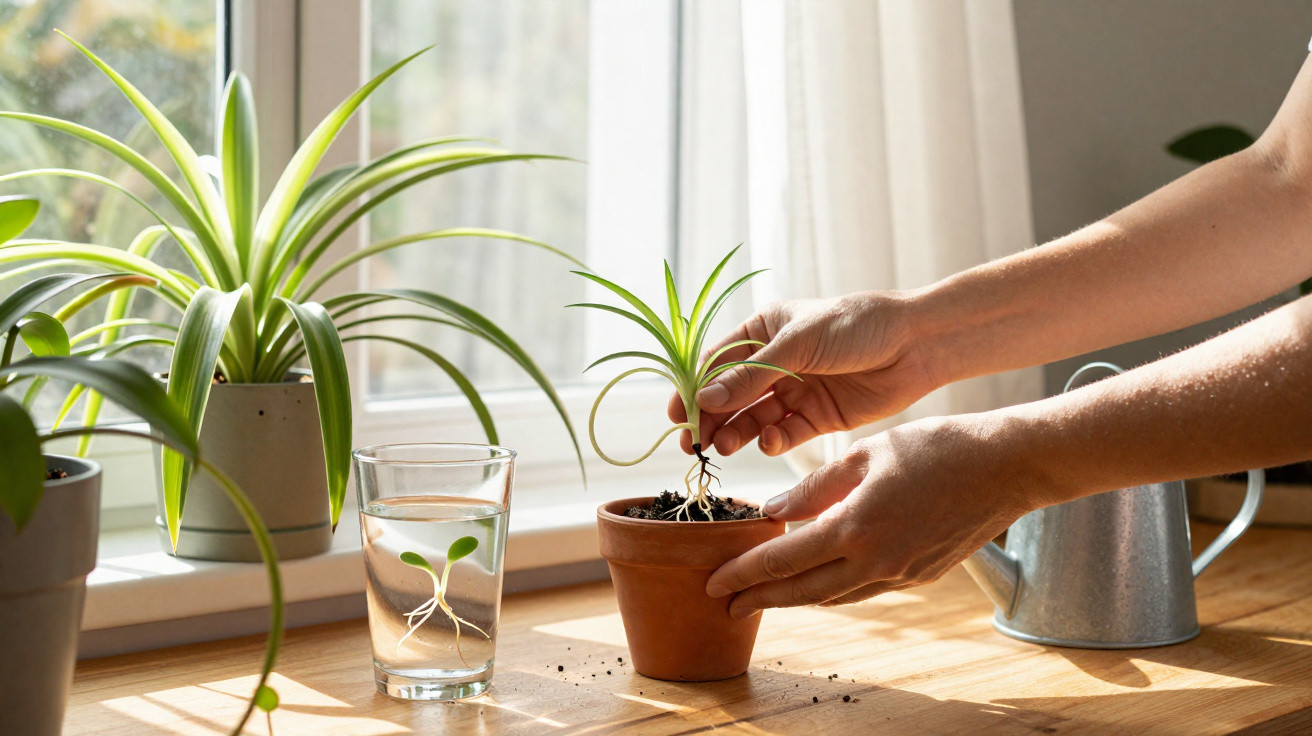
As soon as the miniature rosettes on the stolons show their first small roots, they are ready for the next stage. The best time is generally spring or early summer, when light levels are pleasant and temperatures are steadily around 20°C.
There are two tried-and-tested methods:
Pre-rooting in a pot beside the mother plant
With this approach, the offset initially stays attached to the mother plant. Place a small pot filled with loose, free-draining compost directly beside the main plant. Carefully rest the baby rosette on the compost and secure it lightly, for example with a wire pin or a small wooden stick.
If the compost is kept regularly and lightly moist, the offset will grow strong roots within a few weeks. Only then should the connecting shoot be cut. The advantage is that the young plant continues to be supplied by its mother during this sensitive stage.
Letting it root in a glass of water
Those who enjoy watching roots develop can stand the base of the baby rosette in a glass of water. The important point is to submerge only the lower section; the leaves must remain dry. After one to three weeks, water roots measuring two to three centimetres will usually appear.
At that point at the latest, move it into a pot of loose, well-draining compost. The young root ball must not be “drowned” in its new substrate. A slightly moist, airy environment is enough for a strong start.
How many babies are realistic?
A vigorous spider plant can produce many stolons each year and therefore a whole chain of offspring. Under favourable conditions, numerous offsets are not unusual – enough to add greenery to your home, give plants away or swap them.
To achieve this, however, the mother plant still requires sound basic care: remove dead leaves occasionally, refresh the compost every few years and watch for pests such as aphids or spider mites. If these fundamentals are observed, the plant will remain healthy and vigorous for a long time.
Background: why short days trigger the urge to reproduce
Many houseplants respond to day length. As the period of light decreases, the plant’s hormonal balance changes. In Chlorophytum, the combination of adequate size, well-filled storage roots and shorter days signals that the growing phase is ending and that passing on its genes now takes priority.
Recreating this in the living room, for example by consistently switching off room lighting early, works directly with this natural programme. The plant receives the same cue it would receive in its native habitat as the season approaches its end.
Common mistakes and easy ways to correct them
Many issues can be solved with small adjustments. Here are a few examples:
- Few or no offsets: Check the position, reduce artificial light in the evening and assess the pot size.
- Pale, limp leaves: The plant may be getting too little light or too much water; allow it to dry out briefly and move it closer to a window.
- Brown leaf tips: This is often caused by dry central-heating air or overly hard water; water occasionally with standing or filtered water.
Once you understand these adjustments, you can manage your spider plant very precisely. After the conditions have settled into balance, the system largely runs by itself: manageable care, plus a whole series of new plants every year to share with friends or neighbours.
Comments
No comments yet. Be the first to comment!
Leave a Comment