
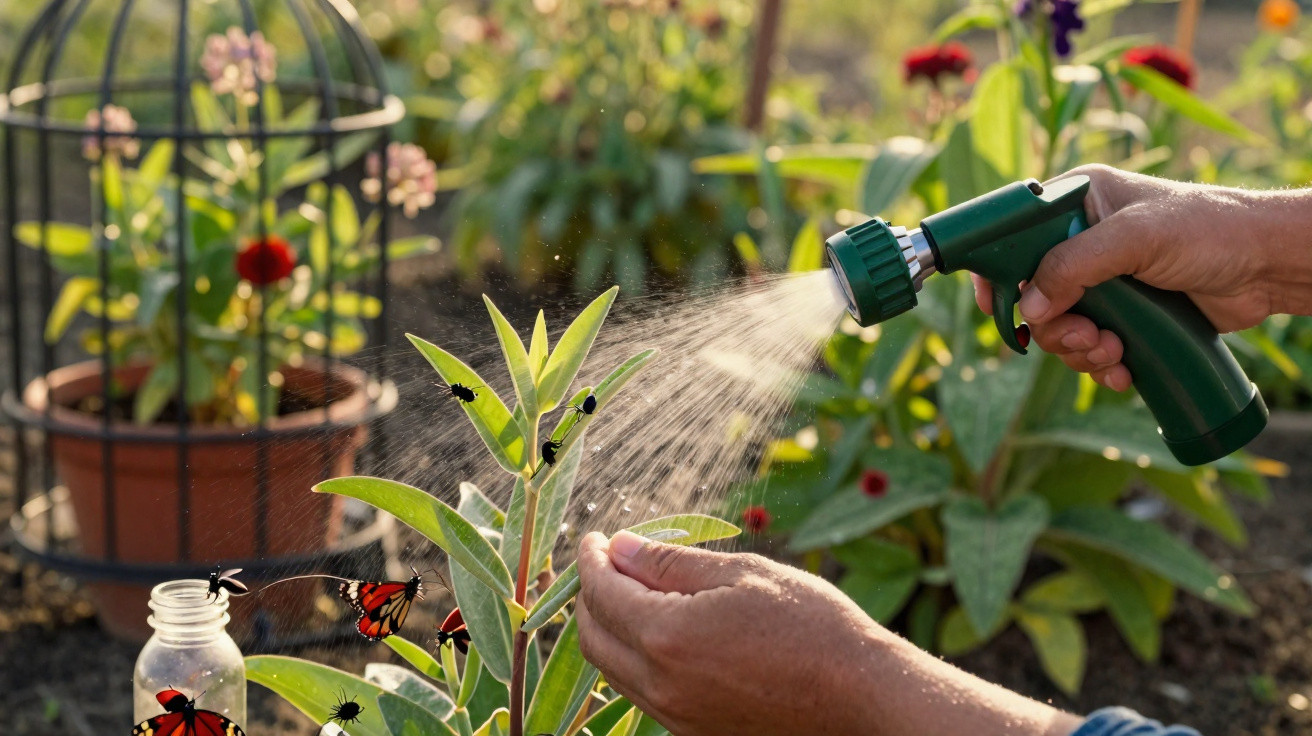
Across North America and the UK, gardeners are increasingly faced with a seasonal dilemma: how can they protect milkweed from aphids without undermining the butterflies the plants were intended to support?
Why milkweed aphids have become such a major issue
As milkweed is planted more widely for monarchs and other pollinators, aphid infestations have become more common in these newly created miniature habitats. The vivid orange insects that gather on stems are usually oleander aphids, which feed readily on milkweed and multiply at an alarming rate.
Although they do not bite people, aphids place plants under strain, restrict new growth and leave foliage coated in sticky honeydew. This substance can develop black sooty mould. The same scene repeatedly appears on social media: a milkweed stem nearly obscured beneath yellow or orange insects, while a lone monarch caterpillar attempts to eat through the infestation.
Aphids aren’t just a cosmetic problem on milkweed – heavy infestations can reduce nectar, weaken stems and crowd out monarch caterpillars.
That conflict has led many gardeners to move away from the usual rapid chemical solutions. Any broad-spectrum product used against aphids may also harm monarch eggs, caterpillars and other beneficial insects nearby. Attention has therefore turned towards gentler, more precise methods, particularly releasing ladybirds alongside a powerful, accurately directed blast of water.
Why chemicals should not be sprayed on milkweed
Garden centres continue to stock systemic insecticides marketed for “sap-sucking pests”. While this remains a common choice for many plants, milkweed presents a very different situation.
- Systemic products travel through plant tissue, meaning caterpillars consume residues as they feed on the plant.
- Contact insecticides destroy ladybirds, lacewings, hoverflies and parasitic wasps as well as aphids.
- Chemical residues may remain on leaves that monarchs use as a nursery for weeks.
Conservation organisations and researchers increasingly advise gardeners to regard milkweed as “no-spray” territory. The question then becomes how to bring aphid populations down while honouring that approach. Physical removal and biological helpers provide the answer.
Water blasts for milkweed aphids: cheap, simple and remarkably effective
Using water to dislodge aphids from milkweed
Many US and UK extension services now advise using one of gardening’s oldest methods: a hose adjusted to produce a strong, concentrated stream. When applied with care, it can remove a substantial share of aphids without resorting to chemicals.
Most aphids never make it back up the plant after a forceful rinse; they dry out, starve or get eaten on the ground.
A useful routine is as follows:
- Fit a spray nozzle and select the “jet” or “shower” setting rather than mist.
- Hold each stem with your spare hand to prevent it from breaking.
- Direct the water beneath leaves, where colonies commonly shelter.
- Concentrate on tender new growth, which is where aphids tend to congregate.
- During a severe outbreak, repeat the treatment every few days.
Timing is important. Early morning is generally ideal, as the plant has the rest of the day to dry and fungal risk is reduced. Ladybirds released later can then forage on foliage that is reasonably dry.
Can a water blast damage monarch eggs and caterpillars?
Concern about harming monarchs prevents some gardeners from using the hose technique. There is a genuine risk, but it can be limited with sensible precautions.
| Stage | Risk from water blast | Practical adjustment |
|---|---|---|
| Eggs | Can be dislodged from leaf surfaces | Visually scan leaves, avoid direct jets on visible eggs |
| Small caterpillars | May be knocked off or injured | Gently move them to a nearby leaf before spraying |
| Larger caterpillars | Usually cling tightly, but still vulnerable | Shield with your hand or skip heavily occupied stems |
Many seasoned monarch gardeners use a mixed strategy. They rinse the worst aphid hotspots on plants with no current eggs, but manually squash aphids or remove small infested stems from plants already carrying caterpillars.
Ladybirds: small predators with a big role
How ladybirds and aphids keep each other in balance
Ladybirds, often called ladybugs in North America, have become the best-known insect for natural aphid management. Both the adult beetles and their larvae eat aphids, with one larva capable of consuming dozens each day. Crucially, they do not threaten monarch eggs or caterpillars.
Native ladybirds arrive naturally in many gardens once aphid populations rise. The difficulty is one of timing: aphids breed rapidly, whereas predators often take a week or two to catch up. During that interval, milkweed can be overrun.
Releasing ladybirds does not create a perfect, instant fix – it gives the natural predator side of the equation a head start.
This has created a small seasonal trade in refrigerated ladybirds for garden release. The practice is debated in some areas, particularly where non-native species are repeatedly introduced. Conservationists now advise choosing locally suitable species from trustworthy breeders instead of buying wild-collected imports.
Releasing ladybirds on milkweed so they remain nearby
Gardeners often complain that purchased ladybirds immediately fly away. Several small changes can make this less likely.
- Water the milkweed before releasing them, providing moisture as well as prey.
- Let them go at dusk, when they are less inclined to take flight straight away.
- Put them directly onto aphid-heavy stems rather than bare leaves.
- Keep outdoor lighting nearby dim, so they settle instead of gathering around bulbs.
Where conditions are favourable, some ladybirds remain for several days, mating and laying eggs. Their alligator-like larvae then emerge into a ready-made, all-you-can-eat aphid buffet.
Pairing the hose with ladybirds
This year’s most widely discussed method is not based on one treatment alone. Gardeners have reported promising results from combining a firm water blast to reduce aphid numbers with a carefully timed ladybird release to hunt down those left behind.
The water blast handles the emergency; ladybirds handle the long game.
After a large, sticky infestation has been reduced to manageable numbers, predators can hold it down. Without the initial mechanical reduction, ladybirds can struggle to keep pace. Once it has happened, however, they can become an effective maintenance team.
During the height of summer, many people follow a sequence such as this:
- Day 1 morning: Wash aphids from stems with water, avoiding any visible monarch eggs and larvae.
- Day 1 evening: Release ladybirds onto the damp milkweed, where aphids have been thinned out.
- Following week: Spot-rinse new colonies, while leaving some aphids as food so ladybirds do not leave the site.
This approach does not make plants completely aphid-free. Instead, it keeps infestations low enough for milkweed to remain productive while ensuring predators have sufficient prey to stay.
Other gentle methods to use alongside ladybirds
Hand removal and selective pruning
In smaller areas, gardeners may simply pinch aphids off with gloved fingers or wipe them away using a damp cloth. Others remove heavily infested soft tips and throw them out. Although this means sacrificing some new growth, it eliminates thousands of insects in one go without additional water or chemicals.
Dealing with ant “bodyguards”
When honeydew accumulates, ants frequently appear and begin farming aphids. In return for the sugary liquid, they defend aphids from predators. This can reduce the effectiveness of ladybirds.
Interrupting this relationship can help. Gardeners wrap sticky barriers around stems or supporting stakes, or prune nearby branches that act as an ant bridge to the plants. Without ant protection, aphids are much more exposed to beetles and lacewing larvae.
What gardeners are actually trying to safeguard
Beneath the practical guidance lies a more fundamental conflict. Milkweed has two functions: it is both a structural border plant and a nursery for a threatened migratory butterfly. That dual purpose changes how gardeners assess damage. A handful of distorted leaves can seem less important when those leaves also carry tiny white monarch eggs.
The goal on milkweed is rarely perfection; it is a truce where the plant, the pests and the pollinators all get just enough.
This perspective also alters how risks are compared. The limited possibility of losing a few caterpillars to a poorly aimed hose stream may seem preferable to the almost certain damage caused by a systemic insecticide across an entire bed.
Planning a garden that needs fewer milkweed aphid rescues
The most robust milkweed patches seldom exist in isolation. They are part of varied, slightly untidy plantings that offer nectar, shelter and a wide range of insect life. Greater diversity brings more natural predators and improves the likelihood that something will be ready to eat aphids before numbers reach crisis point.
Some gardeners now reserve water blasting and ladybird releases for emergencies rather than using them routinely. In the longer term, they establish hedges, wild areas and undisturbed leaf litter where native beetles, spiders and parasitoid wasps can overwinter. These resident species then emerge where aphids are already present, rather than having to arrive in a posted container.
For anyone beginning a monarch-friendly patch, this longer outlook is important. The first season can involve dramatic aphid outbreaks and repeated sessions with the hose. By the third or fourth year, once predators have become established in the area, outbreaks may develop into smaller and more manageable surges.
There is a wider climate dimension, too. Milder winters in many places allow greater numbers of aphids to survive, while early warm spells accelerate their breeding. This places additional pressure on milkweed at a time when monarch populations are already experiencing migration stress. Small chemical-free measures, including the ladybird-and-water method, cannot alter the global situation on their own, but they can help keep local breeding sites viable.
For the moment, late-summer gardens in many places show much the same picture: a gardener crouched with a hose in one hand and a tub of gently moving red beetles in the other, trying to locate the shifting boundary where a plant, a pest and a delicate orange butterfly can still occupy the same stem.
Comments
No comments yet. Be the first to comment!
Leave a Comment