
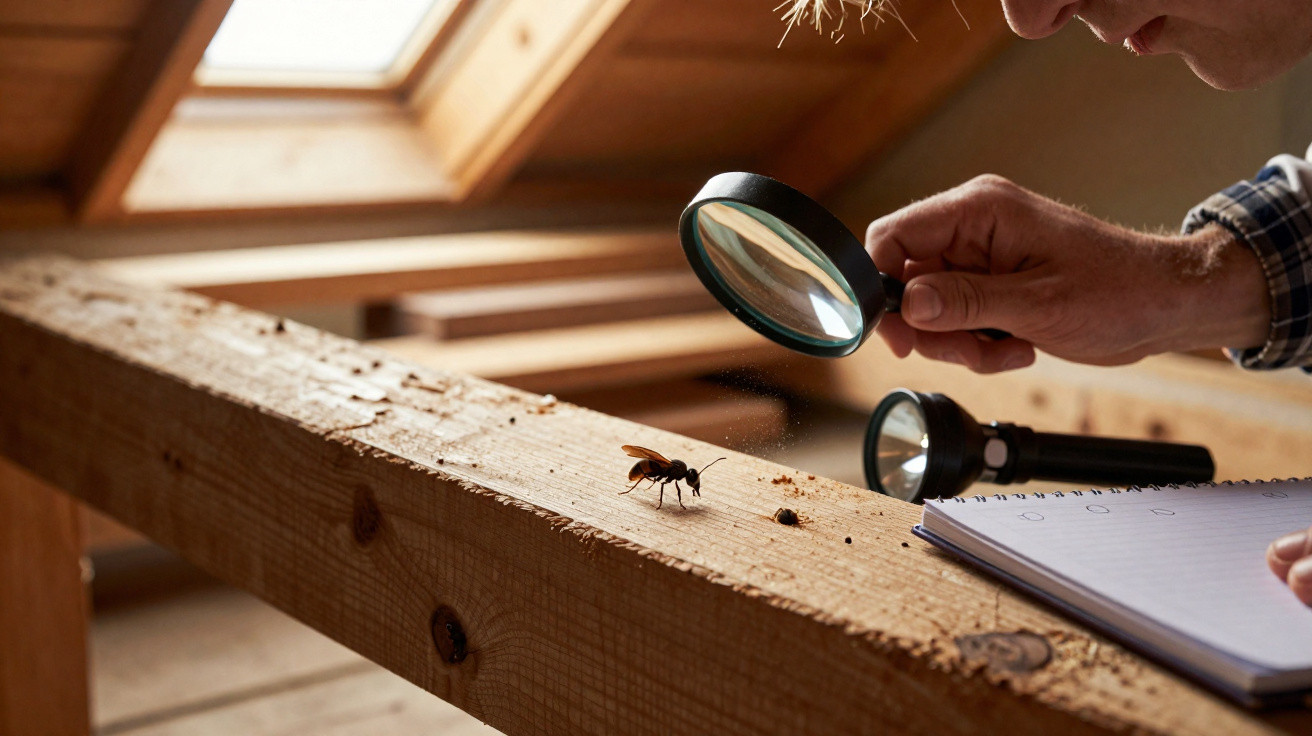
In France, finding this small insect in a home can reveal a hidden attack on timber by other species.
Published on 24 June 2025, the source article, an online publication, raises awareness of the domestic scleroderma. Often mistaken for an ant and immediately killed, this insect does not turn up in people’s homes by chance: it is looking for larvae living inside wood.
A discreet insect that does not attack wood
The domestic scleroderma belongs to the Bethylidae family. It lives in temperate climates and can be found in several parts of France, particularly in the south of the country. Its elongated body and small size mean it can easily be confused with an ant.
It does not feed on furniture, roof timbers or wooden objects. Instead, it targets the larvae of xylophagous insects. This term refers to insects whose larvae tunnel through and feed on wood.
Species frequently mentioned include woodworm beetles and longhorn beetles. These beetles can leave tunnels in antique furniture, beams, floors and certain joinery components. The domestic scleroderma acts as a natural predator of their larvae.
The issue is not necessarily the insect spotted on the floor or wall: its presence may indicate that larvae are already living within a wooden item.
Why its presence should be investigated
Female domestic sclerodermas do not have wings. They move around close to areas where they are likely to find xylophagous larvae. Once they detect a tunnel in the wood, they can reach their prey using their sting.
According to the source article, the female paralyses the larva before laying her eggs nearby. Young sclerodermas then have an immediate food source. This cycle explains why the appearance of several individuals in a home warrants a careful inspection of furniture and timber structures.
Crushing every visible insect does not resolve the underlying cause. Larvae concealed inside the wood remain out of reach and may continue to develop. The right approach is therefore to examine the immediate surroundings.
Signs to look for in timber
- Small holes on the surface of a piece of furniture, beam or skirting board;
- Fine wood dust beneath an antique object or close to a timber structure;
- Visible tunnels in damaged or dismantled wood;
- Repeated sightings of domestic sclerodermas in the same room;
- Weakened areas on furniture, parquet flooring or roof timbers.
A single insect is not enough, by itself, to diagnose an infestation. However, repeated sightings combined with marks on wood justify looking for the affected area. A timber treatment professional can then identify the type of attack and recommend suitable work.
A useful species that can also sting
Domestic sclerodermas can cause discomfort for household occupants. Females may sting people, sometimes while they are sleeping. The sting can be painful and may leave redness, itching or a small blister.
The source article mentions reactions that can occasionally be more pronounced, including hives, swelling or feeling unwell. The response differs between individuals and depends on their sensitivity. Multiple stings may also disturb sleep, especially when the insects are present in a bedroom or near infested furniture.
The domestic scleroderma can be an ally against wood-boring insects, without being a welcome guest in a bedroom or living area.
If stung, it is best to wash the area with soap and water, avoid scratching and monitor how symptoms develop. Applying direct heat, especially with a cigarette or a hot object, presents a risk of burns and should not be done.
If there is widespread swelling, breathing difficulty, faintness, facial involvement or an unusual reaction, contact emergency services or a healthcare professional without delay. A pharmacist or doctor can also advise on managing a persistent skin reaction.
The situation in France
In France, xylophagous insects can damage the wood in a property, including furniture, parquet floors and structural components. The risks differ depending on the species involved, how long the attack has been present and which part of the building is affected.
Termites are subject to specific rules in certain areas, and their presence must be taken seriously. Woodworm beetles and longhorn beetles also require particular attention when they attack load-bearing components or roof timbers. An expert assessment can distinguish an old attack from one that is still active.
In every case, the answer is not to use insecticides indiscriminately. The insect must first be identified, the affected wood located and the extent of the damage assessed. This approach prevents an entire room being treated unnecessarily when the source may be limited to one particular item of furniture.
How to respond without making the problem worse
If you see a domestic scleroderma, the most useful step is to note where it was found. Careful observation may help identify an old piece of furniture, skirting board, bookcase or beam that could be harbouring larvae.
- Avoid handling the insect with bare hands;
- Carefully move it away from the sleeping area if necessary;
- Inspect timber items in the same room;
- Look for holes, tunnels and wood dust;
- Contact a professional if the signs recur or involve part of the property’s structure.
The term “xylophagous” comes from Greek and literally means “wood-eater”. It does not refer to a single insect, but to a group of species whose larvae use wood as both shelter and a food source. It is this concealed activity that can attract the domestic scleroderma.
The presence of this insect can therefore act as a warning sign. It should neither be dismissed nor cause immediate panic. Above all, it calls for the home’s timber to be checked, so that the cause is dealt with rather than focusing solely on an insect that can sometimes reveal an established problem.





Comments
No comments yet. Be the first to comment!
Leave a Comment