
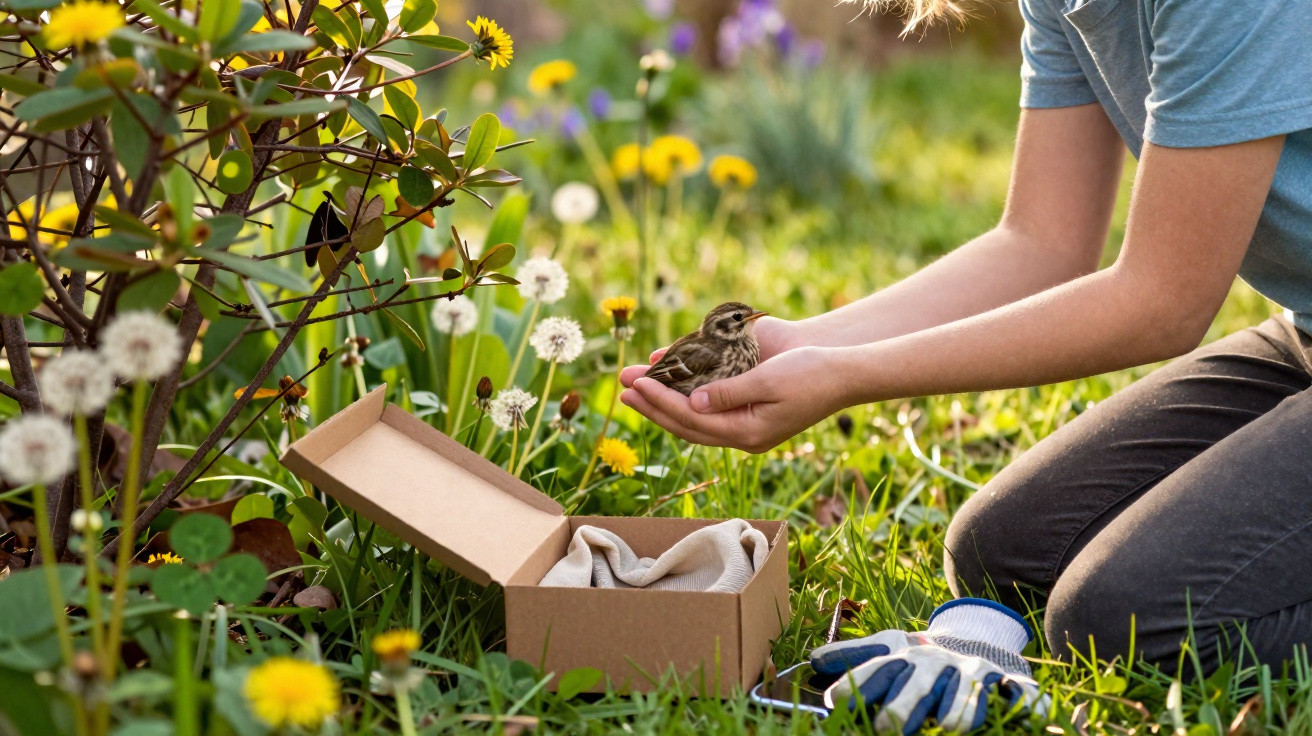
In spring, a lone young bird in the grass often moves residents. Yet human intervention can disrupt a natural learning process.
The scene can be unsettling: a small bird is sitting on the ground, appears clumsy, may make faint calls and does not fly away as you draw near. Whether it is in a garden, beside a patio or at the base of a hedge, the instinct may be to bring it indoors for safety. In the vast majority of instances, however, the youngster has not been deserted. Its parents are nearby and will return to feed it once you have left.
Why a young bird leaves the nest
Breeding starts early in the year for many species. From March onwards, blackbirds, thrushes, robins and some owls begin raising their young. After several weeks, the growing chicks no longer have enough room in the nest. They leave it before they have fully mastered flight.
This period is known as the fledging stage. For several days, the young bird may remain on the ground, in low shrubs or on nearby branches. It hops, flaps its wings, occasionally falls, then climbs back up a few metres away. Although this may look alarming to us, it is a normal part of learning.
“A fledgling that is well feathered, alert but still clumsy is not usually abandoned: it is learning to move around under its parents’ supervision.”
Adult birds do not necessarily stay beside their offspring. They feed it at regular intervals while keeping their distance so as not to draw predators towards it. Someone watching the bird for several minutes may therefore assume that no parent is coming back. In fact, their presence will often prevent the adults from returning.
The figure that exposes a common mistake
According to figures shared by the Bird Protection League (LPO), 39% of animals admitted to its care facilities were wrongly collected by people acting with good intentions. This is far ahead of collisions with a fixed obstacle, which account for 7% of admissions, and vehicle accidents, estimated at 6%.
The issue is not a lack of compassion. It stems from a very common failure to distinguish a youngster learning to fend for itself from an injured bird. Taking away a healthy fledgling deprives it of its parents, their suitable food and the vital lessons it needs to survive.
Not every young bird eats seeds. In spring, many are fed mainly caterpillars, larvae, small insects and spiders. An improvised diet of bread, milk, biscuits or seeds can quickly weaken them.
Three signs that genuinely require attention
Watch from a distance of a few metres and do not touch the bird. Intervention is warranted when there is a clearly visible injury or immediate danger. Three warning signs should prompt concern:
- a drooping wing or a leg held in an abnormal position;
- a wound, blood or missing feathers;
- an inability to stand, hop or respond when someone approaches.
A young bird that moves in short hops, grips a low branch or calls repeatedly does not necessarily need rescuing. It is often calling to its parents. The right approach is to move away, keep pets indoors and observe discreetly from a window.
When the young bird has almost no feathers
The situation is different if the bird is naked, has very few feathers or is plainly unable to hold up its head. It may be a chick that has fallen from the nest too early. If the nest can be seen and safely reached, the chick can be gently returned to it.
The old belief that parents will reject a young bird after it has been touched by a human is untrue. Birds have a limited sense of smell and do not identify their offspring in this way. Your scent is therefore not the risk: the real danger is leaving the chick away from its parents for too long and breaking that connection.
A cat, road or lawnmower calls for a different response
Even a healthy fledgling may face an immediate threat. A cat prowling nearby, a road, an uncovered swimming pool or a frequently used area calls for brief, measured action.
You can move the youngster only a few metres, placing it in a thick hedge, bush, low branch or sheltered low wall. The purpose is not to hide it far from its territory, but to move it out of danger while ensuring the adults can still find it.
“Move it only far enough to remove it from danger, never far enough to separate it from its family.”
If a cat is patrolling the garden, a small open box placed securely at height and lined with dry leaves can provide temporary shelter. The parents must be able to reach the youngster easily. Never close the box or bring it into the house.
What to do if you find an immobile adult bird
An adult bird on the ground requires greater caution. An adult blackbird, tit or pigeon that does not escape as you approach may be injured, ill or stunned after striking a window. Do not handle it repeatedly to test it.
If the bird remains hunched up, is breathing with difficulty, bleeding or cannot fly off after several quiet minutes, carefully place it in a cardboard box with small air holes. Keep it somewhere dark and quiet, away from children and pets. Do not offer food or water. Then contact a wildlife rescue centre or the local branch of the Bird Protection League.
A garden becomes a refuge when it remains slightly wild
Protecting birds is not only about the moment you encounter a youngster on the ground. It is something that can be prepared for throughout the year. A dense hedge, a strip of long grass, leaves left beneath shrubs and native plants provide shelter, insects and nesting material.
The Bird Protection League advises against hedge-cutting and tree pruning between 16 March and 31 August. Cutting in April can destroy an occupied nest or expose young birds that are still unable to fly.
Feeders can be helpful during cold weather, but they may also be removed from March onwards. At this time, adults seek insects to feed their young, which have high protein requirements. A living garden with flowers, insects and natural shelter is far more helpful than a dish of seeds.
In France, populations of common birds declined by around 30% in urban and suburban areas between 1989 and 2019. Allowing a young blackbird to continue learning, postponing hedge-cutting or leaving an area of grass untouched are small actions. Yet they give birds an additional chance to get through the spring.




Comments
No comments yet. Be the first to comment!
Leave a Comment