
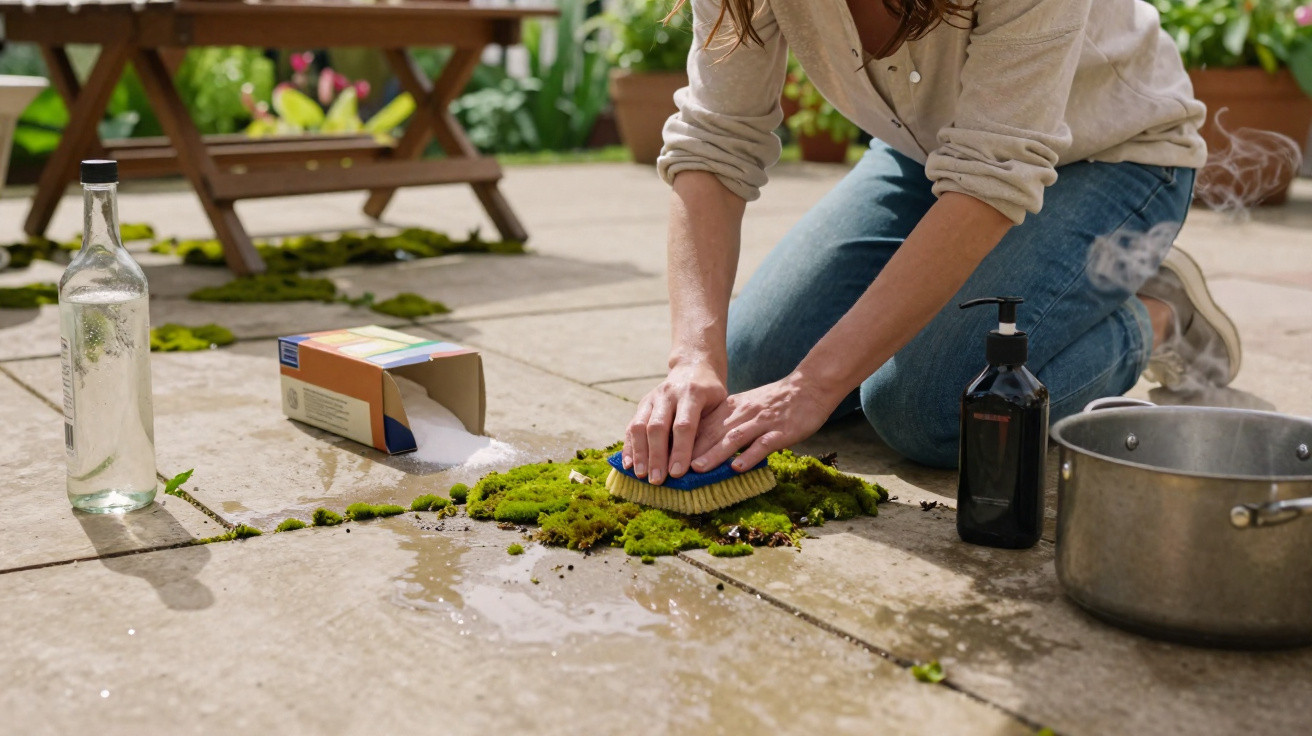
Spring sunshine reaches the garden, the outdoor chairs are brought out… then you notice it: a slick green coating that has transformed the patio into a skating rink.
Throughout the UK and US, winter leaves many homeowners with terraces covered in mossy growth and slabs that are hazardous underfoot. Before turning to aggressive chemicals or commercial-strength cleaners, you can use a few everyday kitchen ingredients to remove the green layer, look after your paving and make the area safer for children and older family members.
Why your terrace becomes a moss magnet
Moss thrives on three essentials: damp, shade and grime. By the end of winter, patios made from concrete, stone, brick or timber commonly provide exactly that environment.
Rain deposits pollution and dirt across the surface. Leaves, bird mess and soil washed from beds create a fine organic layer. Moss spores then settle in wet joints and hairline cracks, take root and gradually spread.
Left unchecked, moss doesn’t just stain your slabs – it makes them slippery, traps even more moisture and speeds up wear.
Over time, paving slabs become darker while fibrous roots fill their joints. On a rainy morning, the surface may be nearly as slippery as ice. This presents a genuine falling hazard for children playing outdoors and for older relatives using walking sticks or walkers.
Consistent upkeep makes a substantial difference. A thorough clean in spring and autumn, combined with brief weekly sweeping during summer, will generally control growth. Many landscaping professionals maintain that a brush and bucket can achieve more than the newest “miracle” chemical spray.
Why you should avoid bleach on a patio
Bleach can seem like the easy answer: pour it on, watch the green disappear and consider the job finished. In practice, it has significant drawbacks.
- It may permanently discolour porous stone and coloured concrete.
- Over time, it can weaken mortar and grout joints.
- Run-off may damage grass borders, decorative plants and organisms in the soil.
- Children and pets may come into contact with residues unless the space is rinsed and ventilated for sufficiently long.
Although bleach rapidly removes visible moss, it does nothing to alter the conditions that encouraged its growth. After only a few wet weeks, the green coating frequently returns.
Simple, mildly alkaline or acidic household ingredients often work just as fast on moss, with far less damage to surfaces and gardens.
Four kitchen ingredients that remove moss better than bleach
1. White vinegar: a reliable patio rinse
A blend of white vinegar and water is among the most effective, manageable treatments for removing moss from a wide range of hard surfaces.
To clean a patio:
- Combine 1 part white vinegar and 1 part warm water in a large bucket or watering can.
- Sweep the terrace first to clear away loose debris.
- Generously pour the mixture across moss-covered areas and into paving joints.
- Allow it to sit for 20–30 minutes, giving the acid time to loosen the green film and limescale.
- Scrub using a stiff brush or deck broom, then rinse well with clean water.
This technique is suitable for concrete, most paving slabs and exterior tiles. If your patio includes fragile limestone or coloured paving, test a discreet patch beforehand, since acid can lightly etch susceptible stone.
2. Baking soda: for established moss patches
Baking soda, also called bicarbonate of soda, is mildly abrasive and alkaline. These properties make it useful against persistent moss in narrow joints or shaded areas.
A straightforward application method is:
- Scatter baking soda directly over moist moss.
- Pour on a little hot water to form a paste on the paving.
- Leave it in place for 15–20 minutes.
- Scrub firmly with a rigid brush, working the paste into the joints.
- Rinse off all traces to prevent white residue appearing as the patio dries.
Baking soda is particularly handy for smaller zones, steps and the edges of raised beds where a pressure washer would be too aggressive.
3. Black soap: mild cleaning with a protective finish
Traditional black soap, commonly produced from potash and olive oil, works as a mild surface cleaner and degreaser. While it does not destroy moss as forcefully as vinegar or baking soda, it helps lift grime and makes it more difficult for moss to become established again.
For regular cleaning:
- Add two tablespoons of liquid black soap to a bucket containing hot water, approximately 8–10 litres.
- Use a broom or long-handled brush to apply it, working the solution over the surface.
- Leave it for several minutes, then brush once more to release light growth and dirt.
- Rinse, or let it dry where the material permits; on some mineral slabs, a light soap film may offer a slight protective benefit.
This is a particularly useful method after removing substantial moss with another treatment, or for maintaining a terrace throughout the summer.
4. Washing soda and potato cooking water: surprising options
Household soda, or washing soda crystals, is not the same as baking soda. It is more powerful and requires gloves, yet, when correctly used, it is still considerably kinder to paving and soil than many shop-bought moss killers.
| Product | Typical dosage | Main use |
|---|---|---|
| Household soda | 1 tablespoon per litre of warm water | Stubborn moss on mineral surfaces, away from plants |
| Potato cooking water | Used neat, while still hot | Light moss and algae, eco‑friendly clean-up |
For washing soda, prepare the mixture, spread it over mossy paving and joints, leave it for up to an hour, then scrub and rinse thoroughly. Keep the solution clear of lawns and flowerbeds, and always wear gloves because it can irritate the skin.
Potato water has natural starches and mild salinity, both of which weaken moss. Once potatoes have been boiled, take the hot water outdoors immediately and pour it over green areas. Brush the surface after the water has cooled a little. It is most effective on light growth and provides a useful “bonus” clean while you are already cooking.
Preventing moss from returning to your patio
After the slabs are clean, routine care rather than powerful chemicals is the key to maintaining them.
The cleaner and drier your patio stays between rain showers, the less chance moss has to return.
Useful measures include:
- Inspecting drainage to prevent water gathering in low areas.
- Sweeping away soil and leaves each week, particularly during autumn.
- Placing outdoor rugs beneath barbecues or dining tables to collect food spills.
- Pruning branches that hang overhead to improve airflow and let in more light.
Some homeowners additionally brush a diluted layer of linseed oil onto natural stone or bare concrete. When mixed with three parts water and used sparingly, it can lightly saturate the material and reduce water absorption, which moss does not favour. Never use this on surfaces that could become dangerously slippery when wet, and test it in a concealed corner first.
Common errors that harm paving slabs
The two biggest causes of patio damage are bleach and pressure washers operated at excessive settings.
With a pressure washer, the problem is not necessarily the equipment but its intensity and distance from the surface. Positioning the lance closer than 30 cm can damage the slab face, make smooth concrete rough and remove mortar or jointing sand. The resulting gaps collect water, allowing moss to return more quickly than before.
Very concentrated treatments and homemade salt mixtures also pose problems. Salt builds up in the ground and may kill surrounding plants, whereas highly alkaline solutions can burn skin and permanently mark some types of stone. If stronger products are necessary, use them only on limited mineral areas and rinse generously before allowing children or pets outside again.
How frequently should a moss-prone patio be cleaned?
The right schedule depends on the climate and the patio's aspect. A north-facing, shaded courtyard in a wet region will develop green growth more rapidly than a sun-exposed terrace in a dry location.
As a general guide:
- Heavy clean: once in spring after the last frosts, and once in autumn after leaf fall.
- Light clean: every one to two weeks in wet spells – a broom and a bucket of soapy water are usually enough.
- Spot treatments: use vinegar or baking soda on new moss patches as soon as you notice them.
Following this pattern prevents the familiar cycle of leaving the issue for years and eventually requiring harsh chemicals or costly professional cleaning to restore the area.
When professional assistance is worth considering
Certain circumstances are beyond DIY treatment. For heritage stone, intricate paving layouts or a large poolside terrace, employing a professional may be financially safer than risking damage by selecting an unsuitable product.
Specialists are able to examine the stone type, slab porosity and joint condition before deciding on the appropriate approach. They often use carefully measured biodegradable cleaners alongside low-pressure rinsing, which can provide reassurance when a pond or stream is nearby.
Additional advice for safer outdoor living
Removing moss is only one aspect of patio safety. Once cleaning is complete, inspect the slabs and joints carefully. Loose edges, cracks and missing grout can catch feet while also allowing water to penetrate. Minor repairs using fresh mortar or jointing sand prevent small defects from becoming costly structural problems.
In homes with toddlers or older relatives, consider what happens on a wet day. Think about the route people naturally take from the back door into the garden. Keeping these particular walkways especially clean, putting a non-slip exterior mat near the door and providing good lighting around steps will reduce the likelihood of falls more effectively than any individual cleaning product.
Comments
No comments yet. Be the first to comment!
Leave a Comment