
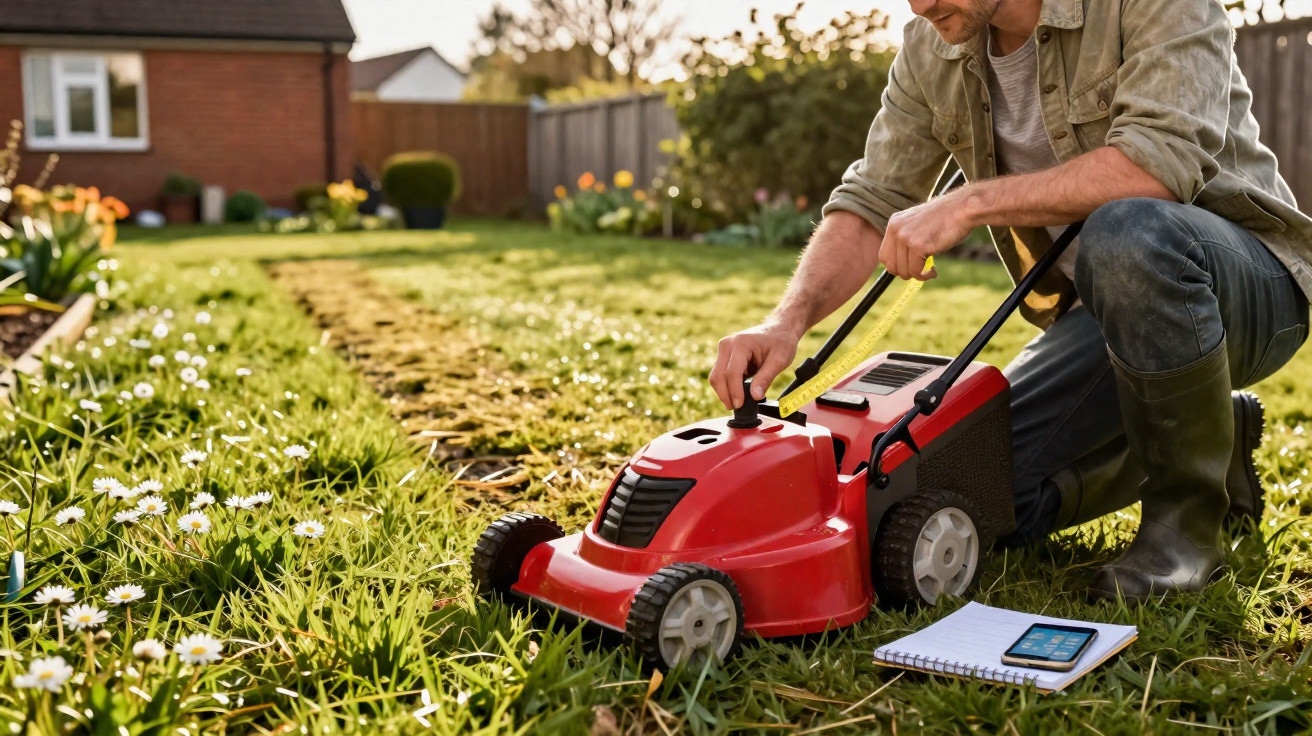
March arrives, the lawn starts growing again and the mower can suddenly seem impossible to resist.
Yet one incorrect setting can undo several weeks of growth.
The year’s first mow may feel like a post-winter reset, but it is also the point at which lawns are often put under severe strain. Mowing too low, beginning too soon or cutting in unsuitable weather can leave grass weakened throughout spring. Just a few precisely judged centimetres separate a thick green carpet from a thin, yellowing lawn.
Assessing your lawn: when March is genuinely the right time
Plenty of gardeners treat the arrival of March as an instruction to bring out the mower. Grass has its own timetable, however. Air temperature, rainfall and the moisture level of the soil are more important than the date on your phone.
Your lawn is ready for its first cut when:
- The grass is a bright, even green rather than its faded winter brown.
- Most blades are roughly 8–10 cm tall.
- The ground feels firm beneath your feet instead of soft and waterlogged.
- Crossing the lawn no longer leaves muddy footprints.
A ruler is more reliable than simply judging by eye. Insert it upright into the turf and check the tallest nearby blades. If they remain below 8 cm, hold off. If they have grown beyond 10 cm, schedule a very light first trim instead of cutting them severely.
The state of the soil is just as significant as the height of the grass. Using a mower on saturated, heavy ground compacts it and leaves ruts behind. Roots then find it harder to breathe, allowing moss to take hold quickly.
Only start the first cut when the grass reaches 8–10 cm and the soil is firm, not squelchy.
Weather pitfalls: why a bright morning may still be the wrong time
Spring sunshine is not always a reliable signal. At the start of the season, grass blades are still recovering from the cold, and poorly timed mowing can shock them as active growth begins again.
Do not mow when:
- Morning dew is still on the grass, or rain has fallen recently.
- Hard night frosts continue to occur regularly.
- Powerful cold winds are drying the upper soil layer.
Damp blades flatten beneath the mower instead of receiving a clean cut. They block the mower deck, pull at the roots and produce a rough finish that can encourage disease. Cutting late in the day before a severe overnight frost also damages the newly exposed tips, slowing growth for weeks.
Choose a dry afternoon, once dew has gone and the risk of a hard frost that night is low.
The one-third rule: the simple principle that protects your lawn
Many people choose the lowest mower setting in the hope of “getting it over with” at once. Although the lawn might appear tidy for a day, the unseen harm can persist for the rest of the season.
Grass blades do more than make a lawn look attractive: they act as the plant’s solar panels. Taking off too much in a single pass abruptly removes the energy-producing surface that sustains the roots.
Using the one-third rule in practice
Never remove more than one-third of the height of the grass in any single cut.
This straightforward principle applies throughout the year, but in March it is non-negotiable. For instance:
| Current height | Maximum you should cut | Height after mowing |
|---|---|---|
| 9 cm | 3 cm | 6 cm |
| 10 cm | 3.3 cm | ≈ 6.5–7 cm |
| 12 cm | 4 cm | 8 cm |
When grass has reached 12–13 cm because mowing was postponed, do not be tempted to scalp it down to bowling-green height. Instead, allow for two or even three cuts across several weeks, reducing the length gradually while following the one-third limit on every occasion.
The key figure: 5–6 cm for the first March cut
Most lawn specialists recommend a forgiving target height of 5 to 6 cm for the first spring mow. It may sound like a small range, but it provides an essential balance.
The ideal height after the first March cut is about 5–6 cm.
At this length, several benefits occur simultaneously:
- Enough leaf surface remains for photosynthesis.
- Winter-damaged tips are cut away, prompting new growth.
- Shade remains over the soil, helping to reduce evaporation.
- Weed seeds encounter less exposed soil and find it harder to establish.
Keeping the lawn a little taller also promotes tillering, in which every grass plant develops side shoots. Additional shoots create a denser sward with fewer spaces for moss and dandelions to grow.
Setting your mower: use centimetres rather than guesswork
Mower height controls frequently use unclear numbers or symbols instead of measurements in centimetres. A setting marked “3” may give a 4 cm cut on one mower but nearly 7 cm on another.
To remove any uncertainty, measure your mower once:
- Put the mower on a level, firm surface, such as a path or patio.
- Select the highest or second-highest cutting position.
- With a ruler or tape measure, check the distance between the ground and blade height.
Alter the setting until it reaches the 5–6 cm target. Record the corresponding position for your particular mower. Many walk-behind mowers sold by major DIY chains produce roughly this height at their highest or second-highest setting, but measurement is the only way to be sure.
Pre-mowing checklist for a healthy spring lawn
Before cutting long March grass, carry out a few rapid checks to prevent problems later:
- Sharpen or change the blade so that it cuts cleanly rather than ripping the grass.
- Remove twigs, stones and children’s toys from the lawn.
- Mow slowly in even strips that overlap slightly.
- Gather heavy clippings if the grass was long, preventing them from smothering the lawn.
- If desired, apply a light layer of well-rotted compost to support soil life.
A sharp blade and a slow, steady pace matter as much as the height setting.
What if you disregard the height rule?
Mowing too close in March seldom kills a lawn completely, but it triggers a series of minor issues that soon accumulate.
Grass left with very little leaf area must draw on root reserves simply to stay alive. Those reserves ought to support spring thickening and root growth. Instead, they are used up replacing the foliage that was removed. The lawn then:
- Develops yellow patches, particularly on shallow or poor soils.
- Forms bare areas where weed seeds can sprout.
- Lets moss take over in wet or shaded places.
- Is less able to withstand summer drought and footfall.
After weeds and moss become established, scarifying, reseeding and additional watering are needed. Maintaining that 5–6 cm height from the outset is both cheaper and gentler than trying to restore a stressed lawn in May.
Two everyday examples: the careful and impatient gardener
Imagine two neighbours on an ordinary suburban street.
Alex holds off until late March. His grass is approximately 9 cm tall, the soil has dried out and he cuts it to 6 cm using a sharp blade. A fortnight later, his lawn is thicker and has very few bare areas. By April, it feels soft and springy, requiring only a gentle trim every week or ten days.
Next door, Sam mows during the first warm spell in early March. The lawn is still wet, the grass is only 6–7 cm high and the mower setting is much too low. This leaves 3 cm stubble marked by the wheels. By late April, pale patches emerge, moss spreads along the path and daisies establish themselves in the thinnest sections. Sam must aerate, overseed and water heavily to put it right.
The climate and soil are the same; the difference is simply the care taken over a few centimetres of grass.
Spring lawn terms gardeners often encounter
Lawn-care guidance can include technical expressions that sound more difficult than they really are. Two commonly arise in advice about the first cut:
- Tillering: the process by which a single grass plant forms extra shoots at its base. These extra shoots make the lawn denser and more durable.
- Scalping: mowing so close that the stems, and sometimes even the soil, are shaved, creating brown or bare areas that are slow to recover.
A first cut at 5–6 cm supports tillering, whereas cutting too low can cause scalping, particularly where the lawn has hollows or raised areas.
Related spring jobs that enhance the first cut
The initial mow is most effective alongside a few gentle jobs, rather than harsh treatments. Light raking after mowing clears lingering winter debris and allows air into the sward. Spot-seeding small bare areas while the soil remains cool gives new grass seedlings time to establish roots before summer heat arrives.
A light topdressing of compost or a fine soil mix helps soil life and fills minor hollows. Combined with the right cutting height, these simple measures help create a lawn that remains greener, withstands weeds and copes more effectively with children’s play, pets and garden furniture throughout the season.




Comments
No comments yet. Be the first to comment!
Leave a Comment