
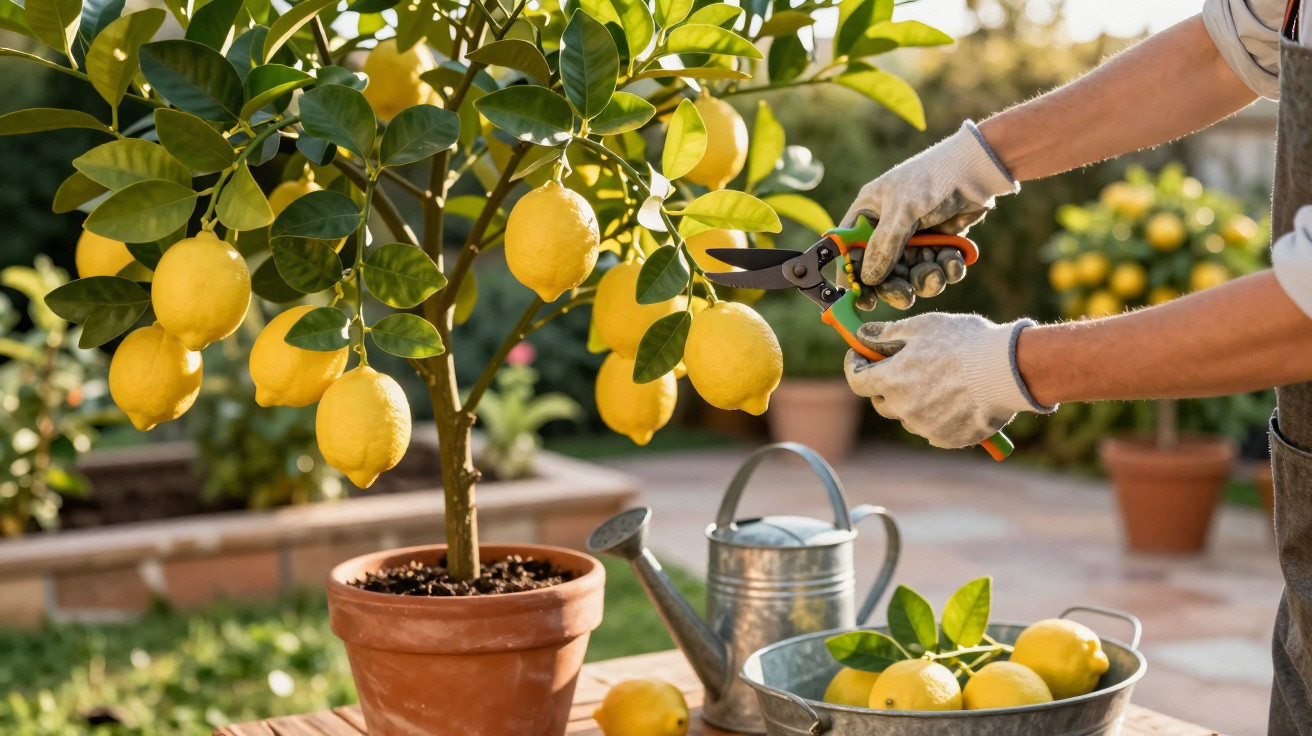
Every year, innumerable gardeners unintentionally undermine their lemon harvest through one straightforward error with the pruning shears.
They may point to the weather, the cultivar or even the soil, yet seldom realise that pruning at the wrong time or in the wrong way can transform a productive lemon tree into a poor performer. Knowing precisely when and where to cut can mean the difference between a handful of sparse fruit and a generous, aromatic crop.
Why most people prune their lemon tree at the wrong time
Lemons do not develop at random on a lemon tree. Most fruit forms on growth produced in the previous year. The buds that will become future lemons begin developing invisibly between late summer and autumn.
Pruning at an unsuitable time is not merely a matter of “tidying the tree”. It means physically cutting away the following season’s lemons before they have the opportunity to form.
Pruning late in spring or early summer often wipes out the very shoots that would have carried the heaviest blossom and fruit.
Many gardeners prune whenever they can fit it in, perhaps during a mild winter spell or on a sunny weekend in May. The result may look tidy at first, but fewer flowers appear several weeks later, and the eventual crop can seem unexpectedly meagre.
Over-cutting is another frequent problem. If a lemon tree is cut back severely, it responds by producing an abundance of vigorous, leafy shoots. Although the canopy then looks dense and healthy, the tree postpones fruit production while it restores its framework.
The golden window: when to prune for maximum yield
In mild and temperate climates, the most reliable period for pruning a lemon tree is from late winter to very early spring: after the harshest frosts have passed, but before flowering is fully under way. Across many areas, this falls from March to early April.
The principle is straightforward. The tree is beginning to become active and sap is rising, yet it has not invested too much energy in flowers. Pruning wounds recover more quickly, while the valuable flower buds on the previous year’s growth are less likely to be harmed.
Choose a frost-free spell, with night temperatures staying above about 5°C, and work on a dry day so cuts close cleanly.
In particularly mild coastal locations or Mediterranean-style climates, pruning can often begin slightly sooner, from late February, provided the forecast is settled and a cold snap is not expected. In colder districts and at higher elevations, late March is generally the safer choice, when new growth is clearly visible but the tree has not yet opened into full bloom.
What you should never do to a lemon tree with pruning shears
Certain pruning practices are damaging regardless of the time of year. Steer clear of these familiar errors if you want plentiful fruit rather than a stressed, unproductive tree.
- Pruning during severe frost or freezing conditions
- Taking off long sections of the previous year’s shoots in one session
- Making ragged, torn cuts that heal poorly
- Removing so many lower branches that foliage remains only as a tuft at the top
- Cutting back to precisely the same point every year, causing large knuckles of dead wood
In hard frost, newly made cuts may freeze and injure the surrounding tissues. This can allow fungal disease and dieback to take hold. A lemon tree experiencing such stress prioritises survival rather than producing juicy lemons.
Step-by-step: how to prune a lemon tree for heavy cropping
1. Prepare the tools before touching the tree
Sharp, clean equipment makes neat cuts, lowering disease risk and helping wounds heal more rapidly.
| Tool | Use |
|---|---|
| Bypass secateurs | Thin shoots and small branches (up to finger thickness) |
| Loppers | Thicker branches where more leverage is needed |
| Pruning saw | Old, woody branches or structural cuts |
Clean the blades with alcohol or disinfectant between trees, particularly if you have recently worked on plants affected by disease.
2. Start by checking the health of the tree
First, step back and assess the tree’s overall outline. The aim is a light, bowl-shaped structure that lets daylight reach the interior and allows air to circulate between the branches.
Remove anything obviously dead, broken or diseased before making other cuts. Dead wood is commonly grey or brittle and breaks cleanly. Branches split by wind, or those with dark, sunken areas, should be dealt with first.
Removing dead and sickly wood first boosts the tree’s energy and makes the rest of the pruning decisions easier.
3. Open up the centre without stripping the tree bare
Lemon trees benefit from both warmth and light. A crowded, tangled centre remains wet after rainfall and is more susceptible to fungal disease. However, removing too much from the middle can leave internal branches exposed to scorching sunlight in hot weather.
Select several shoots that cross inwards and cut them away completely at their origin from a main branch. Work towards an open vase shape rather than one tall central stem. Leave enough space between the remaining branches to prevent them rubbing together or sitting too close.
4. Shorten, do not scalp, last year’s shoots
Many lemon trees develop slim, upright shoots during the previous season. These often carry the buds that will flower in the current year, so cutting them right back loses that fruiting potential.
Instead, reduce these shoots lightly by roughly one third, making each cut just above an outward-facing bud. This promotes side growth that may also carry fruit and keeps the tree at a manageable height and spread.
The best fruiting wood is often neither brand new nor ancient; it is the intermediate, one- to two-year-old growth.
Climate, pots and ground: adapting the method
Lemon trees in pots respond somewhat differently from those planted in open ground. Their roots are restricted, and they may grow in stronger bursts, particularly after repotting or feeding.
For a potted lemon tree, carry out a light annual structural prune in early spring, followed by minor corrective trimming after each flush of growth. Keep the crown in proportion to the pot. When the canopy grows too large, the confined root system can struggle to provide sufficient water during summer, reducing fruit quality.
Trees planted in the ground, particularly in protected gardens, often grow bigger and become more permanent features. For these, establishing a lasting structure is more important. Maintain three to five main branches as the framework, making gentle annual adjustments instead of attempting to reshape the whole tree in a single year.
What pruning actually changes inside your lemon tree
Cutting a branch triggers a range of changes in the way a lemon tree distributes its energy. In practical terms, pruning influences three key factors:
- How light is spread across leaves and fruit
- The balance between leafy growth and flower formation
- Air movement, which affects disease pressure
Allowing extra light into the canopy encourages more even ripening and improves lemon colour. Excessive shade commonly results in smaller fruit that takes longer to ripen.
A tree carrying too many long, vigorous shoots often flowers later. Moderate pruning restrains this excess vigour and encourages a more reproductive state. This brings more blossom and, where pollination is successful, a greater quantity of fruit.
Risks of over-pruning and how to avoid them
Pruning too severely does more than reduce the current year’s harvest; the effect can continue for several seasons. A heavily cut-back tree directs its resources towards replacing the branches it has lost, and yields commonly remain reduced during that time.
Drastic cuts can also expose parts of the trunk and branches that were previously shaded to abrupt sunlight. In hot climates, this may cause bark sunburn, creating cracks that offer pests a way in.
Aim for light, regular work each year instead of a brutal renovation every five or six years.
Where you have taken on a neglected lemon tree with a disordered shape, spread the remedial pruning over two or three years. Each spring, remove several of the most problematic branches and begin creating a new framework, while leaving the tree able to continue fruiting.
Pruning, feeding and watering: how they work together
Gardeners often consider pruning, feeding and watering to be separate tasks, but the lemon tree does not. Every pruning cut influences how it uses nutrients and water.
Following early-spring pruning, new growth begins to emerge. At this stage, a balanced citrus fertiliser supports both developing shoots and flower buds. If nutrition is insufficient, the tree may later shed some of its young fruit.
Water management matters too. A recently pruned lemon tree, with fewer leaves, loses less moisture through transpiration. As fresh foliage develops, however, its water requirement rises again. Uneven watering at this point can cause fruit to crack or drop prematurely.
Helpful terms gardeners often hear around lemon trees
Two terms often arise in discussions of citrus pruning: “wood of the year” and “fruiting wood”. “Wood of the year” describes shoots produced in the current growing season. On lemon trees, these may carry the following flush of fruit, although not necessarily straight away.
“Fruiting wood” refers to branches with the right age and strength to support lemons without breaking. For a lemon tree, this is commonly one- or two-year-old growth that has firmed up slightly but remains supple. Recognising the distinction helps you decide which shoots to retain and which to shorten.
“Sucker” is another useful term. Suckers are exceptionally vigorous, upright shoots that can emerge at the tree’s base or below the graft union. They grow rapidly, divert energy and usually bear little, if any, worthwhile fruit. Removing them quickly directs the tree’s resources towards better-quality lemons higher in the canopy.





Comments
No comments yet. Be the first to comment!
Leave a Comment