
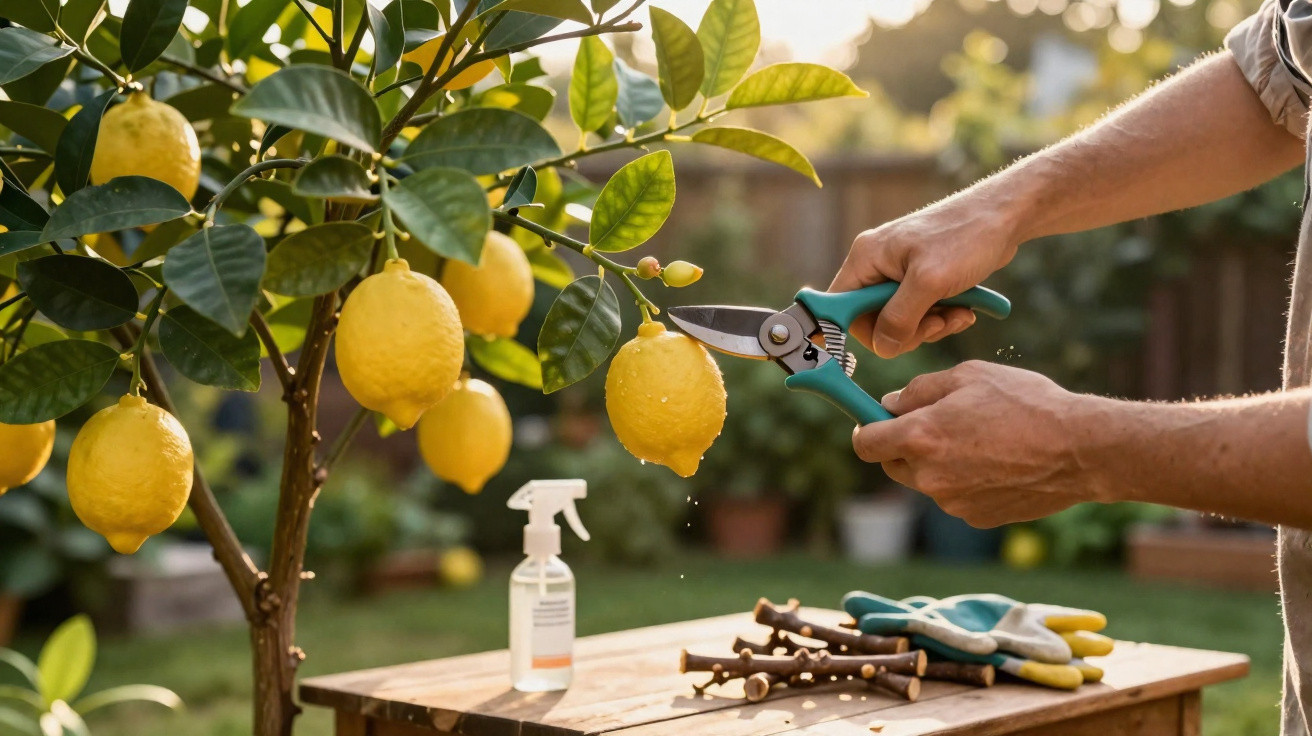
Late summer: the leaves are still glossy, yet there are only a few fruits on the branches.
Many gardeners wonder where they went wrong.
Caught between the fear of cutting too much and the desire to see a heavily laden tree quickly, pruning citrus trees can become something of a domestic taboo. Yet one straightforward action, taken at the right time, can completely transform the yield of orange trees, lemon trees, mandarin trees and even grapefruit trees in gardens and on balconies.
The key moment that transforms your citrus trees
Citrus trees do not go dormant in the same way as apple or pear trees. Their growth slows in colder weather, but they remain active. This is precisely why pruning has its greatest effect in late winter and early spring.
The principle is simple: the sap is about to surge, flower buds are beginning to develop, and the tree is preparing for another growing cycle. When pruning is done early, before this peak, the tree can redirect its energy towards the most promising branches. Done too late, pruning removes the very growth that would have produced the next flush of flowers.
“A single adjustment at the end of winter often makes the difference between a canopy full of empty branches and a tree laden with well-formed fruit.”
This is why gardeners who begin pruning within this time window often report the same surprise: just a few cuts, but a noticeable change by the very next harvest.
Why proper pruning increases the harvest
Fruit grows where few people look
Orange trees, lemon trees and related citrus varieties bear fruit mainly on the previous year's branches. If pruning is delayed, many branches carrying flower buds may be removed without the gardener realising it.
By acting before vigorous growth resumes, the tree has time to:
- heal pruning cuts with a lower risk of disease;
- redirect sap towards better-positioned branches;
- develop flowers where there is greater light and airflow.
The result is a healthier balance between foliage and fruit, rather than the intensely green canopy with disappointingly modest production that frustrates so many people.
Light, air and flavour: the trio many people overlook
An overly dense tree casts shade within its own canopy. This leaves the centre damp, encourages fungal problems and reduces fruit quality.
“An airy canopy, with light reaching through its centre, tends to produce fruit with better colour, firmer skin and more concentrated flavour.”
As more sunlight moves between the branches, the tree produces fewer fruits that remain “green forever” and lowers the risk of diseases that thrive in constantly damp foliage.
Pruning as protection against diseases and pests
Citrus trees face a varied range of problems: sooty mould, gummosis, borers, scale insects and aphids. In many cases, too many branches provide the ideal invitation for an infestation.
When the structure is cleaner and less tangled, three things happen:
- dry or diseased branches are removed before they become sources of infection;
- pest hotspots are easier to see and control with simple treatments, such as mild soap or mineral oil;
- the tree itself responds better because it is not “spending” energy on doomed growth.
For thicker cuts, many agronomists also advise using wound sealant or a protective treatment, especially in humid areas. This helps prevent fungi and bacteria from entering through open wounds.
How to prune citrus trees with one effective action
Before making any cut, begin by observing the tree. Walk around it, look up beneath the canopy and try to identify a balanced structure; this helps to prevent over-pruning.
The three questions to ask before using loppers
For each branch, ask yourself:
- Is this branch dry, diseased or broken?
- Does it cross or rub against another branch, creating wounds?
- Does it close off the centre of the canopy, blocking light and air?
If the answer to any of these questions is “yes”, that branch is a good candidate for removal. The aim is to create channels of light through the middle of the canopy without leaving the tree looking like a bare “broom handle”.
How much to cut without damaging production
Experts generally agree on one figure: removing roughly one third of the branch volume can already make a substantial difference. Cutting more than this increases the risk of stress.
“Pruning lightly and intelligently, year after year, delivers more than radical pruning carried out from time to time.”
Cuts should be clean, angled and made just above a bud facing outwards from the canopy. This guides new shoots towards brighter areas and prevents a tangle from developing in the centre.
Tools, hygiene and small details that prevent problems
One common mistake is using any old pair of garden shears. Blunt blades tear branches and leave larger wounds, which take longer to heal.
| Tool | Main use |
|---|---|
| Loppers or pruning shears | Thin and medium branches; precise cuts |
| Pruning saw | Thick, fully woody branches |
| Heavy-duty gloves | Protection from thorns and injuries |
| Alcohol or disinfectant | Cleaning blades between one tree and another |
Disinfecting tools after working on a plant showing signs of disease prevents a localised issue from spreading throughout the garden.
Potted lemon tree, in-ground orange tree: does it make a difference?
Potted citrus trees, which are very common on balconies, respond even more quickly to pruning. Their restricted root space means that any imbalance between the canopy and the growing medium has a greater effect on plant health.
In these cases, the advice is to be even more restrained: keep the tree low, between 1.5 and 2 metres tall, and focus pruning on excessively upright branches or those growing into the centre of the canopy.
“In pots, pruning works almost like a ‘fine adjustment’ to balance roots, leaves and fruit in a limited space.”
In the ground, older trees can tolerate somewhat greater intervention, provided it is gradual, particularly if they have gone years without any structural pruning.
The risks of over-pruning and signs that pruning worked
When a gardener becomes too enthusiastic, a citrus tree generally responds in one of two ways: an explosive flush of thin, very vigorous shoots, or an overall weakening marked by yellow leaves and few flowers.
Some positive signs that pruning has been carried out well include:
- new shoots appearing close to the cuts, but not excessively;
- more flowers spread across the canopy rather than concentrated on one side;
- fruit forming on well-lit branches, with less premature drop.
If the plant responds with too much vertical growth, it can be worth carrying out a small “corrective prune” a few months later, removing only the most disorderly shoots.
How to fit pruning into your garden routine
For anyone already tending a vegetable patch, watering plants or applying seasonal fertiliser, adding citrus trees to the schedule is straightforward. A practical approach is to combine three points in the year:
- late winter: the main prune, removing dead branches and opening up the canopy;
- mid-spring: light correction, cutting poorly positioned shoots;
- after the main harvest: remove only dry or broken branches.
This pattern allows the tree to recover between adjustments without sudden shocks.
From a technical perspective, pruning works directly alongside other care: balanced fertilising, watering without waterlogging and preventative pest control. A well-nourished tree responds better to cuts, produces more viable flowers and copes better with hot summers or light frosts.
Anyone growing more than one type of citrus tree in the garden can watch how each species responds to the same kind of pruning. Lemon trees are usually more vigorous, while mandarin trees tend to be a little more sensitive. Adjusting the intensity of pruning in each case turns this “single action” into a gardening habit that yields fruit for many years.





Comments
No comments yet. Be the first to comment!
Leave a Comment