
The first time it strikes you, you are in your compact garden with a coffee, asking yourself why it feels so… flat. The plants are in place, the flowers are undeniably attractive and the grass is reasonably green. Yet the whole scene resembles a postcard trapped beneath glass: no depth, no sense of surprise, and nothing that encourages your eyes to travel or makes you want to wander around.
Then you call on a friend whose garden is scarcely any larger than your own, and it feels as though you have arrived somewhere entirely different. The path bends, a small tree reaches into the view, and the rear fence somehow appears much farther away. You are still in town and can just make out the sound of traffic, but the space feels like a secluded piece of countryside.
The area is identical. The atmosphere is utterly different.
That is the moment you realise that a beautiful garden is not simply thrown together. It is carefully calculated.
Why some gardens feel bigger than they are
Pause at the entrance to any genuinely appealing garden and you may notice a curious thing: your eye does not stop at the fence. Instead, it keeps moving. It follows a curved brick line, pauses on a tall grass, leaps towards a tree at the far end, then turns towards a bench partly concealed in a corner.
That route taken by your gaze is deliberate rather than accidental. Gardeners working with restricted urban plots are, in effect, set designers. They use layers and overlaps, deciding what you notice immediately and what only emerges while you are enjoying a second cup of tea.
The garden’s physical dimensions stay the same, but its apparent size changes.
Picture a typical ‘before’ garden: a small rectangular lawn, a thin border running along the fence, perhaps a few potted geraniums and a barbecue looking forlorn in one corner. From the back door, the entire space is visible at once. There is nothing left to uncover, so your mind loses interest almost straight away.
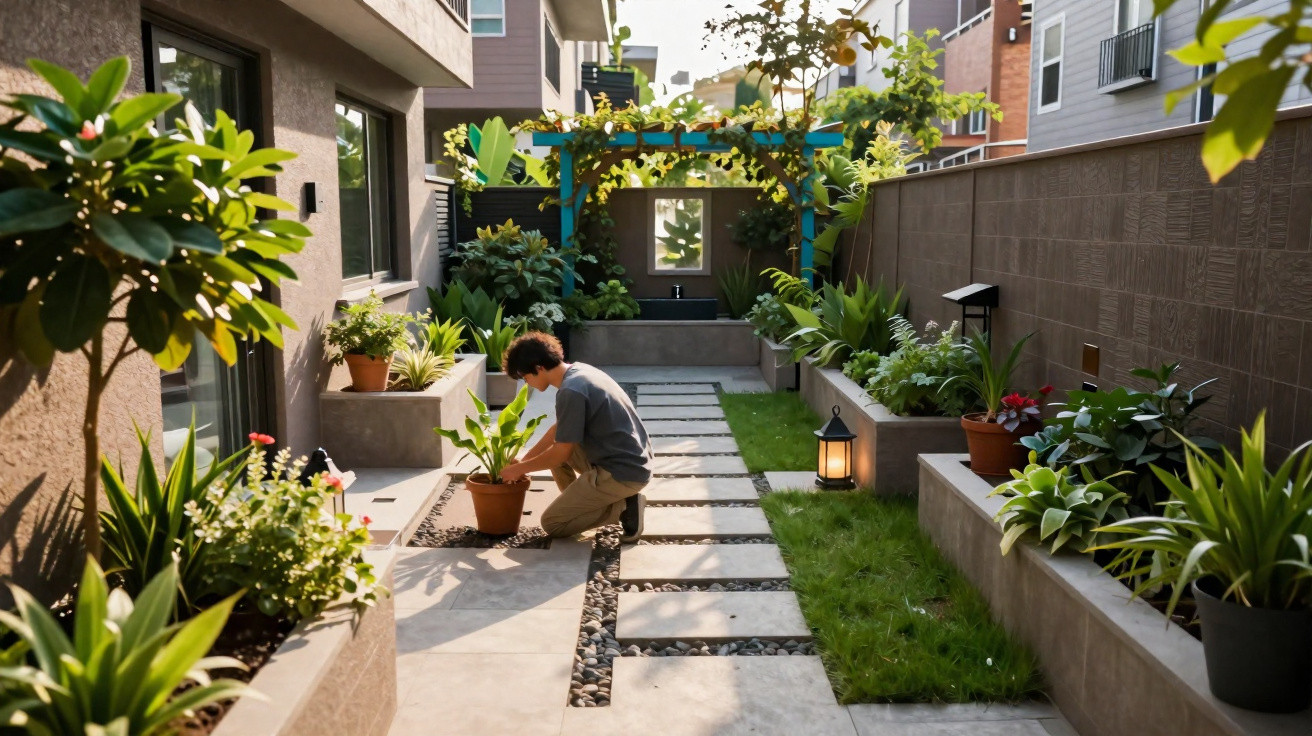
Now imagine that same 40 m² garden arranged into three understated areas: a compact paved terrace beside the house, a small tree with taller planting in the centre, and a slim bench at the very back, partly screened by a trellis covered in climbing jasmine. Your gaze must now move through the garden.
Not one extra square metre has been added. Still, your brain subtly reclassifies it from a ‘patch’ into a ‘garden’.
This is close to an optical trick. Before we identify a ‘rose bush’ or a ‘hosta’, our eyes register vertical and diagonal lines, light and shade, and enclosed and open areas. If everything sits at the same height and the same distance away, the brain compresses the image, much like a flash photograph against a white wall.
Introduce low, medium and high layers, however, and obscure certain views while opening up others, and the setting acquires depth. Perspective begins to work: nearby objects appear bigger, distant ones look smaller, and our minds quietly assume that ‘there’s more there than I can see’.
That is the understated calculation that makes a garden feel abundant, regardless of what the boundary line says.
Designing a small garden in three dimensions
Begin with a straightforward adjustment: rather than planning your garden as a flat sketch, approach it as an architect would. On a sheet of paper, replace the single lawn with three layers stretching from house to fence: near, middle and far. Next, consider what should fill every level: low planting in the foreground, medium-sized shrubs or grasses in the centre, and a vertical feature at the rear.
In a compact garden, height is your greatest asset. One small multi-stemmed tree, such as an amelanchier or Japanese maple, immediately makes the backdrop seem more distant. A pergola or an arch takes the eye upwards and onwards.
You are creating a green passageway, even if it is only six metres long.
Many of us place every element against the edges because we worry about making the garden feel enclosed. The seating goes against a wall, beds are pressed up to the fence, and the middle remains bare. The paradox is stark: an empty centre can make a small garden appear even smaller, rather like an unoccupied parking bay.
Experiment with the reverse approach. Position a small bistro table a little away from the centre. Set a loose group of perennials or airy grasses in a gently shaped island bed, clear of the fence. Lay stepping stones at a modest diagonal instead of in a direct line from the door to the shed. This small change makes the eye move in a zigzag, lengthening its visual route.
Most of us have experienced that instant of entering somebody’s garden and wondering, “Wait, how is this place still going?” It is not chance. It is choreography.
A simple principle of visual psychology sits behind it. Our minds respond to clues of depth: overlapping forms, decreasing scale and partly blocked views. If one plant conceals part of another, or a path vanishes behind a clump of shrubs, the mind assumes that there is ‘more’ beyond it. That ‘more’ need not be extensive; it simply has to be there.
This explains why a narrow side passage can feel intriguingly roomy when it includes a curve or turn, whereas a broader rectangle that is completely visible can seem harshly short. The key is not revealing every part of the garden from the doorway. Keep one thing hidden from the first glance.
You are doing more than gardening: you are controlling the speed at which the space unfolds.
Depth, perspective and the illusion of space: practical tricks
A useful first step is to select one principal view - the ‘money shot’ - normally seen from the back door or sitting-room window. Stand there and take a photograph on your phone. Draw three horizontal strips across the image with a pen: foreground, middle ground and background. Then decide what will define each one.
For the foreground, use containers, ground cover or low-growing herbs. In the middle ground, add a path, a group of mid-height perennials or perhaps a small raised bed. The background needs a vertical focal point, such as a trellis, small tree, tall grass or painted fence. Treat each strip as an opportunity for a distinct height and texture.
Even this basic exercise shifts a garden from ‘carpet mode’ into three dimensions.
A frequent error is arranging all planting in a tidy procession around the perimeter. It seems sensible, almost courteous: you do not want to take over the limited area available. But the outcome is a green border enclosing a lifeless middle, like a picture with no subject at its centre.
Create overlap instead. Allow a shrub to reach slightly forward from the rear border, or let a taller plant extend into the middle section. Repeat an element - the same grass variety or the same pot in three sizes - to draw the gaze farther in.
And, certainly, there will be times when you get it ‘wrong’: a plant may become too large, a pot may sit too near, or a path may feel uncomfortable. That is simply part of the process. Honestly, nobody carries out this work every single day; we make adjustments when something begins to bother us.
“Small gardens scare people because every mistake is visible,” a landscape designer in Lyon told me. “But that’s exactly why they’re exciting. One clever line, one well-placed tree, and you’ve changed the whole movie in someone’s head.”
- Use light and dark: Put paler foliage and blooms nearer the house, with darker, denser greens towards the rear. Light colours appear to advance while dark colours recede, making the border look longer.
- Play with diagonals: Set out a path or stepping stones on a mild diagonal instead of sending them directly forwards. A diagonal is automatically perceived as longer than a straight line of equal length.
- Break the back fence: Reduce the impact of this firm boundary with a trellis, climbing plant or staggered planting scheme. Once the edge is less defined, the brain no longer interprets it as ‘the end’.
- Scale your furniture: Large corner sofas overwhelm a tiny terrace. Select lighter, visually open pieces that let both the eye - and your legs - pass through the space.
- Create one ‘borrowed view’: Use an arch or a hedge to frame a far-off tree, roofline or skyline. Even a small glimpse beyond your boundary extends the mental horizon.
A garden that thinks bigger than its square metres
Once you view an outdoor area in this way, your thinking changes. Rather than fixating on its dimensions, you begin paying attention to its lines, pauses and shadows. An awkward corner becomes an opportunity for a tucked-away chair. A dull fence becomes a backdrop that can be painted a darker shade, allowing plants to stand out while the boundary fades.
The illusion of space does not depend on buying unusual plants or funding an expensive overhaul. It comes from a succession of modest, almost unnoticeable choices made over several seasons. Relocate the bench. Add one taller shrub. Replace a straight line with a curve. Remove what interrupts a view, then introduce something that directs it.
Gradually, a cramped little garden stops seeming apologetic and starts acting like a place through which you want to stroll slowly. Its measurements will remain unchanged. But on a warm evening, as the light moves along the path and your eyes settle on that partly hidden corner, the numbers will not seem especially important.
| Key point | Detail | Value for the reader |
|---|---|---|
| Think in layers | Split the view into foreground, middle ground and background, using varying heights and textures | Produces immediate depth and a feeling of progression in a compact garden |
| Guide the eye | Use paths, diagonals, repeated planting and partial concealment to control what is seen first | Makes the garden seem larger and more intriguing without adding square metres |
| Soften boundaries | Disguise the rear fence line with climbers, dark paint and vertical features | Blurs the point at which the garden ends, increasing its perceived space |
FAQ:
- Question 1: How do I create depth if my garden is just a narrow strip? Use the long shape to your benefit. Take a stepping-stone path along a gentle diagonal, divide the area into two or three ‘rooms’ with a trellis or arch, and change the heights as you go: low ground cover, then medium perennials, followed by a small tree or tall grass at the far end.
- Question 2: Will adding more plants make my small garden feel overcrowded? It may if all the plants are the same height or tightly packed at the front. Prioritise vertical layers and airy choices, including grasses or open-structured shrubs. They provide volume without weight, concealing and revealing views rather than creating a solid barrier.
- Question 3: Can colour really alter the feeling of space? Yes. Cool shades - blues, purples and silvery foliage - visually recede, so placing them at the back can lengthen a border. Warm, bright colours seem nearer, so position them closer to the house for a roomier perspective.
- Question 4: What is the fastest way to create more perspective? Paint the back fence in a darker colour, then position one taller feature before it: a slender tree, trellis or obelisk supporting a climber. The contrast between the dark background and vertical feature immediately makes the boundary appear farther away.
- Question 5: Do I need a professional design to achieve this? Not necessarily. Begin with photographs of the main view, sketch basic near/middle/far bands, and try a single alteration at a time. Live with every change for a few weeks. Space is experienced, not merely drawn, and your own feeling of ease is the most reliable guide.

Comments
No comments yet. Be the first to comment!
Leave a Comment