
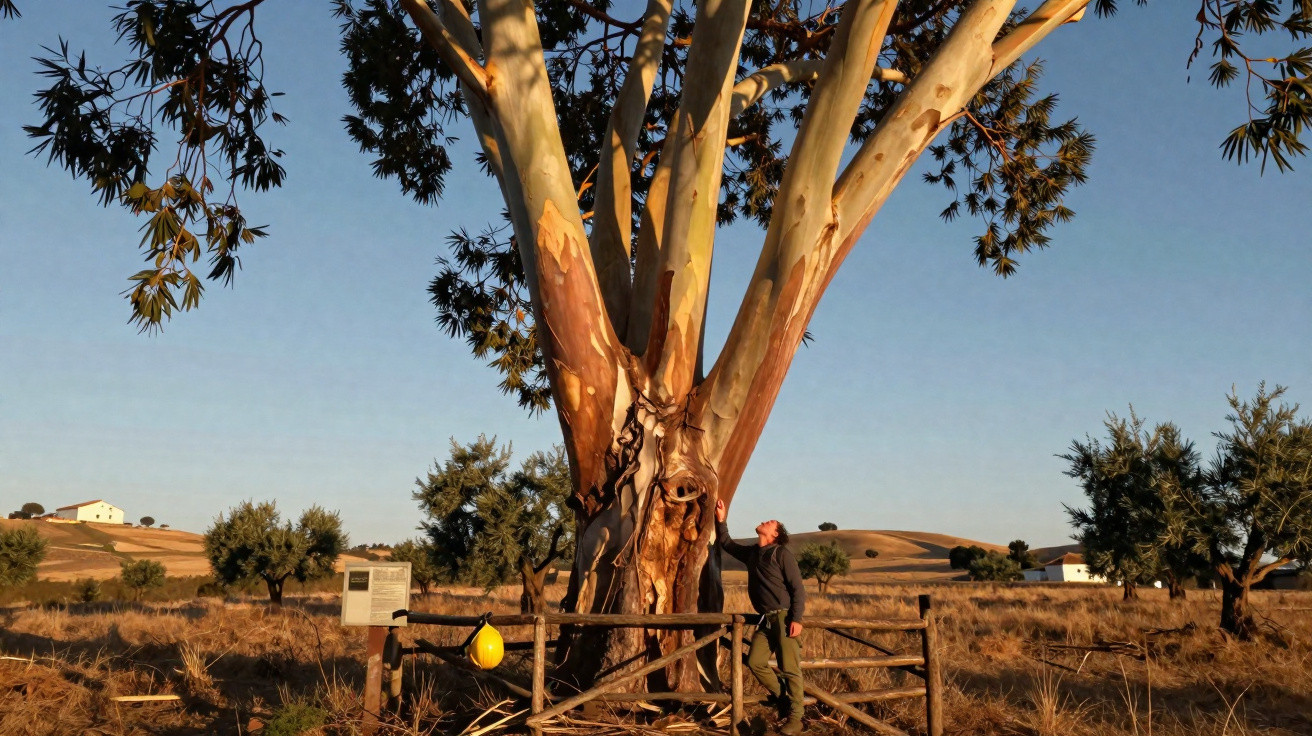
Hidden in the countryside north of Seville, one eucalyptus has grown to such a height that it is now among Spain’s tallest trees. It has transformed an otherwise unassuming agricultural estate into an unexpected destination for tree enthusiasts and inquisitive travellers.
The Sevillian giant rising 60 metres above the countryside
Known as the Eucalyptus of Huerta de Malagón, after the rural estate on which it grows, the tree stands in the municipality of Villanueva del Río y Minas. It is not native to Spain: the specimen is a red river gum, Eucalyptus camaldulensis, a species originating in Australia.
The official inventory of Singular Trees and Woodlands of Seville records the eucalyptus at a total height of 60 metres. This puts it among the highest trees documented in Spain, alongside the renowned coastal eucalyptus stands of Galicia and Asturias.
This rural eucalyptus in Seville stands 60 metres tall, with more than 10 metres of bare trunk before its crown even begins.
Its clear trunk section, called the bole or fuste, reaches about 10.5 metres before the first principal branches emerge. The trunk has a circumference of 5.45 metres at chest height, increasing to 6.51 metres at the base. Spreading approximately 15 metres from north to south, its crown forms a dense, elevated canopy that commands the farmland around it.
Viewed from afar, the tree draws a striking vertical line across the Andalusian skyline. It demonstrates how introduced species can attain exceptional proportions far beyond their native range once they become established.
What makes the Huerta de Malagón eucalyptus exceptional
Evergreen and rapid-growing, eucalyptus trees were introduced to the Iberian Peninsula chiefly for timber and paper manufacture. They are now common in numerous coastal and inland landscapes, although their effects on native ecosystems remain a subject of debate.
Seville’s environment department awards “singular” status using several measures, rather than relying solely on age or height. Ecological, historical and landscape value are also assessed, and the Huerta de Malagón eucalyptus fulfils all three criteria.
- Height: 60 m, among the tallest measured in Spain.
- Trunk height (bole): 10.5 m before branching.
- Trunk perimeter at 1.3 m: 5.45 m.
- Trunk perimeter at base: 6.51 m.
- Approximate crown diameter north-south: 15 m.
By Andalusian standards, its sheer vertical scale is outstanding. The region has other substantial eucalyptus trees, including the celebrated specimen on Paseo Catalina de Ribera in Seville’s Murillo Gardens, yet no other recorded urban or countryside example in the province matches the 60-metre height measured at Huerta de Malagón.
Among the Andalusian “tree celebrities”, this isolated farm eucalyptus stands out for height in a landscape usually dominated by olive trees and holm oaks.
A landscape defined by one tree
Villanueva del Río y Minas is associated more closely with its mining heritage than with forestry. Its surroundings combine scrub, Mediterranean woodland and traditional agricultural land. Against this setting, the towering eucalyptus acts as a natural landmark.
From nearby paths, it provides a point of orientation for walkers, hunters and farm workers, much like a church tower. Its thick crown gives shade during summer and offers birds a lofty lookout, particularly raptors and crows that settle on its upper limbs.
Its entry in the regional inventory gives the tree formal recognition as part of Andalusia’s natural heritage. The designation does not make it an enclosed monument, but it does require local authorities to observe its condition and consider it when making planning and land-use decisions.
Other notable trees in Seville province
The Huerta de Malagón giant is one of many exceptional trees included in the register. Seville’s inventory contains dozens of singular specimens across its municipalities, including native trees and species introduced to estates and gardens centuries ago.
| Tree | Location | Notable feature |
|---|---|---|
| Eucalyptus of Hacienda Torrijos | Valencina de la Concepción | Approx. 47 m in height, standing on a historic estate |
| Eucalyptus of La Pizana | Gerena | Around 40 m, used as shelter and roosting place for birds |
| Ancient wild olives (acebuches) | Various sites | Veteran specimens tied to traditional grazing landscapes |
| Notable cork oaks | Various sites | Valued for age, size and role in dehesa ecosystems |
Collectively, these trees offer a picture of the province’s botanical variety. Some are indigenous species that have endured centuries of change, while others are foreign species that adapted so successfully that they have become embedded in local identity.
Eucalyptus forests: between admiration and concern
In Spain, eucalyptus trees prompt both admiration and unease. Their fast growth makes them valuable for pulp and timber, yet extensive dense plantations have been associated with reduced biodiversity and greater fire risk in certain areas.
The Huerta de Malagón eucalyptus is an individual tree, not part of a broad monoculture, and this alters its impact. A single immense eucalyptus amid mixed farmland and scrubland does not place the same demands on soil and water as an industrial plantation spread across whole hillsides.
The Sevillian giant shows what eucalyptus can become in the right conditions, but also invites questions about how and where the species should be used.
Managing a tree of this scale involves particular considerations. Dead limbs falling from 60 metres can pose a risk, while strong winds may break branches, especially following years of drought. Forestry professionals therefore generally keep a close watch on such specimens. Pruning, health inspections and, in extreme situations, structural supports may be considered to ensure the tree remains safe and upright.
What “singular tree” status really involves
In Spain, the phrase “árbol singular” describes individual trees or small clusters distinguished by extraordinary age, size, rarity or cultural importance. Although each autonomous region sets its own standards, the underlying approach is similar: catalogue first, then protect.
For the Huerta de Malagón eucalyptus, this involves recording its measurements, precise location and state of health. Any work liable to affect it should account for its presence. Visitors can still see, photograph and enjoy the tree, but it is less likely to be removed for road expansion or new infrastructure.
For travellers, the designation can function as a subtle guide to exploring the area. Increasingly, nature lovers arrange routes around catalogued specimens, making little-known estates, country roads and small villages appealing weekend stops. Seeing the eucalyptus can be paired with local walking trails, exploration of Villanueva del Río y Minas’s mining heritage, or birdwatching in the nearby Guadalquivir basin.
How climate change may affect giant trees
Whether native or introduced, large trees are especially susceptible to prolonged drought and severe storms. Their expansive crowns require considerable water, while their great height leaves them exposed to wind damage and lightning.
Climate models for Andalusia indicate hotter, drier summers and less regular rainfall. This combination may put tall trees such as the Huerta de Malagón eucalyptus under strain. Stressed specimens are more susceptible to pests, fungal disease and structural defects.
Forestry technicians are increasingly considering situations in which protective action may be necessary. Measures include mulching the soil to retain moisture around the roots, carefully cutting away weakened limbs and, in some instances, restricting foot traffic around the base to prevent soil compaction. These steps are not dramatic, but over several decades they may determine whether a tree declines gradually or survives for the long term.
Ways to see and understand trees like this eucalyptus
For travellers drawn to this Sevillian giant, it can be the starting point for a wider exploration of how people plant, shape and use trees. A day’s route might include several singular specimens in the province, moving from introduced eucalyptus trees to ancient wild olives and cork oaks that support traditional grazing systems.
For families, trips of this kind provide a straightforward way to discuss concepts that can otherwise seem remote or technical. “Canopy” becomes the shaded place for lunch. “Trunk perimeter” becomes the number of children, holding hands, needed to encircle the tree. “Non-native species” becomes a conversation about what is planted, the reasons for planting it and the consequences decades afterwards.
In this way, the 60-metre eucalyptus of Huerta de Malagón is not merely an unusual entry in an inventory. It is a living study in adaptation, scale and the enduring effects of historical planting choices, standing over the Sevillian countryside as a permanent, silent point of reference.






Comments
No comments yet. Be the first to comment!
Leave a Comment