
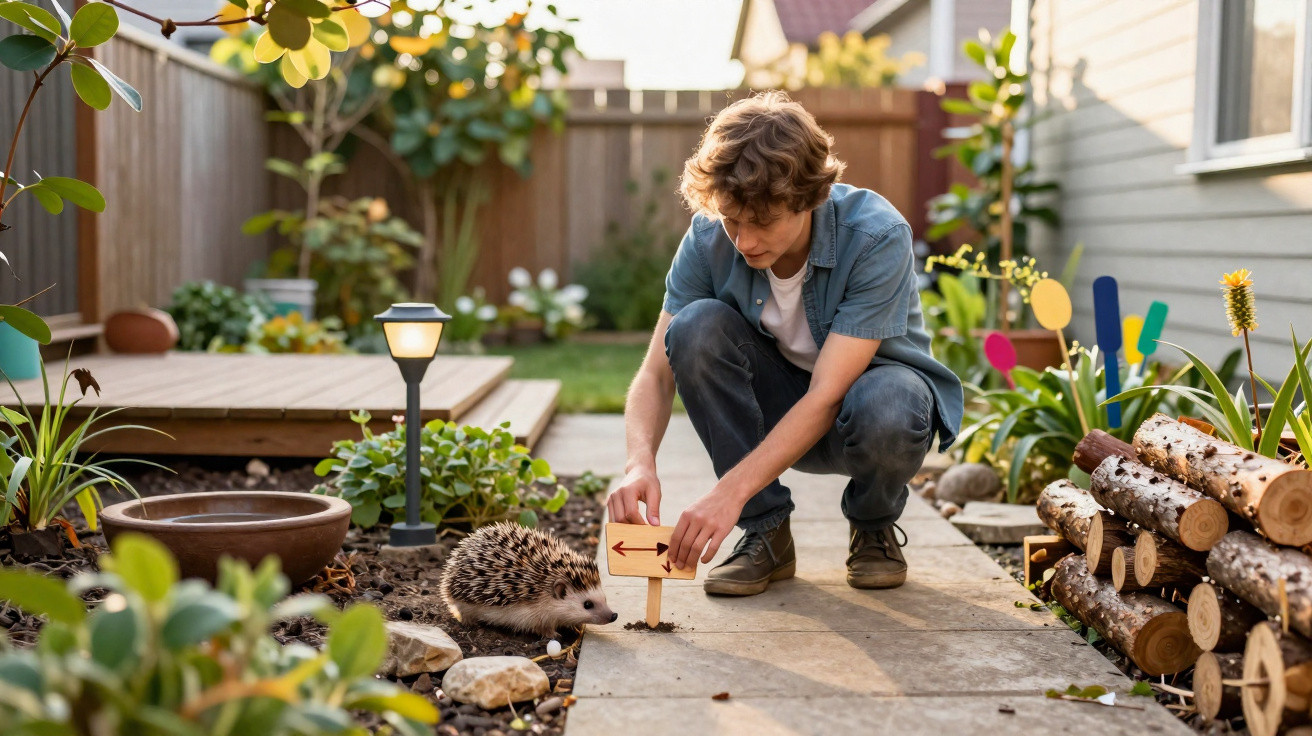
One still evening, my head torch caught a hedgehog motionless in its beam, only centimetres from the black opening of the garden pond. Every rustle seemed amplified in the windless air, and I had stepped outside merely to pick herbs for supper. Yet there was this small, shivering bundle of spines, halted at the water’s rim and puzzled by the harsh dark edge of the rubber liner.
I had never enclosed the pond with a fence. There was no netting, wire or anything that resembled a boundary: only a reflective sheet of water and several stones.
That evening brought home a simple truth: garden animals do not only collide with the things we make. They can also come to harm through the things they cannot see.
Why wildlife gets hurt in “gentle” gardens
Watch a peaceful garden for an hour at dusk and the risks begin to reveal themselves. Birds swerve at the final moment beside a glass greenhouse. Bees fly into an immaculate conservatory pane. Frogs jump towards an ornamental pool, only to slide helplessly down its slippery side.
We usually associate injury with large, obvious dangers such as strimmers, vehicles and neighbours’ cats. Yet the unobtrusive risks are often the attractive details we value most: a minimalist pond, a polished fence or an immaculate patio whose step disappears into matching tiles.
To us, these features appear tranquil and harmless. For a hedgehog, toad or bat, however, they can form a confusing maze of unseen boundaries and traps.
Wildlife rescue centres report the same distressing, familiar sequence of garden accidents. Hedgehogs are discovered drowned in recessed plastic containers; stunned birds lie beneath spotless windows; newts become stranded in deep-sided water butts with no means of climbing out.
Tiggywinkles Wildlife Hospital, a British charity, has reported that garden ponds are among the most frequent human-made dangers to hedgehogs. The issue is not that ponds are inherently harmful, but that their smooth, steep sides are difficult for a small nocturnal animal to identify.
We seldom witness the accident itself. Instead, we notice what is missing afterwards: feathers scattered on the lawn, or a hedgehog that fails to curl into a ball when approached.
Most garden wildlife does not interpret danger as people do. Animals cannot read warning notices or comprehend a tidy vertical fall. They navigate through scent, sound, contrast and the slightest difference in texture beneath their feet.
When we create exceptionally clean outlines and invisible changes between surfaces, we remove many of their safety signals. A glass panel reflecting the sky can appear to a bird as more open sky. At night, a jet-black pond liner may look to a hedgehog like an extension of the surrounding dark soil.
Minor visual markers - a colour change, a row of stones or a clump of plants - work as punctuation within the garden. They do not obstruct an animal’s route; they simply suggest: “Careful, something different starts here.”
The power of tiny signals instead of hard barriers
Begin with water. To reduce wildlife injuries, give ponds and troughs a distinct, visible margin. This need not mean a high fence or a cage, only a textured visual marker: a circle of pale stones, a slim band of contrasting gravel, or fragments of broken terracotta partly buried so that they remain secure.
At ground height, this narrow strip acts like a strong underline. Small mammals notice the transition from yielding soil to a firmer material. Amphibians can see the lighter border and alter their route. Birds can recognise where land finishes before swooping down for a drink.
Nothing is being excluded; you are merely highlighting the point where the hazard begins.
Windows are another discreet source of harm. The familiar sequence is a sharp thud, a burst of wings, then a bewildered blackbird on the terrace. Many gardeners believe the answer must be complete nets or dense sticker coverage across the glass, but this is not usually necessary.
A wildlife group in Germany tested slim vertical window lines spaced at around 10 cm intervals. Collisions fell dramatically because birds could at last identify the surface as solid rather than as sky. The markings were barely noticeable indoors, while remaining sufficiently visible in a bird’s peripheral vision.
On a shed or greenhouse, several lengths of tape, childlike painted streaks, or even muddy handprints can achieve some of the same result. Imperfection saves lives.
When you consider cues rather than cages, you begin to view the garden differently. Steps that disappear into the decking can be made safer by a pale strip of timber along the front or a line of small pots. A fashionable, mirror-smooth fence panel can be visually interrupted with climbers, a hanging tool or even an old enamel sign.
Realistically, nobody walks around the garden daily to inspect every possible risk. Small, lasting markers perform that job silently, at every hour.
The principle is straightforward. Rather than stopping animals with tall barriers, you encourage them to slow down with clues. Give them enough information to turn, pause or take a second look. Small changes can have a substantial impact.
Simple visual tweaks you can add this weekend
One of the simplest changes is to focus on “edges”. Any location with a sudden fall, a deep trap or a hard surface should have a visible, textured boundary. Around a pond, this might be one line of light-coloured cobbles. Around a raised bed, it could be a strip of rougher, paler timber along the upper plank.
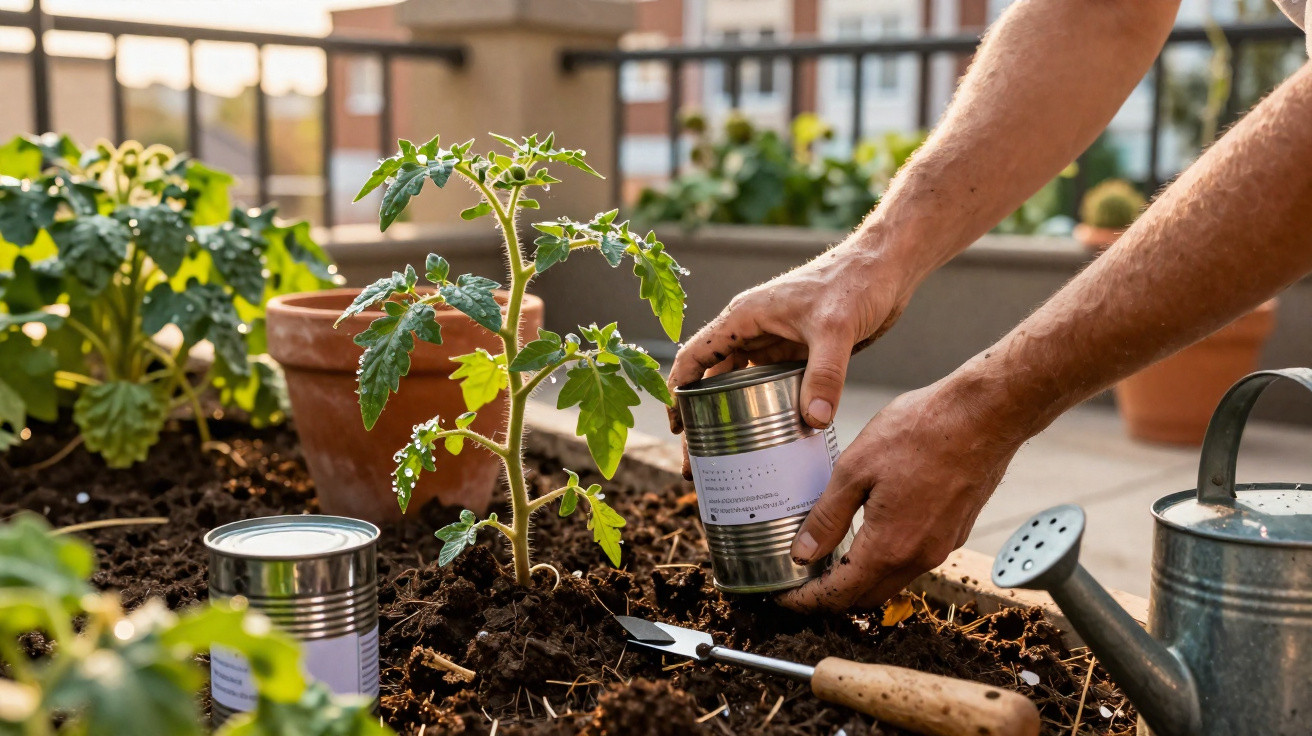
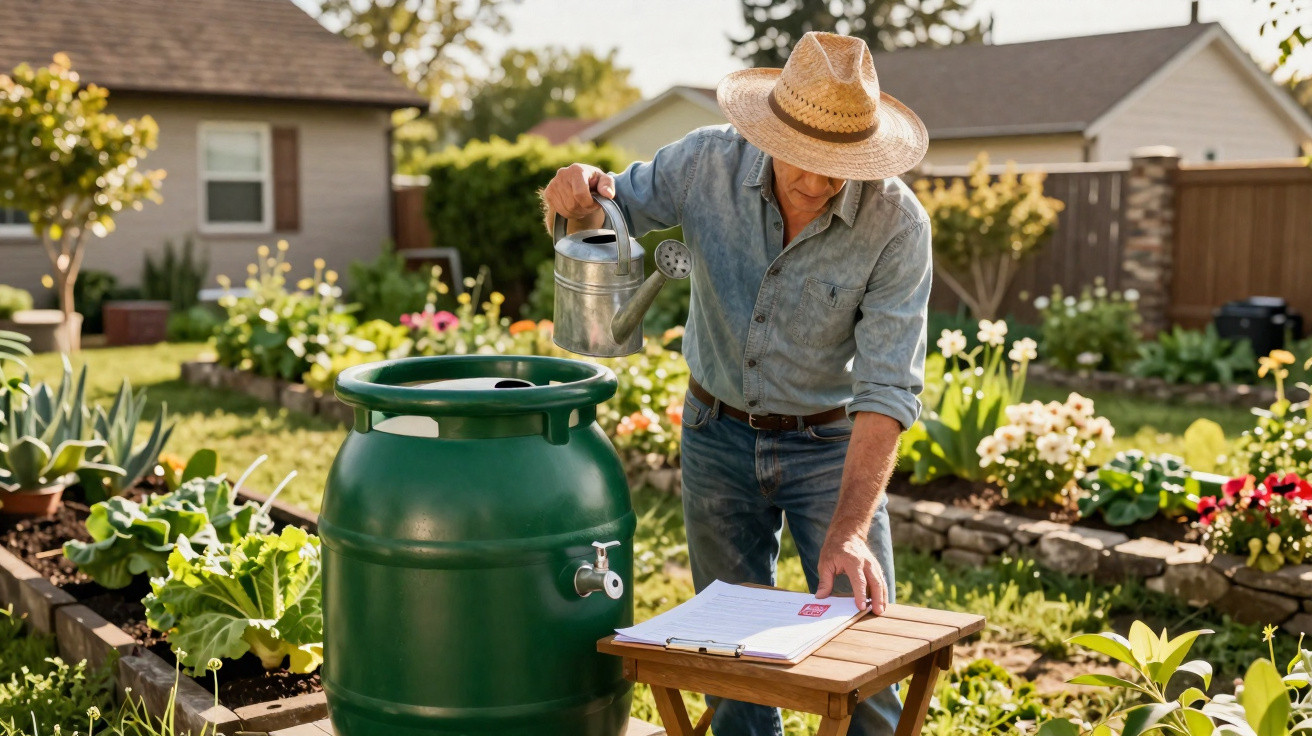
For water butts, place a branch or narrow plank from the rim to the ground, and cover part of it with a light, non-slip material such as an old towel. For a trapped frog or beetle, that pale, scratchy strip becomes both a ladder and a signpost.
Even drain covers and basement wells can become easier to identify when you paint a simple ring around them or scatter small, irregular stones nearby.
There is often an urge to choose an extreme solution: complete fencing, full netting, or doing nothing at all because you do not wish to “spoil” the appearance. Both approaches can feel oddly alike - rigid, all-or-nothing responses in a place intended to be alive.
Most of us know the feeling of buying a beautiful new planter or glass balustrade, then later realising that animals experience it very differently. That pang of guilt may lead people either to overprotect or to dismiss the problem and hope for the best.
Small cues offer a gentler middle ground. They preserve your preferred look while accommodating the untidy, unpredictable ways wildlife travels through a garden.
“Wildlife doesn’t need us to build fortresses,” says urban ecologist Rachel Sumner, who advises on animal-friendly gardens. “It needs us to leave doors open and add just enough clues so those doors don’t turn into hidden traps.”
- Apply paint or tape in a narrow contrasting line to glass at animal height, particularly on greenhouses and balcony panels.
- Combine textures at important transitions: gravel beside lawn, bark against concrete, and stones around water.
- Fit gentle slopes or ramps into and out of deep containers that could collect water.
- Disrupt broad, level reflective surfaces with plants, hanging items or irregular patterns.
- Inspect the garden after dark with a torch and identify where boundaries disappear. Make these areas your first priority.
A gentler way to share space with wild neighbours
A slight change in perspective turns the garden from a private display into a shared passageway. Each path may be a hedgehog route. Every area of exposed soil can be a beetle amphitheatre. Every glass pane can potentially create an illusion.
Small visual markers function almost like subtitles for the garden. They make our sharp edges and sleek surfaces legible to wild eyes and paws: a white stone in one place, a rough surface in another, or an untidy plant suspended where a bird might otherwise strike glass.
You do not need a wildlife qualification or a large budget. Curiosity, plus the patience to occasionally look from ground level, is enough. Lie on your stomach, crouch beside the pond and squint at a gleaming shed panel as a sparrow might.
The more you do this, the more you realise that safety doesn’t always look like a fence; sometimes it looks like a smudge, a shadow, a slightly crooked line of bricks.
These are not dramatic interventions. They are understated, near-invisible gestures of welcome worked into the features already present. A garden built around cues rather than cages often feels gentler, more lived-in and more personal.
When you next go outside at dusk, stop briefly. Hear the movement in the hedge, the faint splash in the pond and the beat of wings in the dark. Somewhere nearby, an animal is deciding which way to go.
Your smallest visual choices may be what allows it to survive the night.
| Key point | Detail | Value for the reader |
|---|---|---|
| Use visual edges around hazards | Add contrasting stones, paint or texture where drops or water begin | Reduces risk of falls and drownings for hedgehogs, frogs and small mammals |
| Break up glass and reflective surfaces | Apply thin lines, stickers or plants to interrupt sky reflections | Cuts down bird collisions without ruining views or light |
| Create escape routes from traps | Add pale, grippy ramps or sticks in deep containers and ponds | Gives trapped animals a clear route to safety with minimal effort |
FAQ:
- Question 1 Do I really need visual cues if I already have a wildlife-friendly garden?
- Question 2 Will adding stones or paint around my pond spoil the look?
- Question 3 Are commercial bird stickers on windows effective enough?
- Question 4 What’s the quickest weekend change that actually saves lives?
- Question 5 Can these cues help pets like cats and dogs as well as wildlife?

Comments
No comments yet. Be the first to comment!
Leave a Comment