
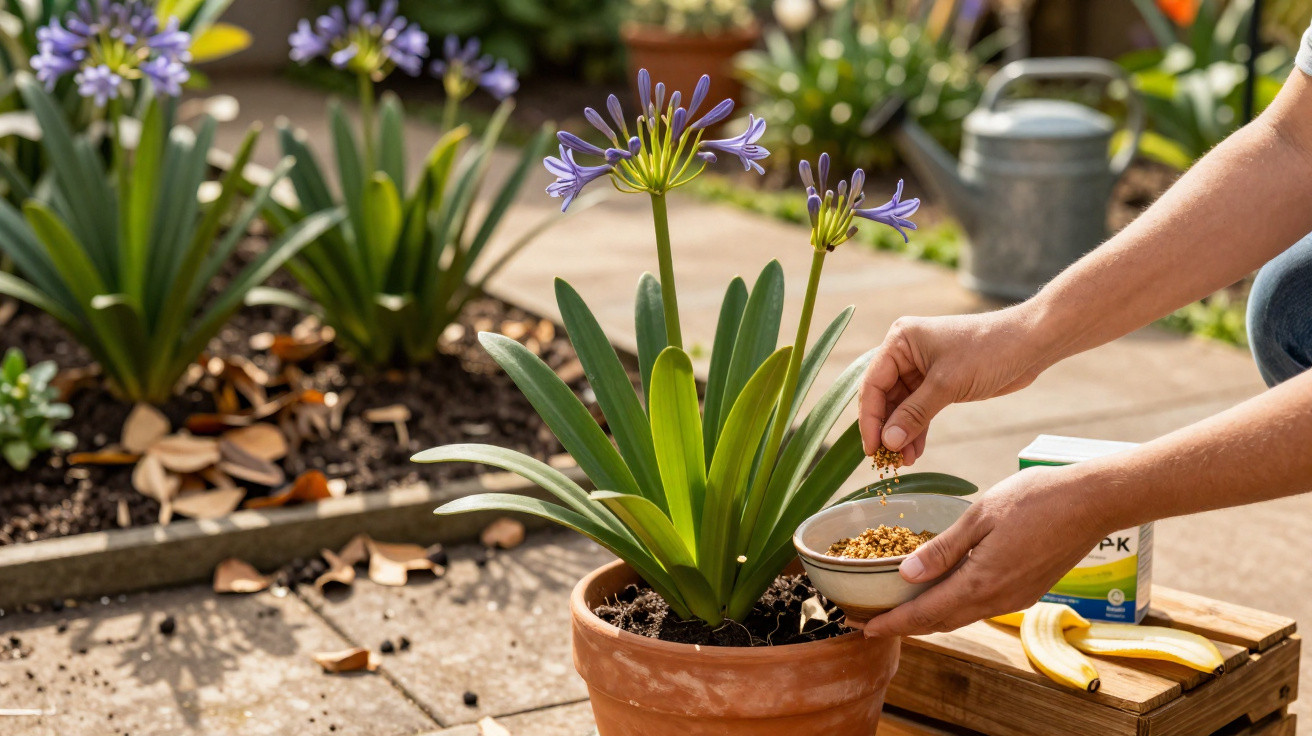
Many amateur gardeners are puzzled year after year when their so-called African lily looks healthy yet produces hardly any flowers. The cause is rarely the variety; almost always, it comes down to the timing of care. By providing the right nutrients and working the root zone properly before the end of March, you can greatly increase both the height and number of flower stems.
Why March determines flower-stem height
Agapanthus, often sold as African lily, begins a short but crucial burst of growth after its winter rest. During this period, the plant activates its buds, the roots become active again and, put simply, decide how much energy will go into foliage and how much into flowering stems.
Depending on the variety, the rounded flower heads later sit at heights of roughly 30 to 120 centimetres. Genetics account for much of this range, but they are not the only factor. The foundations for sturdy, tall stems are laid as the root area warms up and growth begins – usually in March.
“If you strengthen Agapanthus deliberately before the end of March, you direct its energy away from foliage and towards strong, tall flower stems.”
Professionals refer to this as the “post-dormancy phase”. During this brief window, the plant responds particularly well to care measures. A practical and straightforward routine combines gentle soil loosening with a clearly targeted nutrient mix.
The P–K approach: phosphorus and potassium rather than leaf feed
To encourage the African lily to produce flowers rather than endless foliage, it particularly needs two nutrients in spring: phosphorus (P) and potassium (K). It will also readily take up nitrogen (N), but this mainly promotes leaves rather than blooms.
Spring tidy-up around the roots
The process is easy to remember, whether the plant is in a border or a container:
- Remove all dried leaves and dead plant material.
- Cut last year's spent stems back to the base.
- Loosen the soil around the rootstock lightly, to a depth of 3–5 cm.
- Work nutrients carefully into the soil without damaging the roots.
Loosening the surface with a small cultivator or hand rake breaks up the compacted crust left after winter. Air and water can penetrate again, earthworms and microorganisms become active, and nutrients reach precisely the area where the young fibrous roots are starting up again.
The ideal nutrient mix for strong flower stems
After loosening comes the plant’s “feed”:
- 1–2 handfuls of mature compost or worm castings per plant.
- A thin layer of sieved wood ash as a natural potassium source.
- No fertiliser high in nitrogen, or only a very small amount.
Compost or worm castings provide a broad range of nutrients while also invigorating the soil. Wood ash – only from untreated wood – supplies mainly potassium, which supports stem strength and encourages more prolific flowering.
“A useful rule: phosphorus supports buds and roots, while potassium strengthens stems and tissues – ideal for huge rounded flower heads.”
Finally, many professionals cover the loosened surface with another thin layer of compost, then add an organic mulch layer around two centimetres thick, such as flax or hemp fibre. Watering slowly and deeply carries the nutrients straight into the active root zone.
A household trick using banana skins
If wood ash is unavailable, there is a simple household alternative: cut banana skins into pieces of around one centimetre and bury them very shallowly around the plant. As they gradually rot down, they also release potassium, albeit more slowly.
African lily in pots: limited space, major results
Agapanthus grown in containers tends to fill the entire compost volume with roots. After two to three years, the plant often sits in the pot as a solid mass. Without annual loosening and fresh nutrients, watering can simply run down the sides of the container without properly soaking the rootball.
The consequences are:
- The plant is underfed despite regular watering.
- Flower stems remain below 30 centimetres and bend over easily.
- Plenty of leaves develop, but very few flowering stems appear.
As long as the rootball has not become completely congested, the spring P–K routine using a hand fork, compost, potassium and mulch is normally entirely sufficient. Repotting is only needed once the roots completely fill the edge of the pot.
Repot correctly, then feed
When repotting, choose a container only slightly larger than the existing one. Giving Agapanthus too much room often causes it to focus first on producing roots and foliage again, delaying flowering.
The new pot should have:
- Large drainage holes in the base to prevent waterlogging.
- A drainage layer of expanded clay or coarse gravel.
- A structurally stable compost mix containing enough coarse material.
Once planted, follow the same procedure as for border-grown plants: lightly break up the surface, work in nutrients with an emphasis on phosphorus and potassium, mulch, then water thoroughly.
Agapanthus in borders: divide plants when clumps become overcrowded
For plants in the ground, care begins as soon as the soil noticeably warms in spring. It is then worth carrying out a quick check: if clumps are very dense or thick roots are already appearing at the surface, it is time to divide them.
Gardeners do this by lifting the entire clump, splitting it into several sections with a spade or sharp knife, and ensuring that each piece has strong roots and one or two growth buds. The divisions can then be replanted in the border, preferably with a little space between them so that they can establish again.
“Dividing in March works like a rejuvenating treatment: the plants repay it with renewed vigour and more flowering stems in the following years.”
Immediately after planting, a thin organic mulch layer helps the soil retain moisture for longer and reduces competition from weeds. The P–K fertiliser step is best carried out straight after the divisions have been replanted.
What if you miss the end-of-March deadline?
Many amateur gardeners look at the calendar in mid-April and realise that the March window has passed. In mild areas or during a particularly warm spring, the treatment can often still be carried out, provided the plant has only just visibly started to grow.
The plant’s stage of growth is more important than the date: as soon as fresh leaf tips are visible and the soil no longer feels icy cold, loosening and feeding with phosphorus and potassium are still worthwhile. The earlier this is done after growth begins, the better.
Plants in containers usually start developing slightly earlier than those in borders because the compost warms up more quickly. Anyone who checks their pots regularly will spot the first green shoots and can act in good time.
Care during the season: water, pruning and liquid fertiliser
Between June and September, the African lily displays its full splendour. To prevent the long stems from flagging in the middle of summer, the plant needs a dependable water supply – especially when grown in a pot.
Water deeply during dry spells instead of merely moistening the surface. For container plants, any excess water in saucers can be poured away after a few minutes to avoid waterlogging. In borders, the mulch applied in spring helps retain moisture for longer.
Removing faded stems is worthwhile for two reasons: the plant does not expend energy on producing seed, and the overall appearance remains tidy. Anyone wishing to collect seed can, of course, leave individual stems in place.
For container-grown plants, a liquid fertiliser for flowering plants can be used during the main growing period, dosed according to the manufacturer’s instructions. The key point remains the same: do not overdo the nitrogen. Fertilising too heavily for foliage risks a mass of green leaves without flowers.
Why some Agapanthus produce leaves only
If an African lily grows well year after year but produces few blooms, this quick checklist is useful:
- Was a nitrogen-rich fertiliser used heavily in spring?
- Did the plant receive a targeted P–K feed at the start of the year?
- Is it sitting very loosely in fresh compost in a pot, without the pressure of a firm rootball?
- Has the Agapanthus been kept permanently in deep shade?
Many poorly flowering plants suffer from a combination of too much nitrogen, poor timing and insufficient sunshine. The site should be bright and preferably sunny, with at least several hours of direct sun each day. For nutrients, focus specifically on phosphorus and potassium in late winter and early spring, while keeping nitrogen use lower.
Additional notes: frost, variety choice and companion planting
Agapanthus is considered only partially hardy. In very cold regions, it will survive severe frost in the ground only with thick winter protection, and often not at all in a pot. Many gardeners move container plants to a frost-free but cool garage or shed, then return them outdoors from March.
When planting new specimens, you can choose between deciduous and evergreen varieties. Deciduous types usually cope better with hard frost, although they emerge slightly later. Evergreen forms are more visually appealing, but they definitely need protection during cold winters.
In a herbaceous border, African lilies work particularly well with grasses, daylilies, lavender or low-growing roses. Their tall, clean stems and rounded flower heads bring calm to the planting scheme, while companion plants shade the soil and reduce evaporation. Taking the P–K approach seriously in March can make such combinations look considerably more dramatic – with flowers that quite literally stand above everything else.
Comments
No comments yet. Be the first to comment!
Leave a Comment