
The real key lies somewhere else.
Anyone hoping to see a robin in the garden in spring will usually think of seed mixes, fat balls and attractive nest boxes. Yet some gardens remain empty while the neighbouring plot is full of hopping and birdsong. The explanation is often found in an inconspicuous area at the very bottom of the garden: on the ground, beneath shrubs and hedges.
Why the robin does not visit the feeding station
The European robin (Erithacus rubecula) measures only around 12 to 14 centimetres and weighs barely 20 grams. Despite its small size, it can be remarkably confident in the garden. Many people know the sight: while digging over a border, a robin suddenly appears nearby, waiting for disturbed insects and worms before flying off again.
That is precisely the crucial point: in spring, this bird eats almost exclusively animal food. It primarily hunts:
- Woodlice and millipedes
- Worms and larvae
- Spiders
- Snails and slugs
- Small beetles and their larvae
- Ants and other small insects
A robin nearly always looks for this prey on the ground. Areas that are rich in food, lightly vegetated and slightly shaded are therefore far more appealing than even the most attractive hanging feeder. Protein is especially important during the breeding season: young birds are not fed seeds, but solely insects and other small creatures.
“Where the soil is alive, the robin stays – where everything is clinically clean, it flies on.”
Many young birds do not survive their first year. Only a small proportion live beyond three years, although individual birds can reach 15 years of age. A generously supplied “ground table” can therefore determine whether entire broods live or die.
The secret hotspot: an artificial “mini woodland floor” beneath shrubs
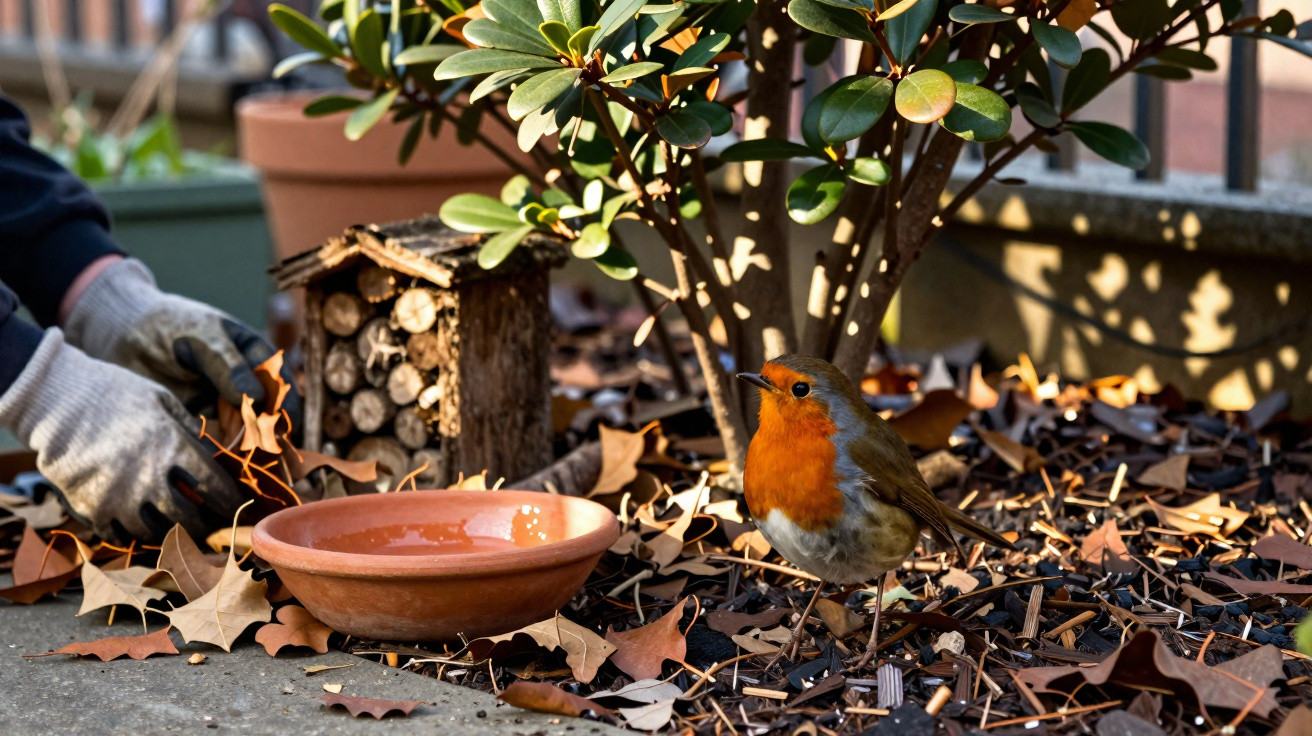
The key step starts where many gardeners unknowingly get everything wrong: at the base of shrubs and hedges. Rather than raking the ground completely bare, create a small “mini woodland floor” with leaves and dead wood.
The principle is simple: leave a 10 to 15 centimetre-deep layer of dead organic material beneath shrubs from late autumn until around mid-May. This forms a natural feeding area that gradually becomes home to a huge number of small creatures.
The ideal spot is:
- At the base of a dense hedge or larger shrub
- In partial shade, preferably somewhat shaded and sheltered from wind
- Close to a quick escape route into foliage or onto a branch
Here, the robin can forage openly on the ground and dart into dense cover in an instant when danger appears. If you have a cat or neighbourhood cats visit regularly, establish this area in a corner that is as cat-safe as possible, or make it less appealing to cats with obstacles.
How to create a robin area step by step
Collecting leaves and using them properly
Instead of disposing of all fallen leaves, it is worth deliberately “relocating” them:
- Rake or sweep leaves from the lawn and paths.
- Move the material beneath shrubs or into a quiet corner of the garden.
- Spread it into a loose layer around 10 to 15 centimetres deep.
Important: the layer must not be compacted too firmly. Air still needs to circulate through it so that fungi and soil organisms can do their work. The conditions loved by worms, woodlice and similar creatures only develop once the material begins to decay slightly.
Dead wood as a ground-level insect hotel
Alongside the leaves, add a few thicker twigs, small branches or short pieces of wood. They should already be slightly or partly decayed, although fresher pieces can be mixed in too. Cavities develop inside them, providing hiding places for insects and larvae – a buffet for the robin.
To speed up the process a little, partly bury unsprayed apple leftovers or vegetable peelings, excluding citrus fruit, in the leaves. The sugar stimulates microbial activity, making the spot exceptionally attractive to tiny organisms within a short time.
“A patch of ‘wild mulch bed’ beneath shrubs replaces every luxury feeding house for the robin.”
The most common mistakes – and how to avoid them
Many well-intentioned gardening jobs have the effect of an eviction notice on a robin. Three points are particularly critical:
- Spring cleaning with a leaf blower: Clearing away every remnant in March removes exactly the habitat the bird needs at this time.
- Hedges cut bare: Bright, exposed spaces without cover make the area unappealing or even dangerous.
- A completely “tidied” ground surface: Black, bare soil with no leaves or structure offers neither food nor shelter.
The trick is to intentionally leave one or more garden corners “untidy”. Do not rake, weed or use a leaf blower there. It may initially look unfamiliar to the eye, but to a robin this corner looks like ideal habitat.
What matters besides food: water, peace and safety
Living soil is almost enough on its own. Nevertheless, a few additions can make the garden even more appealing:
- Shallow water dish: A low dish on the ground, near a shrub or wall, provides drinking water and a place to bathe.
- Moderate winter feeding: Fat-based food and shelled sunflower seeds are helpful in winter. From spring onwards, the robin should mainly hunt for itself.
- Nest box in a quiet location: A box with a relatively large entrance hole, positioned 1.5 to 2 metres high, may be accepted from March.
It is crucial that cats cannot reach it easily. Thorny shrubs, dense branches or uneven ground can help make the area less appealing to predators.
Why “wild mulch” benefits both robin and garden
This wild carpet of leaves is more than a food source. It also prevents the soil from drying out, retains moisture and supplies nutrients over the long term. Fungi and bacteria slowly break down the material, while anything the robin does not eat ends up as humus around the shrubs’ roots.
Anyone who already mulches can make use of this effect. Rather than spreading bags of purchased bark mulch, your own autumn leaves are often enough. Over the years, this improves soil structure, benefiting perennials, woody plants and even some vegetable crops.
Practical advice for small gardens and balconies
A robin can also be welcomed on a small plot. In a terraced-house garden, a single corner beneath a shrub or beside a fence where leaves and twigs are left in place is often sufficient. Even a large planter containing leaves, dead wood and some soil life can serve as a stepping stone where green spaces already exist nearby.
Robins use several gardens within the same area. Speaking to neighbours and persuading them to create small “wild” strips as well greatly increases the chances of regular visits. A loose network of natural corners works like connected habitat, even in densely built-up areas.
In this way, the garden becomes more lively in more than just appearance. You can hear the quiet, bright song, see the characteristic hopping on the ground – and know that an unobtrusive carpet of leaves beneath the shrub has made a decisive contribution.

Comments
No comments yet. Be the first to comment!
Leave a Comment