
Many hobby gardeners miss their chance of lush sweet peas in April – one small action determines whether summer vases are full or empty.
Anyone hoping to carry armfuls of fragrant cut flowers from their own garden in summer needs to take action in April. For sweet peas, those classic climbing summer flowers, this month is when a crucial mistake is often made: the plants grow, but are not trained correctly – and the consequences only become clear weeks later.
Why April determines the future of your sweet peas
Sweet peas make a delicate start, then quickly put on length. At this point, they need guidance rather than sympathy. Let them simply ‘get on with it’ and you will end up with long, slender stems and few blooms – often much later than necessary.
“In April, you decide whether your sweet peas will become bushy plants covered in blooms or merely scramble sparsely in summer.”
Broadly speaking, April comes down to three things:
- pinching out young shoots correctly
- gradually acclimatising plants to wind, sunshine and changing temperatures
- planting out in good time, with sturdy supports for climbing
Take these three steps seriously and you have a strong chance of almost uninterrupted flowering into late summer.
Where are your plants now?
Before getting started, take an honest look at your starting point. In practice, there are usually three scenarios:
- You raised plants in pots during autumn or winter.
- You bought young plants from a garden centre.
- You have not sown anything yet and are wondering whether an April sowing is still worthwhile.
What matters most is shoot length. As soon as young plants reach roughly 12 to 20 centimetres tall, it is time for the vital next step. This range is your cue to begin.
Pinching out sweet peas: the often-forgotten step
This is where many people go wrong: the plants look healthy and are growing enthusiastically, so they are allowed to shoot ever upwards. That makes sense from the sweet pea’s perspective – but it is disastrous from the gardener’s.
What happens when you pinch them out
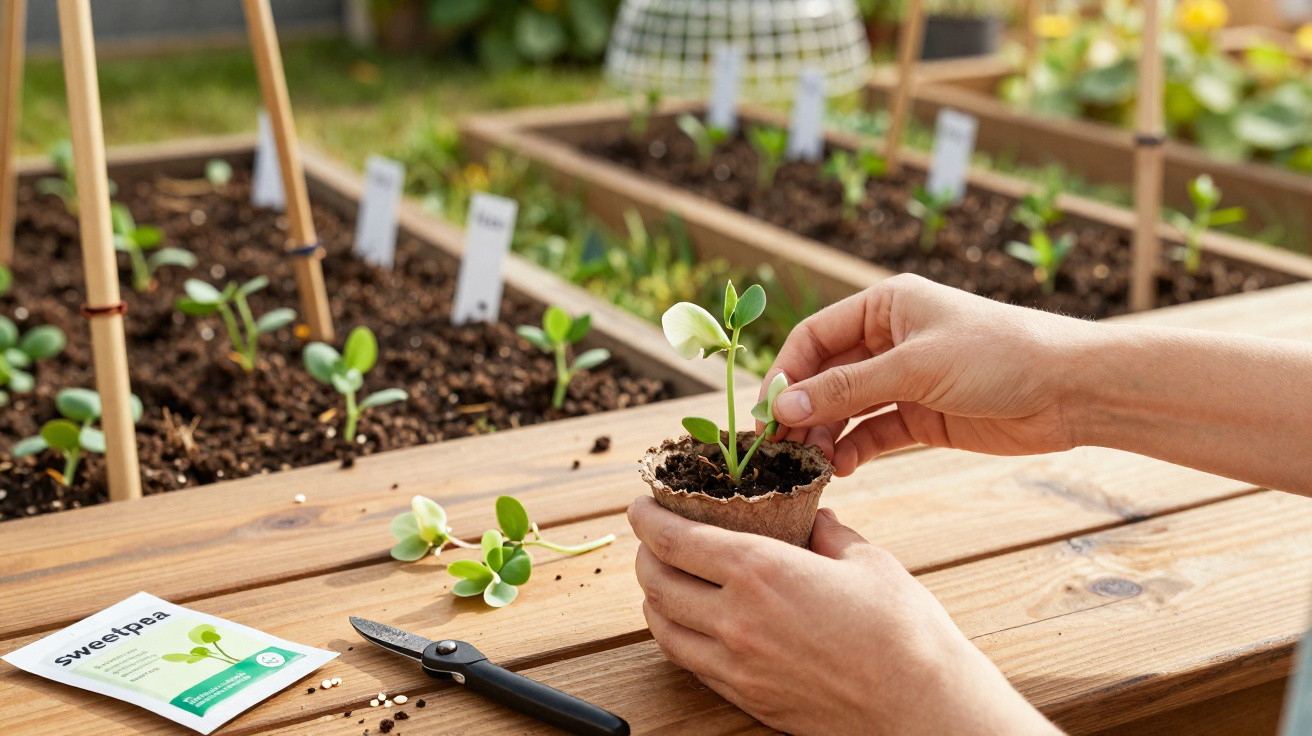
When shoots are 12 to 20 centimetres long and carry two or three pairs of true leaves, pinch off the growing tip. You can do this using thumb and forefinger or clean scissors.
“Removing the shoot tip forces the sweet pea to branch – one spindly stem becomes several flowering shoots.”
The result is:
- more stems from each plant
- considerably more buds and flowers
- a sturdier shape, with fewer floppy, elongated ‘fishing rods’
Important: remove only the tip; do not make a half-hearted cut somewhere along the middle. One clean cut just above a leaf node is enough.
What if you pinch out too late – or not at all?
If you skip pinching out, you will often later find:
- sparse blooms on long, thin stems
- a noticeably later flowering period
- plants that bend over more easily or are battered by wind
A plant that has developed a poor structure struggles to recover from it. This is why April timing matters more than any expensive fertiliser.
Hardening off young sweet peas: outdoors, but not straight into the deep end
Plants raised in a warm home or greenhouse can react badly outdoors: wind, sunshine and temperature changes all act like a small stress test for unprepared young plants.
How to acclimatise them to outdoor conditions without drama
The traditional approach is known as ‘hardening off’, and takes one to two weeks:
- At first, place them in a sheltered, bright spot for just one or two hours.
- Increase their time outdoors a little each day.
- Bring them back indoors or into a frost-free greenhouse on cold nights.
- Avoid intense midday sunshine during the first few days; morning or evening light is better.
A simple cold frame, an unheated greenhouse or even a covered balcony is ideal as a transition area. After around 7 to 14 days, healthy plants are ready for their permanent position.
Planting sweet peas out: spacing, depth and timing
Once nights are reasonably consistently mild and the soil has warmed up, sweet peas can go into a border or large pots. As a guide, aim for a soil temperature of around 15 to 16 degrees.
Planting correctly for the best sweet pea growth
- Planting depth: roughly the same depth as in the original pot.
- Spacing: leave around 15 to 20 centimetres between plants.
- Soil: loose and rich in humus, improved with well-rotted compost.
- Containers: choose deep pots where possible, at least 25 to 30 centimetres deep.
“Root space also influences the number of flowers – cramped, shallow pots slow sweet peas down considerably.”
Put climbing supports in place immediately – not ‘sometime later’
Sweet peas are classic climbers: without support, their shoots lie on the ground, become tangled and snap more easily. This is exactly why climbing supports should be installed in the border as you plant.
Supports that work well
Suitable options include:
- trellis against fences or house walls
- climbing obelisks as a focal point in the border
- several bamboo canes or hazel poles tied together at the top
Loosely tie in the shoots, ideally with soft string or specialist plant ties. Tough wire can quickly cut into and damage the stems.
Summer care: water, nutrients and checks
To ensure the plants fully deliver on April’s promise, they need steady care throughout the season.
| Task | Frequency | Note |
|---|---|---|
| Watering | regularly, keeping the soil lightly moist | never leave permanently wet; waterlogging encourages fungal diseases |
| Feeding in pots | every 2–3 weeks | use a liquid flowering-plant feed at a weak concentration |
| Tying in | as needed | gently guide new shoots onto the supports |
| Health check | weekly | watch for aphids and powdery mildew |
Aphids, powdery mildew and poor flowering: common problems and quick fixes
Pests and fungal diseases often appear during warm spells. Acting early prevents more serious damage.
- Aphids: Rinse them off with a strong jet of water, or spray with a mild soap solution.
- Powdery mildew: Remove affected leaves, avoid watering over the foliage and tie plants in more openly for better airflow.
- Few flowers: Check whether the plants were actually pinched out in April and whether they receive enough light and nutrients.
“Low flower numbers are often not caused by a ‘bad summer’, but by a missed spring cut.”
Cutting sweet peas for fragrant summer bouquets
How you cut stems for the vase also determines how long the plants will continue. The best time to cut is in the morning, when stems are well supplied with water.
- Cut only strong, long stems.
- Leave a few buds on the plant so that it continues producing.
- Do not cut too low: leave three to four nodes above ground level.
Regular picking encourages the plant to form new buds. If too many seed pods remain, sweet peas quickly switch into ‘ripening’ mode and flower less.
Why the April trick is useful for other climbing plants too
The principle behind the April cut – redirecting growth rather than allowing it only to head upwards – can be applied to many climbers. With other annual climbing plants, such as morning glories or black-eyed Susans, it is also worth assessing overly long, unbranched shoots while they are young.
Anyone who generally tends to protect young plants and ‘not touch them’ often deprives themselves of the finest display of flowers. Sweet peas in particular cope remarkably well with a decisive cut and repay it for months with fragrant armfuls of blooms – provided that essential April step is not forgotten again.

Comments
No comments yet. Be the first to comment!
Leave a Comment