
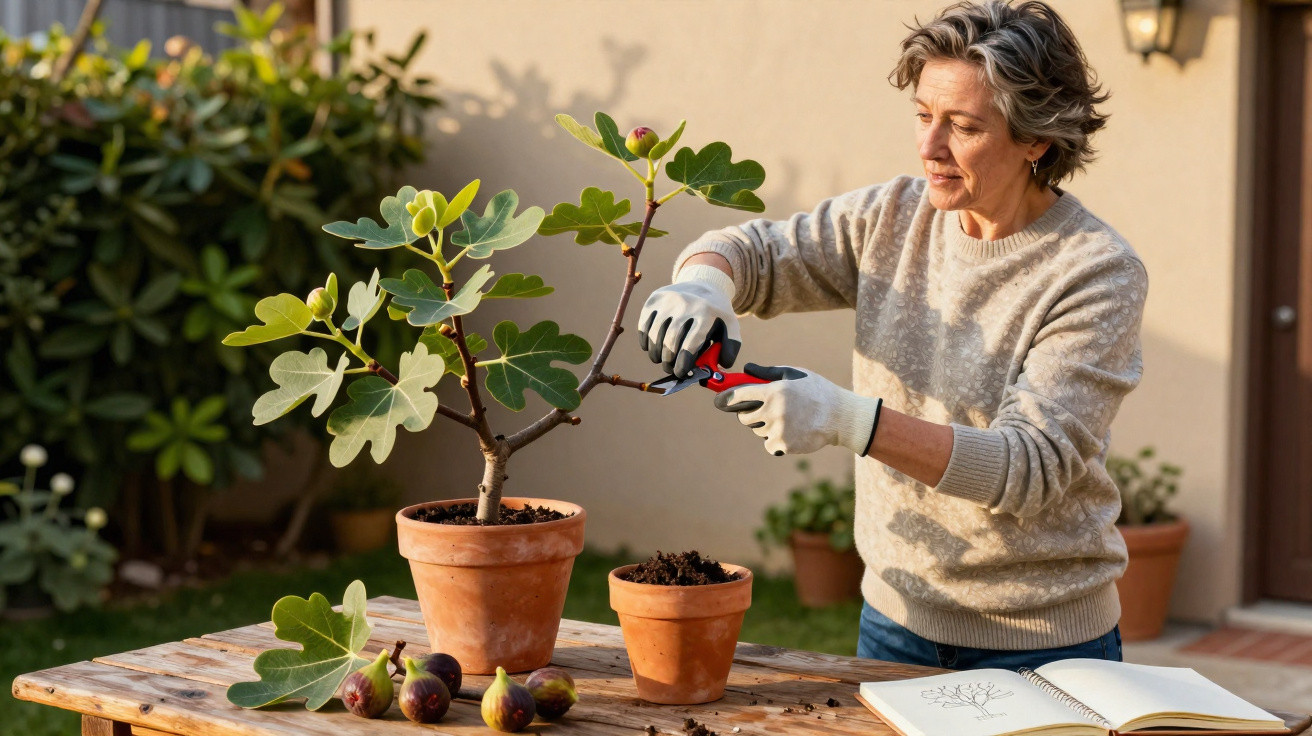
A vigorous fig tree covered in leaves yet producing hardly any figs is an increasingly familiar sight in gardens. While a neighbour’s tree seems ready to collapse under the weight of ripe fruit, your own may remain frustratingly sparse. The good news is that, in many cases, neither the variety nor the climate is to blame, but a very specific care routine carried out at the end of winter.
Why pruning determines whether your fig bowl is full or empty
A fig tree left untrained will grow in a wild, disordered way. Its canopy becomes congested, branches cross over one another, and some grow back towards the centre. This creates a dark, damp area with very little air movement. Fungal diseases can take hold easily, while flower and fruit buds develop poorly.
A second mistake can then ruin the crop entirely: pruning far too severely. Cutting at the wrong time or removing too much growth can quickly take away the very shoots that should have produced figs. The tree may still look healthy and vigorous, but it will bear very little fruit.
The best time for this work is late winter, generally between February and March, once severe frosts are no longer expected and the buds are close to breaking. At this point, the tree’s energy can be directed towards its genuinely productive areas without weakening it excessively.
“The key to a full bowl of figs is an airy canopy with a small number of clearly defined scaffold branches – together with targeted winter pruning.”
The ideal framework: 4 to 6 strong scaffold branches are enough
Rather than forming a dense ‘broom’, a fig tree needs a clear structure. Experts recommend retaining four to six main scaffold branches, arranged around the trunk like the spokes of a wheel. They should be:
- strong and healthy-looking;
- evenly distributed around the trunk;
- growing outwards from the centre;
- free from cracks and fungal infection.
These branches create a bowl- or goblet-shaped form. An open ‘window’ of light remains at the centre, allowing sunshine and air to reach the inner canopy. This lowers moisture levels, helps prevent fungal problems and enables fruit buds to ripen more effectively.
Anything that disrupts this structure should be removed: dead twigs, crossing branches, shoots growing inwards, and branches rubbing against one another. Cut them away as close to their point of origin as possible, leaving no stubs where rot may develop.
The frequently overlooked task at the base of the trunk
Many gardeners focus on the canopy but neglect the lower trunk. So-called water shoots or suckers often emerge from the roots and the lower part of the trunk. These shoots use substantial amounts of water and nutrients, yet they usually fruit late, if at all.
If left in place, they compete with the canopy. The result is even more foliage and even fewer fruits. For this reason, one rule is especially important at the end of winter:
“Remove every shoot growing from the root area or close to the trunk promptly – the earlier in the year this is done, the better the fruit production higher up in the canopy.”
Then shorten the extension growth on the chosen scaffold branches by around one third. This pruning stimulates dormant buds lower down and encourages branching nearer the canopy. That is precisely where most figs will later form.
The small detail with a major effect: outward-facing buds
Cutting at random often undoes all the careful canopy work by the following year. The location of each cut directly determines the direction in which the next shoot will grow.
Make the cut just above a bud facing outwards. In spring, the new shoot emerging from that bud will also grow away from the centre instead of filling the inside of the canopy again.
“Always cut above an outward-facing bud – this keeps the inside of the tree bright and dry while directing fruiting shoots outwards.”
Following this principle over several years naturally creates a broad, open, bowl-shaped canopy. The tree can crop heavily without requiring fungicides or complicated support systems.
Light, warmth and soil: even the best pruning cannot overcome a poor site
Winter pruning is only one part of the picture. A fig tree needs certain conditions before it can produce a worthwhile crop:
| Factor | What a fig tree needs |
|---|---|
| Light | At least 6 hours of direct sunlight each day |
| Wind | A sheltered position; a south- or south-west-facing house wall is ideal |
| Soil | Light, well-drained soil with no waterlogging |
| pH value | Slightly acidic to mildly neutral, approximately 6 to 6.5 |
| Root zone | A mulch layer of 5 to 20 cm for protection and moisture retention |
A generous mulch layer made from leaves, woodchip or straw keeps the soil evenly moist and protects the roots from frost and summer heat. In very heavy soil, incorporating sand or grit can help water drain away more quickly.
Feeding correctly: more potassium and phosphorus, less leaf growth
Figs respond strongly to nutrient supply. Too much nitrogen produces huge leaves and long shoots but a poor harvest. Anyone who treats their tree to plenty of lawn fertiliser or fresh manure every year may unintentionally suppress fruit production.
A supply of potassium and phosphorus, supplemented with mature compost, is considerably more useful. This combination supports flower and fruit set, strengthens the wood and helps the figs ripen.
- Nitrogen: use only moderately, ideally through well-rotted compost
- Potassium: improves fruit quality and winter hardiness
- Phosphorus: supports flowering and fruit formation
- Compost: supplies trace elements and improves soil structure
Organic fertiliser applied in early spring, lightly worked into the top layer of soil and followed by mulching, is usually entirely sufficient. Those growing figs in pots should also provide regular but restrained liquid feeding.
Different fig varieties need different strategies
In cooler areas, such as northern and central parts of the UK, variety selection is especially important. Broadly, there are two types of fig:
Figs with one cropping period
Some varieties produce only one main crop in late summer. They are considered more reliable in areas prone to late frosts because they have fewer early fruitlets that could be damaged by frost. Winter pruning for these varieties focuses more strongly on building a stable canopy and retaining robust shoots formed in the previous year.
Figs with two cropping periods
Other varieties produce their first figs in early summer, followed by another crop in late summer. These early fruits often form on shoots from the preceding year and are particularly vulnerable to frost in cold locations. Gardeners in northern areas must protect these varieties well or prune with great care, so that shoots carrying the early fruit buds are not lost altogether.
There is also a particular biological exception: some Mediterranean varieties require a specific fig wasp for pollination. Without this insect partner, hardly any fruit will set, regardless of how perfectly the tree is pruned and fed. For home gardens, self-fertile varieties that produce fruit without a pollinator are therefore the most suitable choice.
Practical fig tree pruning: what to do at the end of winter
If you are unsure, follow this straightforward sequence:
- View the canopy from the outside: which branches form the basic structure, and which ones interfere with it?
- Select four to six robust scaffold branches and remove all competing shoots.
- Cut out dead, diseased, inward-growing and crossing twigs.
- Completely remove water shoots at the base of the trunk and from the roots.
- Shorten the extension shoots of the scaffold branches by roughly one third, cutting just above an outward-facing bud.
- Make clean, smooth cuts on larger branches, trimming back any ragged edges.
Working in this way gives the tree structure, strengthens fruiting shoots and provides the basis for a stable canopy that will crop for many years.
Risks and common mistakes when pruning figs
This work is not entirely without risk. Frequent problems include:
- Pruning during periods of severe frost, when fresh wounds may suffer frost damage.
- Cutting back radically into old wood, causing all fruit buds to be lost.
- An unclear canopy shape, with too many scaffold branches competing and making the canopy dense again.
- Repeatedly shortening all young shoots in summer, which deprives the tree of its reserves.
Anyone new to pruning should therefore proceed gradually rather than trying to correct everything in a single year. Figs tolerate a great deal, but the harvest often lags one or two years behind the care given. Patience pays off.
Related tasks that work well alongside winter pruning
Late winter is useful for more than pruning figs. At the same time, the area around the tree can be improved by removing weeds, loosening the soil, renewing the mulch and, where necessary, preparing irrigation for dry summers. If you do not yet have an irrigation pipe or drip line, it can be installed now without disturbing the roots.
If your tree is grown in a container, inspect the pot at the same time. Where roots have started circling, repot in early spring and lightly reduce the rootball. Combined with canopy pruning, this keeps the plant balanced and prevents it from producing plenty of leaves but scarcely any fruit.
In this way, a frustratingly leafy fig tree can gradually become a dependable source of aromatic fruit, with one carefully carried out task at the end of winter providing the key.



Comments
No comments yet. Be the first to comment!
Leave a Comment