
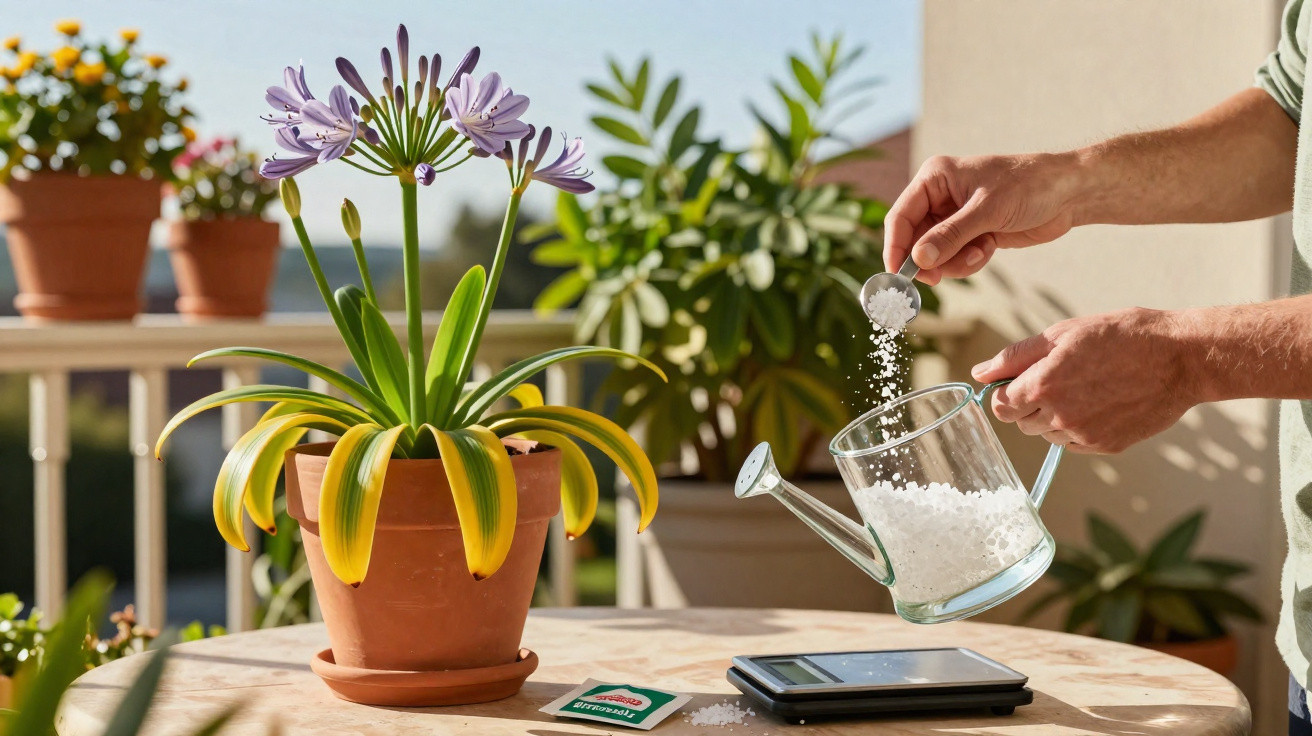
A simple bathroom remedy can turn everything around.
Anyone who grows Agapanthus in a container will know the problem: at the garden centre, these plants look like holiday greetings from the south, yet once home they suddenly lose vigour. Their leaves become paler, yellow stripes emerge and flower stems fail to appear. The watering can is then quickly filled with “all-purpose fertiliser” – often with no real result. Surprisingly often, the cause is a very specific nutrient deficiency that many amateur gardeners do not even consider.
When Agapanthus loses vigour: typical warning signs
Agapanthus, often called African lily, enjoys sunshine, nutrient-rich compost and sufficient water. Even so, specimens grown in pots commonly begin to struggle after one or two years.
- Leaves turn light green to yellowish.
- Yellow stripes develop between the leaf veins.
- The main veins remain distinctly green.
- Flower stems stay short or barely appear at all.
Many people instinctively interpret this as “The plant is hungry, give it more fertiliser!” However, complete fertilisers may supply nitrogen, phosphorus and potassium while frequently lacking the trace elements that allow leaf green to function properly in the first place.
Agapanthus often does not lack “everything”; above all, it may be missing one building block: magnesium, the driver of rich green foliage.
In containers, regular watering washes these trace elements out more quickly. The growing medium may still look fine on the surface, but it has become depleted internally.
Identifying magnesium deficiency: what chlorotic foliage looks like
The technical term is “chlorotic foliage”, or, more specifically, “magnesium chlorosis”. The process behind it is straightforward: without enough magnesium, the plant cannot produce the green pigment chlorophyll at full strength.
Typical signs in Agapanthus include:
- Leaves look generally tired and dull.
- Yellowish areas occur between the leaf veins, while the veins themselves stay green.
- The older, lower leaves show symptoms first.
- Flowering is noticeably weaker than in the previous year.
Nitrogen deficiency looks different: in that case, the entire leaf tends to become an even pale yellow, without green veins. Telling these two issues apart helps when choosing the correct remedy.
The £2 bathroom remedy: why Epsom salt works so well
The shelf containing bath products often holds exactly what Agapanthus needs: Epsom salt, chemically known as magnesium sulphate. In its pure form, with no fragrances or oils, it is an excellent fast-acting magnesium source for container plants.
Epsom salt supplies magnesium for green foliage and sulphur, which makes other nutrients easier to use – without overfeeding the plant with additional nitrogen.
Magnesium sits at the centre of the chlorophyll molecule. When it is absent, photosynthesis can only run at reduced capacity. The plant produces less green pigment, the leaves become lighter and there is simply less energy available for flower formation.
The second component, sulphur, works quietly in the background: it helps the plant use existing nitrogen and phosphorus more efficiently. This allows Agapanthus to get more from what is already present in the growing medium.
Step-by-step: how gardeners dose Epsom salt correctly
For the treatment to work without causing harm, it is worth following a clear routine. Standard practice for weakened container-grown Agapanthus is as follows:
- Dissolve one tablespoon of Epsom salt (around 15 g) in a little lukewarm water.
- Top up the mixture with water to make one litre.
- Apply it only to soil that is already moist; never pour it onto a completely dry root ball.
- Direct the solution at the root area rather than pouring it over the foliage.
- Use it once a month, from the beginning of spring until high summer.
Those wanting to act especially quickly can also treat the leaves: spray them with a solution at half strength, ideally early in the morning or in the evening. This prevents scorching in the sun and allows the plant to absorb the active ingredient rapidly.
How quickly will changes become visible?
Many amateur gardeners notice the first improvements after two to three weeks: new leaves emerge stronger, older sections look somewhat fresher and new flower stems appear more robust. Leaves that have turned completely yellow will not become deep green again; they remain a kind of “scar” – what matters is the healthy new foliage.
Safety rules: when less Epsom salt is more beneficial
Epsom salt is powerful, but targeted. Overdoing it can disrupt other nutrient cycles. Excess magnesium can, for example, block the uptake of calcium and potassium. Agapanthus needs both to develop stable cell walls and strong shoots.
A clear plan is therefore worthwhile:
- Short-term treatment: 15 g per litre, once a month, only where visible symptoms are present.


Comments
No comments yet. Be the first to comment!
Leave a Comment