
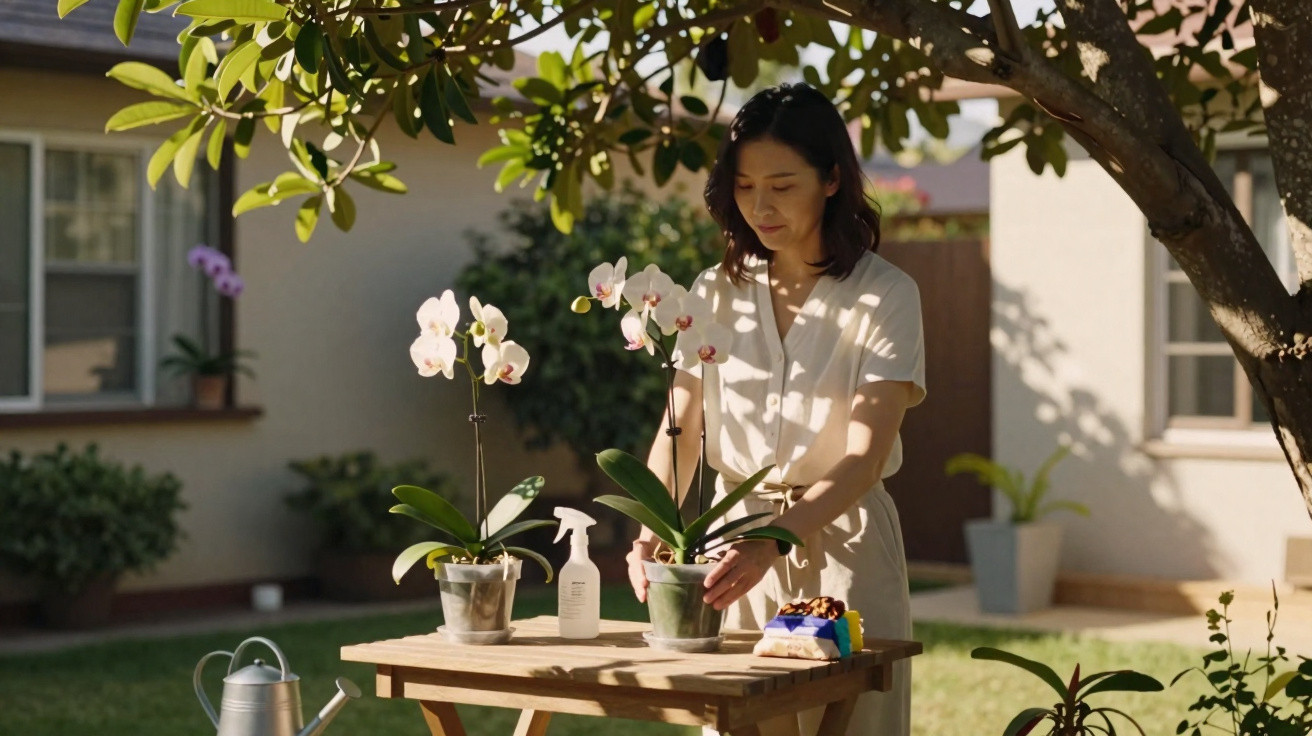
The answer is often no more than a change of location away.
Anyone who brings home a Phalaenopsis from the garden centre initially enjoys weeks of magnificent flowers. A year later, the pot often contains nothing but green leaves. The plant is quickly labelled “temperamental” or “difficult”. In reality, it simply responds very consistently to its surroundings – and that is where one surprising professional tip comes in: the right, slightly unconventional position determines whether your orchid flowers again year after year.
Why the usual windowsill often holds an orchid back
In many homes, an orchid remains in the same spot for months, usually on a windowsill above a radiator. On the face of it, this seems sensible: there is light and warmth, and watering is easy. For the plant, however, it creates a permanent state of exception.
Phalaenopsis orchids originate in tropical forests. There, they grow on tree trunks, surrounded by humid air, gentle air movement and noticeable differences between daytime and night-time temperatures. In our continuously heated rooms, precisely these signals are missing.
“Without cooler nights and slightly changing conditions, the orchid lacks the trigger it needs to produce a new flower spike.”
Typical windowsill problems include:
- Constant temperatures: around 20 °C, day and night – with no autumn or spring stimulus.
- Dry central-heating air: humidity drops in winter, roots suffer and leaves can look limp.
- Unsuitable light: too little light deeper inside the room, or leaf scorch at south-facing windows.
For flower formation, daytime temperatures of roughly 18 to 22 °C and cooler nights of 12 to 15 °C are ideal. The plant also needs plenty of bright but indirect light, such as that provided by an east-facing window. If conditions stay virtually unchanged all year, the plant remains stuck in a “permanent summer” – attractively green, but reluctant to flower.
The unusual professional tip: move the Phalaenopsis orchid outdoors in summer
A Finnish garden designer takes a strikingly different approach based on her experience: rather than relying on specialist fertiliser or complicated care, she uses a bold but simple change of position. Her trick is to put the orchids outside for summer.
She does not simply place her Phalaenopsis on the patio. Instead, she suspends it in a hanging basket – sheltered, yet outdoors. This may seem unusual at first, but it more closely resembles conditions in its natural habitat.
“Summer outdoors gives the orchid exactly what it lacks on a living-room windowsill: natural humidity, a gentle breeze and a clear difference between day and night.”
How to set up the outdoor position
To follow this approach, proceed roughly as follows:
- Choose a suitable time: in central Europe, this is usually from early to mid-June, once night-time temperatures remain reliably above 12 °C.
- Use a hanging basket: simply put the pots into a basket or hanging planter; there is no need to repot or install anything complicated.
- Find a partially shaded place: beneath an overhang, in the light shade of a tree, or against a north- or east-facing wall.
- Avoid direct midday sun: sunburned leaves cause more harm than any benefit gained from cooler temperatures.
- Monitor rainfall: protect plants from persistent rain or heavy showers so that the roots do not sit in water.
It is important to hang the planter or basket high enough to keep slugs and other ground-dwelling creatures away from the plants. During wet summers, a place beneath a roof overhang is worthwhile; in drier areas, the location can be more exposed to the air.
What summer outdoors really does for an orchid
Moving outdoors works on several levels at once – and it is this combination that makes such a difference to flowering.
| Factor | Living room | Outdoors in summer |
|---|---|---|
| Temperature | constant, with little day/night variation | warmer days, noticeably cooler nights |
| Humidity | often dry, affected by central heating | higher, especially after rain and in the evening |
| Air movement | usually still | light breezes and a steady supply of fresh air |
| Light | artificial light and window filtering | a natural daily pattern with changing light levels |
Orchids interpret these exact signals as the starting cue for a new flowering phase. Many owners report that new flower spikes suddenly appear in late summer or early autumn after their plants have spent several weeks hanging outside.
How to care for an orchid outdoors
A new position does not mean that every routine needs changing. However, a few aspects do need adjusting:
- Watering: outdoors, the growing medium can dry more quickly depending on wind and temperature. Before watering, use a finger to check whether the bark is still slightly damp.
- Fertilising: during the growing season, apply a specialist orchid feed at a weak concentration every two to three weeks.
- Checking: inspect leaves and roots regularly. Spot discolouration, feeding damage or soft areas early.
- Adjusting for heat: during heatwaves above 30 °C, move the plant into deeper shade or temporarily closer to the house wall.
As nights become noticeably cooler again in late summer, bring the plants back indoors in good time. Around 10 to 12 °C should be treated as the lower limit.
The ideal indoor position after summer
Once back inside, the orchid will be happiest in a bright location that does not receive harsh direct sun. An east-facing window is usually ideal; north-facing windows can also work if furniture does not block the available light.
Suitable rooms include, for example:
- a bathroom with a window and good ventilation;
- a lightly heated guest-room or bedroom corner;
- a veranda that is not heated continuously.
Daytime temperatures can be around 20 °C, with a slight drop at night. Short-term fluctuations are not harmful as long as the plant is not exposed directly to cold draughts. Air should circulate, but icy air should not blow in through an open window.
What balcony owners can do without a garden
Those without a garden can achieve the same result on a balcony. Protection from wind, direct midday sun and heavy rain is what matters. A covered east- or west-facing balcony is particularly suitable.
The orchids should remain in their free-draining pots and can be placed or hung in a simple basket. Good drainage remains essential: do not use a decorative outer pot without a drainage hole, and avoid saucers where rainwater can collect.
Common mistakes that stop orchids flowering
Alongside an unsuitable position, the same issues repeatedly prevent new flowers from forming:
- Constant wetness: roots rot, leaving the plant unable to build up energy for flowering.
- Cutting old flower spikes too early: some Phalaenopsis produce side shoots with new buds on partly dried-out spikes.
- A position that is too dark: remember that leaves often cope with less light than abundant flowering requires.
- Moving the plant constantly: after its summer move, the plant needs a reasonably permanent place indoors again.
Why temperature differences have such a strong effect
Many orchid species use the shift from warm days to cooler nights as a signal to begin a new flowering phase. In their native habitat, this indicates the transition between the rainy and dry seasons – a time when pollinators are active and reproduction is worthwhile.
Recreating this natural rhythm on a small scale helps the plant activate its internal clock. That does not mean sitting beside the radiator with a thermometer. Even a slightly cooler bedroom compared with a warm kitchen-living area makes a noticeable difference.
More enjoyment from orchids with minimal extra effort
Perhaps the most appealing point is that this positioning trick requires no exotic equipment, specialist accessories or daily rituals. A hanging basket, a weather-protected outdoor space and a watchful eye on temperature and light are often enough to encourage fresh flowers on the same plant for years.
Anyone who sees their orchid as more than a decorative object and instead as a living housemate may be surprised by how quickly it responds. In many cases, a new delicate flower spike appears as early as the first autumn after its outdoor “summer holiday” – clear visible feedback that the unconventional position was exactly the stimulus the orchid had been waiting for.
Comments
No comments yet. Be the first to comment!
Leave a Comment