
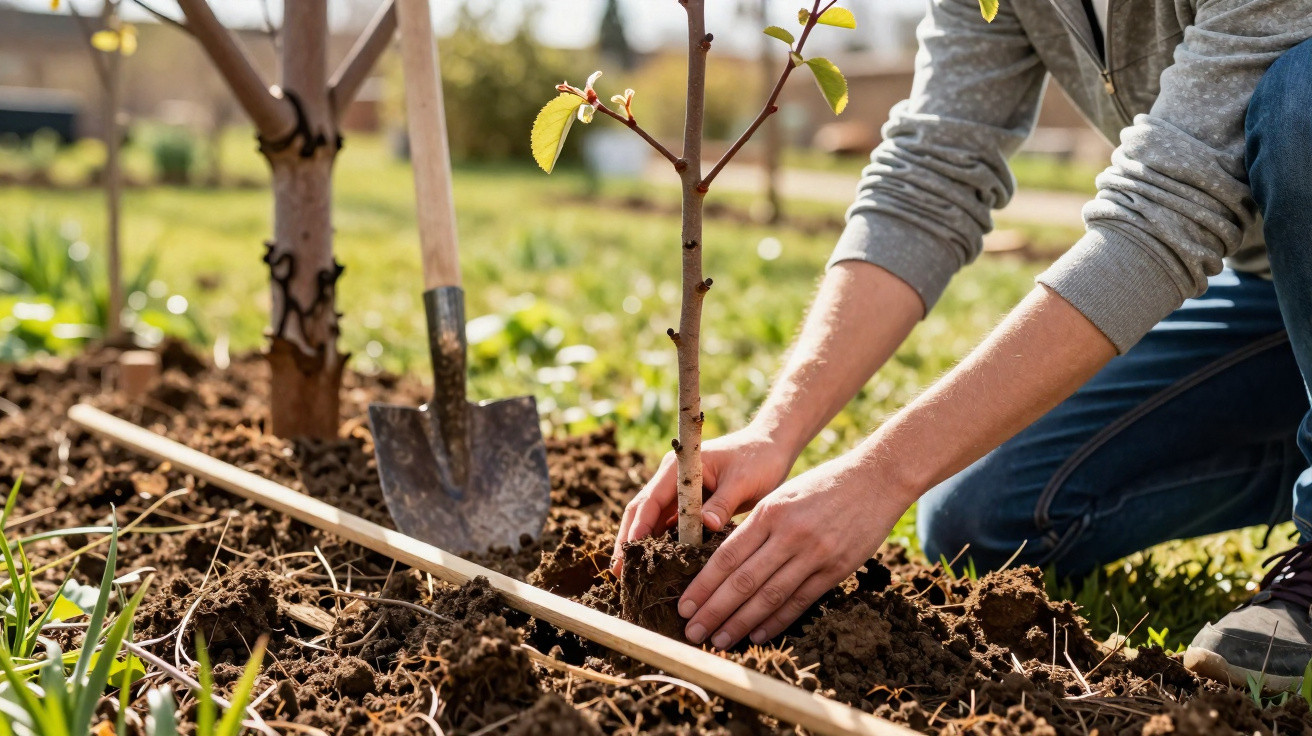
When you plant an apple, cherry or apricot tree in the garden in March, thoughts usually turn to fertiliser, variety choice and watering. Hardly anyone considers one tiny area on the trunk, even though it determines the tree’s survival, flowering and eventual crop. Yet this particular spot is far too often buried beneath the soil, with consequences that may only become apparent once the tree is already suffering.
The most common planting mistake: buried too deeply and slowly suffocated
Why well-intentioned planting can quickly become fatal
Many gardeners like to set a young tree particularly deeply into the ground. The reasoning sounds sensible: deeper planting should mean greater stability and better protection from wind and weather. So soil is piled up, firmly trodden down and perhaps even shaped into a small mound directly around the trunk.
In reality, this approach acts like a suffocating cushion. The base of the trunk needs oxygen and air circulation. Once it is completely enclosed by soil, moisture builds up, the bark remains permanently wet and the tree cannot “breathe” at this sensitive point.
“Bury the base of the trunk, and you deprive the fruit tree of air – and often of its chance to flower and bear fruit.”
Wet soil around the trunk: a fungal paradise rather than a dream harvest
Trunk bark is made to be exposed to air, not to live beneath wet soil. If it stays constantly damp, a process known as maceration begins: the tissue softens, becomes vulnerable and leaves the way open for fungi and rot.
Below ground, the trunk gradually decays. At first, the tree may still look reasonably normal from the outside, but internally its supply system starts to fail. The transport tissues become blocked, so sap reaches buds and young shoots poorly. The result is weak growth, very few flowers and little or no fruit.
The crucial area: how to identify the graft union
Key reference points: the root collar and graft swelling
Nearly all fruit trees bought from a nursery are grafted. This means a desirable variety, such as a particular apple, is joined to a more robust rootstock. This “join” on the trunk is the critical point that must never end up below the soil.
There are two separate areas:
- Root collar: the transition between the roots and trunk, at ground level.
- Graft union: usually a few centimetres above it, visible as a thickening, small bump, scar or slight bend in the wood.
Look closely at your tree and you will almost always find this point without difficulty. It resembles a healed scar – and that very scar influences vigour, willingness to flower and disease resistance.
Why this “scar” drives flowering and fruit production
At the graft union, the cultivated variety meets the rootstock, which may provide strong root growth, frost resistance or reduced vigour. This pairing is what makes modern fruit trees suitable for gardens in the first place.
If this area is covered with soil, however, something deceptive happens: the cultivated variety attempts to produce roots of its own in order to separate from the rootstock. This requires a huge amount of energy. Instead of forming flower buds, the tree puts its resources into emergency measures.
“When the graft union ends up underground, the tree forgets how to flower and fights to survive.”
The benefits of the carefully selected rootstock are then lost: lower resilience, a later start to cropping and weaker flowering. In the worst case, the tree may fail completely.
How to plant properly in March: the golden height rule
The ideal position: keep the graft union clearly above ground level
There is one straightforward rule when planting: the graft union must sit 5 to 10 centimetres above the final soil level. The root collar should be just above the surface, never below it.
Proceed as follows:
- Dig a planting hole deep enough for the roots to sit comfortably without being cramped.
- Shape a small, firm mound of soil at the bottom of the hole and spread the roots over it.
- Hold the tree so that the graft union is clearly above the surrounding ground level.
- Refill with soil and gently firm it, without burying the base of the trunk.
This raised position keeps the sensitive area dry and well ventilated. Sunlight and air can reach the scar, while fungi and rot find it far harder to take hold.
A trick to prevent the tree sinking later
Freshly loosened soil contains plenty of air and settles over the following weeks and months. As it does, the tree can gradually sink unnoticed, leaving the graft union in damp soil after all.
A simple technique avoids this problem: place a cane or tool handle across the planting hole. Position the tree so that the graft union is level with, or slightly above, the lower edge of the cane. Only then should you refill the hole. This visual reference helps prevent the tree from being planted too low.
If the tree is already suffering: warning signs of being “buried alive”
Clear symptoms in spring
A fruit tree planted too deeply reveals its distress gradually. Many gardeners interpret the signs as a “poor variety” or a “bad gardening year”, when the tree is actually calling for help.
Warning signs include:
- Shoots remain short and thin, with barely any annual growth.
- Leaves turn yellow early or stay small and pale.
- Buds swell but fail to open, or they dry out.
- Overall, the tree seems “frozen” in spring while others are already coming into growth.
When these symptoms appear together, inspect the base of the trunk. If there is a mound of soil extending well above the root collar, this planting error is often the cause.
Rescue action: expose the trunk again
Once the problem has been identified, there is only one solution: free the base of the trunk. Carefully draw back the soil around the trunk using your hands or a small hand trowel.
“The aim of the rescue is to create a shallow hollow around the trunk, leaving the graft union and root collar exposed to the air again.”
A delicate touch is essential. Do not sever surface roots or damage the bark. By working carefully, you give the tree a second chance. Over the following years, its root system can recover and its ability to flower will usually return.
Checklist for healthy fruit trees over the long term
What to check while refilling the planting hole
Before finishing the backfilling, take a moment to check the following:
- The graft union is visible and at least a hand’s breadth above the ground.
- There is no mound of soil directly against the trunk that traps moisture.
- Create the watering basin so water runs to the roots slightly further out, rather than against the trunk.
- Firm the soil only with gentle pressure; do not compact it like cement.
Working this way supports the tree’s natural anatomy rather than working against it. The root area remains active, the trunk bark stays dry and the flower buds receive a reliable supply of nutrients.
Why the right planting depth achieves more than fertiliser and specialist compost
Many gardeners spend money on expensive composts and fertiliser salts, while the real deciding factor is a difference of just a few centimetres in trunk height. A correctly planted fruit tree often needs less fertiliser, copes better with dry spells and produces its first crops sooner.
The graft union is, in a sense, the fruit tree’s “control centre”. It governs vigour, the beginning of flowering and cropping behaviour. Cover it, and you interfere with this system. Keep it clear, and you fully benefit from the work already carried out by nurseries and plant breeders.
Especially in small gardens, where every square metre matters, the difference between an incorrectly and correctly planted tree can determine whether, after five years, you are carrying baskets full of apples or still standing puzzled in front of a crown with few flowers.
Checking the trunk takes only a few seconds, yet it can prevent years of frustration. Anyone planting this spring – or inspecting established trees critically and exposing them where needed – is quietly but very effectively laying the foundation for a fruit garden that crops for many seasons.

Comments
No comments yet. Be the first to comment!
Leave a Comment