
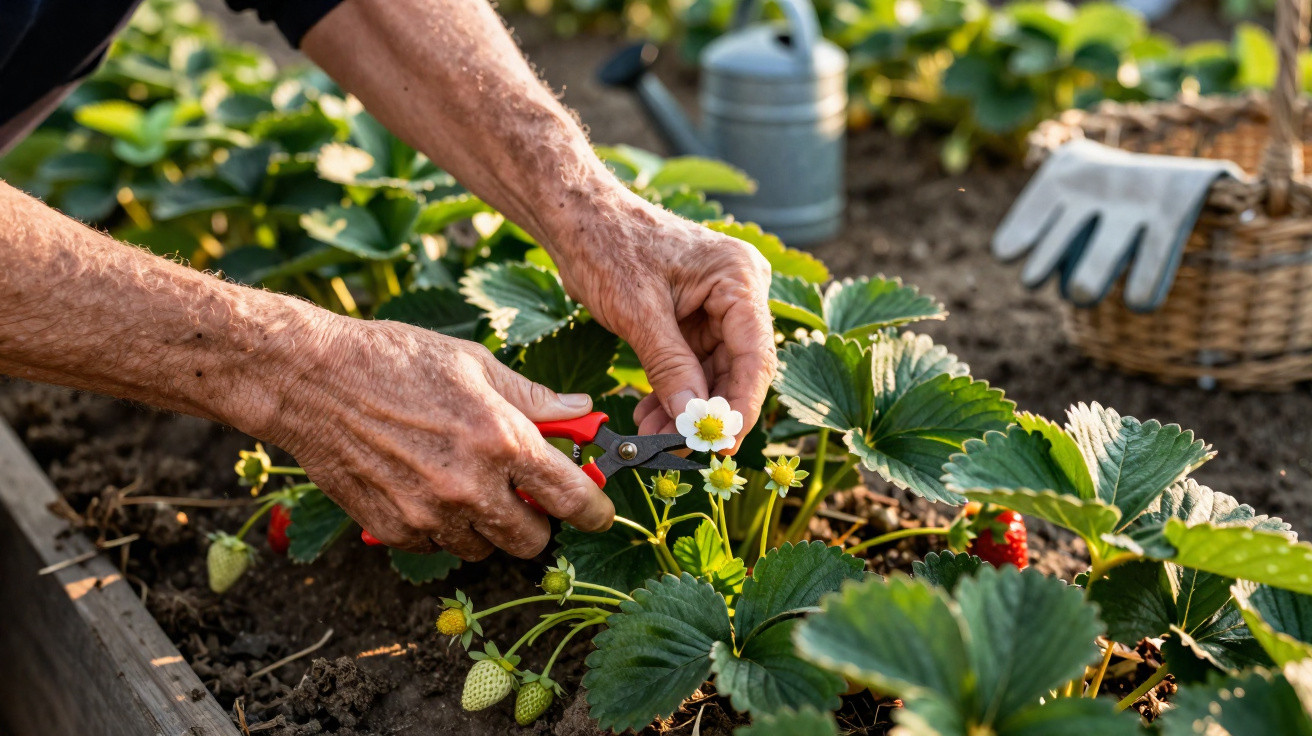
Many amateur gardeners celebrate every first strawberry flower – and, without realising it, undermine their own harvest.
Anyone growing strawberries in the garden or a raised bed knows the feeling: those first small white blooms seem to promise sweet fruit. Yet this is precisely when an increasing number of experienced gardeners reach for their secateurs – and later report considerably more, better strawberries. This seemingly harsh practice is based on a straightforward principle of plant physiology and shrewd yield planning.
Why early flowers weaken the whole strawberry plant
Strawberry plants use a great deal of energy to produce fruit. If the very first flowers are left in place during spring, the plant directs its strength into berries before it has properly established its foundations.
Sacrificing the first flowers strengthens the roots and leaves – laying the groundwork for a much more abundant main harvest.
At the beginning of the growing season, roots and leaves are generally still delicate and underdeveloped. If the plant must support fruit at this stage, several things can happen:
- the first strawberries often remain small and watery
- their flavour is less intense and sweet
- the plant is more likely to become weak over the summer
- the total harvest may be smaller
Removing the first buds consistently, on the other hand, makes the strawberry plant allocate its energy elsewhere: to its roots, foliage and sturdy shoots. This “preparation phase” acts rather like a training camp for the rest of the year.
What happens below the surface when flowers are removed
Once the flowers have been cut, activity really begins below ground. With no fruit to sustain, the plant sends its nutrients directly into the root system.
This produces several changes in the soil:
- roots extend further down into the ground
- the root system becomes denser and more extensively branched
- the plant can access water more effectively during dry spells
- minerals such as potassium, phosphorus and nitrogen are absorbed more efficiently
The result is also clearly visible above ground after only a few weeks: foliage grows denser, leaves become larger and leaf stalks stronger. The strawberry plant can process substantially more sunlight, producing sugars and stored reserves from it.
Strong roots combined with lush foliage create a type of “energy store” from which many large, aromatic fruits can later develop.
The right time: when cutting flowers truly makes sense
Timing is crucial. Waiting too long means losing some of the benefit.
How to spot the ideal moment
- As soon as the flower stems (flower clusters) emerge from the centre of the plant but are still closed
- before the buds noticeably swell or the first petals can be seen
- at the latest, before a small green fruit begins to form
Once tiny strawberries are already visible, the plant has invested considerable energy. Cutting at this point can still help, but it no longer delivers the full benefit.
Step by step: how to remove the first strawberry flowers correctly
Although the method may sound rather rough, it needs to be carried out carefully. Heavy-handed treatment can damage the plant more than the flower itself would.
Tools and preparation
- sharp, clean garden scissors or fine secateurs
- optionally, a small knife for particularly crowded clumps
- disinfectant, such as alcohol, for the tools
Clean the blade thoroughly before beginning. When treating several plants, clean it again between each one to avoid transferring fungal spores or bacteria.
What to do at the plant
- Find the flower stem with your fingers and gently bend it to one side.
- Position the secateurs close to the base of the stem, immediately above the leaf rosette.
- Remove the flower stem with one clean, smooth cut.
- Do not tear or pull it off, as this could loosen the entire plant.
Do not leave the cut flowers on the soil beside the plant; place them straight into the compost or food and garden waste bin. This reduces the risk of disease organisms building up in the bed.
How the strawberry bed changes after a few weeks
Anyone using this approach needs a little patience, but is usually rewarded more than adequately.
Rather than a brief, tiny spring harvest, you can often look forward to a long, more even strawberry season with considerably more robust fruit.
Typical observations after deliberately cutting the first flowers include:
- The plants look fuller and more vigorous overall.
- New flower stems emerge later, supported by stronger shoots.
- The strawberries become noticeably larger and firmer, and are often distinctly sweeter too.
- Harvesting is spread across a longer period rather than concentrated in one short peak.
Where several plants in the same bed can be compared – some with their first flush removed and others left untouched – the difference is usually very clear.
Which strawberry plants benefit most from cutting
This technique is not only suited to professional growers with plantations; it is particularly useful in smaller home gardens.
| Situation | Recommendation |
|---|---|
| First year after planting | Remove the first flowers consistently, as establishment is the priority. |
| Well-established plants that are several years old | Assess their condition: remove the first flush from weaker plants, while strong plants can keep some flowers. |
| Everbearing varieties | Remove only the very first flush of flowers, then allow them to fruit as normal. |
| Very early outdoor varieties | Intervention is often worthwhile, as early berries ripen less well in cold conditions. |
If you are unsure which variety is growing in the bed, try treating only some of the plants. A direct comparison in your own garden will show whether cutting is worthwhile.
Essential care after cutting strawberry flowers
For growth to really take off after this “flower treatment”, the plant needs suitable conditions.
- Watering: Water regularly and evenly; the soil should remain lightly moist, but never waterlogged.
- Mulch: A thin layer of straw, grass clippings or bark mulch retains soil moisture and protects the crown bud.
- Feeding: Give a light application of organic berry fertiliser, ideally in spring.
- Runners: If you want plenty of fruit, cut away excessive runners so that the plant directs its energy into the harvest.
If your aim is specifically to raise new young plants, leave a few runners in place, while ensuring that the parent plant is not completely exhausted.
The emotional hurdle: why cutting them off is still worthwhile
The hardest part of this technique happens not in the strawberry bed, but in your mind. It feels wrong to remove healthy flowers for no apparent reason. Many gardeners need a season to become accustomed to it.
Cutting away the first flowers means giving up a few early fruits – in exchange for a much stronger, longer main harvest.
If you are sceptical, begin cautiously: remove all first flowers from one section of the bed and leave the rest as usual. During summer, the direct comparison will reveal which option is more convincing.
Common strawberry-growing terms explained briefly
Strawberry gardening advice repeatedly uses terms that can initially confuse beginners:
- Flower cluster / flower stem: the shoot with several flowers at its end.
- Rosette: the leaf base from which all leaves and flower stems grow.
- Stolons / runners: long, creeping shoots that produce new young plants.
- Everbearing varieties: strawberries that repeatedly flower and fruit from early summer until autumn.
Knowing these terms, and using your secateurs and watering can with purpose, often enables you to get considerably more from the same planting area. Giving up the very first fruits then pays off in baskets full of aromatic strawberries – just when summer is properly getting under way.
Comments
No comments yet. Be the first to comment!
Leave a Comment