
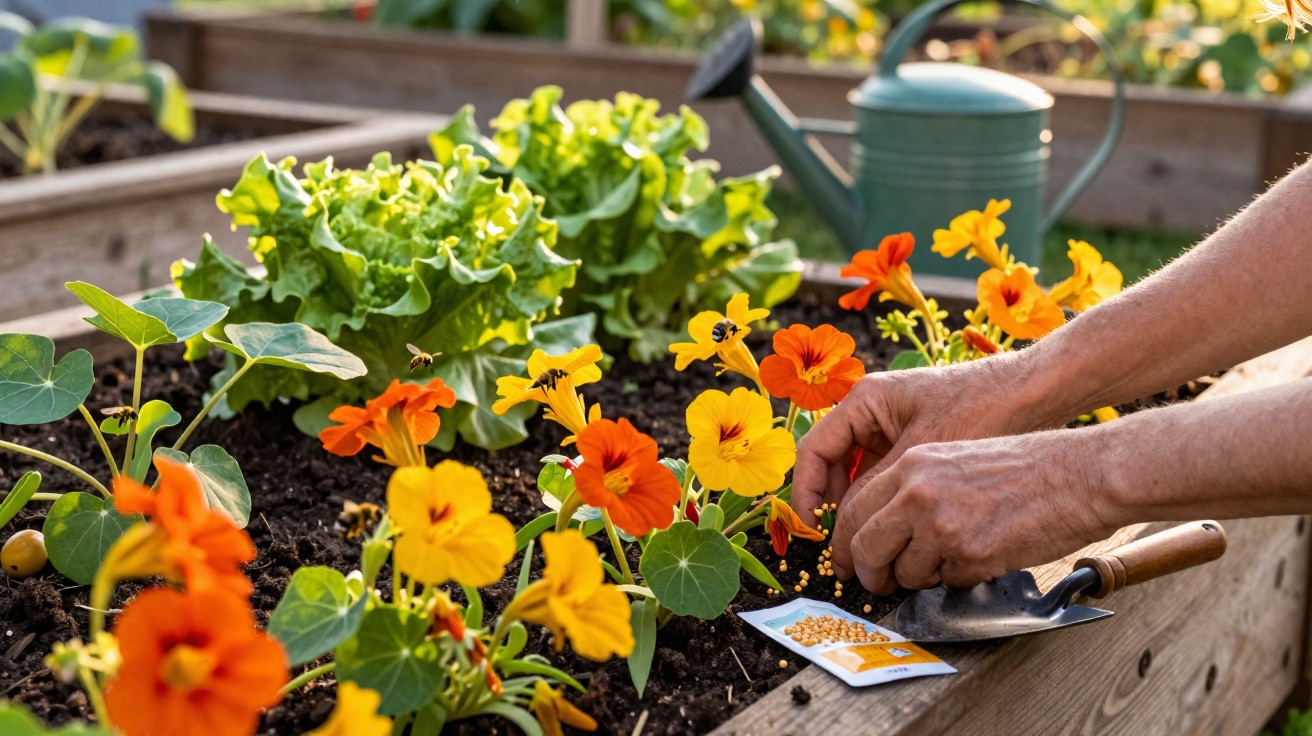
As early as the first month of spring, it is decided whether the vegetable garden will be full of life or ravaged by pests.
Many amateur gardeners begin the new season enthusiastically in March, sowing tomatoes, beans and courgettes – only to wonder a few weeks later why their young plants are stunted or have disappeared altogether. One straightforward, inexpensive flower can make all the difference: it protects vegetables, attracts pollinators and, as an added benefit, creates a strikingly lively bed.
The spring surprise: one flower that strengthens the entire bed
As the first mild days arrive, the soil comes back to life. This is when beds are prepared, compost is spread and seeds are sorted. Including one particular flower at this stage creates a natural protective barrier for the whole growing season.
That flower is the nasturtium. In many gardens, it is merely seen as an attractive ornamental plant trailing from a fence, but it is actually a versatile aid to sustainable vegetable growing. It needs very little attention, grows quickly and can be incorporated flexibly into virtually any bed.
“Nasturtiums work like living insurance for the vegetable garden: inexpensive to buy, enormously valuable in terms of yield.”
Why March is the ideal time to begin
Once the ground is no longer freezing cold and the days become a little longer, nasturtiums quickly get going. Sowing in March or early April ensures the plants are well established just when young vegetables are at their most vulnerable.
This creates a natural rhythm: as tomatoes, beans, peas or squash produce their first leaves, the nasturtiums are already forming their protective foliage, followed soon by flowers. Inexpensive seed packets are available in almost every garden centre and often contain enough seed to cover several square metres of bed.
A living shield: how nasturtiums draw aphids away from vegetables
A smart diversion strategy against pests
Aphids are among the most common frustrations in a vegetable garden. Black aphids in particular are fond of bean and tomato plants. This is exactly where nasturtiums show their greatest strength: many aphid species find them irresistible.
Rather than attacking the vegetable plants, aphids tend to gather on the soft, rounded leaves of nasturtiums. Gardeners use this trait deliberately: the flower acts as a sacrificial plant, intercepting pests and stopping them from spreading in large numbers across the crops themselves.
“The aphids feed on the nasturtiums – and the beans, tomatoes and courgettes reward this with healthy growth.”
Less pressure on young plants
Young vegetable plants suffer particularly badly when aphids suck their sap. Growth slows, leaves become distorted and flowers fail to appear. When nasturtiums grow nearby, pest pressure is distributed differently: the aphids become concentrated in one manageable area.
This delivers clear benefits:
- Sensitive vegetable plants remain vigorous for longer.
- Infestations can be spotted quickly by eye.
- Control measures, such as spraying with a jet of water, can be focused on just a few plants.
- Chemical treatments become unnecessary.
With regular checks, heavily infested nasturtium shoots can simply be cut off and disposed of. This keeps the system in balance without affecting the entire bed.
A magnet for bees and bumblebees: how the flower boosts the harvest
An early food source for vegetable-garden pollinators
Nasturtiums are not just a shield; they are also a buffet. Their vivid yellow, orange or red blooms provide plenty of nectar and pollen, often at a time when many other garden flowers are only beginning to bloom.
This is what makes them so useful: bees and bumblebees find a dependable food source early in the season, remember its location and return to the garden again and again. Nearby vegetable and fruit plants benefit directly.
More flowers, more fruit
Whether it is courgettes, squash, cucumbers, strawberries or fruit trees, a considerable proportion of flowers goes unproductive without pollination. The more pollinators there are at work, the more fruit will eventually develop.
“Where nasturtiums bloom, the likelihood of laden tomato plants, plump courgettes and heavily fruiting apple trees rises considerably.”
Many gardeners underestimate this effect. Rather than buying expensive specialist fertilisers, a carefully positioned row of nasturtiums can often be enough to visibly increase insect activity.
How to position nasturtiums correctly in the bed
A flowering protective wall around the garden edge
Location is crucial. One popular approach is to sow nasturtiums all the way around the vegetable garden. This colourful “wall” slows aphids at the boundary before they can reach the valuable crops in the middle.
As well as being practical, it transforms the appearance of the garden: bare bed edges are replaced with a colourful frame that neatly separates the productive garden from the lawn or path.
Between the rows for maximum benefit
The effect is even stronger when individual clusters of nasturtiums are also planted directly within the bed. They work particularly well alongside:
- Tomatoes
- Beans and peas
- Brassicas
- Courgettes, squash and cucumbers
- Peppers and chillies
Their large leaves provide shade and help the soil retain moisture for longer. At the same time, they remain low enough not to smother neighbouring plants, provided they are cut back promptly if they begin to spread too vigorously.
| Area of the garden | Recommended use of nasturtiums |
|---|---|
| Bed edge | A dense border row as an outer protective barrier |
| Between tomatoes | Individual clumps between plants to divert pests |
| Under fruit trees | Broad sowing as a source of flowers and an insect magnet |
| Window box | A trailing, edible ornamental and protective plant |
How to sow nasturtiums successfully with no prior experience
A step-by-step guide to this protective flower
Nasturtiums are among the most rewarding plants for beginners. Their seeds are large, easy to handle and germinate reliably. There is no need for a complicated plan; this basic method is enough:
- Loosen the soil lightly and remove large stones.
- Push the seeds around 2 to 3 centimetres deep into the soil.
- Leave roughly 20 to 30 centimetres between sowing positions.
- Water them in and keep the area lightly moist during the first few days.
The first seed leaves usually emerge after one to two weeks. The plant then grows rapidly. It does not tolerate waterlogging, but copes surprisingly well with dry conditions, as long as it is not allowed to dry out completely for weeks on end.
Low-maintenance, edible and decorative
Many gardeners only later realise that, by sowing nasturtiums, they have planted not only a helper for the vegetable garden but also an edible crop. The leaves and flowers have a mildly peppery flavour, similar to cress, and work well in salads, on bread and butter, or as a garnish for soups.
This brings several benefits together: protection from pests, more pollination, a more attractive bed and an additional harvest for the salad bowl. Allowing a few plants to set seed in autumn often results in volunteer seedlings appearing in the bed the following spring.
Why this one flower should become standard in every vegetable garden
Nasturtiums clearly demonstrate the power of mixed planting. Instead of maintaining monocultures made up of rows of vegetables alone, gardeners create a small ecosystem in which flowers, beneficial insects, pests and vegetables interact.
Anyone who has seen how well beans, tomatoes or courgettes develop alongside this colourful companion will usually include it automatically in future years. For families wanting to use as few sprays as possible while still harvesting plenty, it is almost essential.
There is another advantage: children love the bright flowers and large leaves. This makes the productive garden a playful place to learn, while chemical plant protection products become less appealing because nature takes care of much of the work.
Anyone adding a packet of nasturtium seeds to their shopping basket this March is quietly laying the foundation for a more resilient, productive and visibly more attractive vegetable garden this year.
Comments
No comments yet. Be the first to comment!
Leave a Comment