
A simple change in approach suddenly transformed everything.
Many city dwellers will recognise the problem: you constantly scrub the patio or balcony, vigorously wipe away unpleasant droppings and put up with the smell – only for it all to look exactly the same the following day. One reader said she cleaned every week, yet nothing ever changed. Only when she fundamentally changed her approach and used several methods together did the pigeons stay away for good.
Why pigeons love balconies and patios
Anyone hoping to get rid of pigeons should first understand why they have chosen their particular balcony. It is rarely a coincidence; specific attractions are usually responsible.
- Food scraps: Crumbs, bread, pet food and uncovered food supplies act like a magnet.
- Comfortable perches: Window ledges, railings and canopies provide ideal places to land and rest.
- Sheltered nooks: Covered areas, corners beneath roofs and recesses in masonry are perfect for nesting.
Pigeons are creatures of habit. Once they find a safe, comfortable place with a dependable food source, they return again and again – usually bringing more birds with them.
The crucial change: make the space unattractive, not merely clean
Cleaning a patio every week with a pressure washer and detergent only tackles the symptom rather than the cause. This was precisely what happened to the resident mentioned above: she cleaned, but did nothing to alter the area for the birds. The visits stopped only once she made her outdoor space genuinely inconvenient for them.
“The less welcoming a balcony is for pigeons, the sooner they will look for another territory – entirely without violence.”
Remove food sources consistently
The first step sounds obvious, but it is essential. Hardly any pigeon will remain permanently where there is no food.
- Do not leave leftovers on the table.
- Plant window boxes in a way that does not leave seed mixes exposed on the compost.
- Offer food for songbirds only in protected feeding stations that pigeons cannot access.
- Keep rubbish bags tightly closed and dispose of food waste promptly.
Many people underestimate how far pigeons will fly for a few breadcrumbs. Just a small, regular supply can be enough to establish a fixed “feeding route”.
Make surfaces awkward and slippery
The key adjustment on the troublesome patio was targeted changes to the usual landing places, rather than cleaning alone. Pigeons favour stable surfaces with good grip. If they slide or cannot find secure footing, they will seek somewhere else.
- Metal or plastic spikes: Fitted to masonry ledges and railings, these prevent landing without harming the birds.
- Tension wires: Fine taut wires or cords across parapets make the landing surface unstable and insecure.
- Smooth materials: Perspex sheets placed on favourite perching edges cause pigeons to slide off, which they perceive as dangerous.
The resident initially attached just a thin nylon cord to the patio parapet. That alone stopped the pigeons from perching comfortably. She also fitted a narrow strip of Perspex to the window ledge. Within a few days, the regular visitors had disappeared.
Smells pigeons cannot tolerate
Many people prefer to try natural remedies before turning to technical systems. Strong smells can be particularly useful for disturbing sensitive animal noses.
Household remedies with a deterrent effect
- Household vinegar: Mix water and vinegar at a 1:1 ratio in a spray bottle and apply it regularly to affected areas.
- Hot spices: Ground pepper, curry powder or cinnamon scattered across window ledges can put pigeons off using the landing spot.
- Strongly scented plants: Pots of rosemary, mint or heavily scented geraniums are decorative while also deterring many pigeons.
Anyone using these approaches should refresh them regularly, as rain and wind quickly wash away liquids and spices. In heavily used areas, combining several measures makes sense.
Movement and reflections: what unsettles pigeons
Pigeons are sensitive to sudden flashes of light and irregular movement. This can be used effectively on balconies.
Simple tricks using everyday items
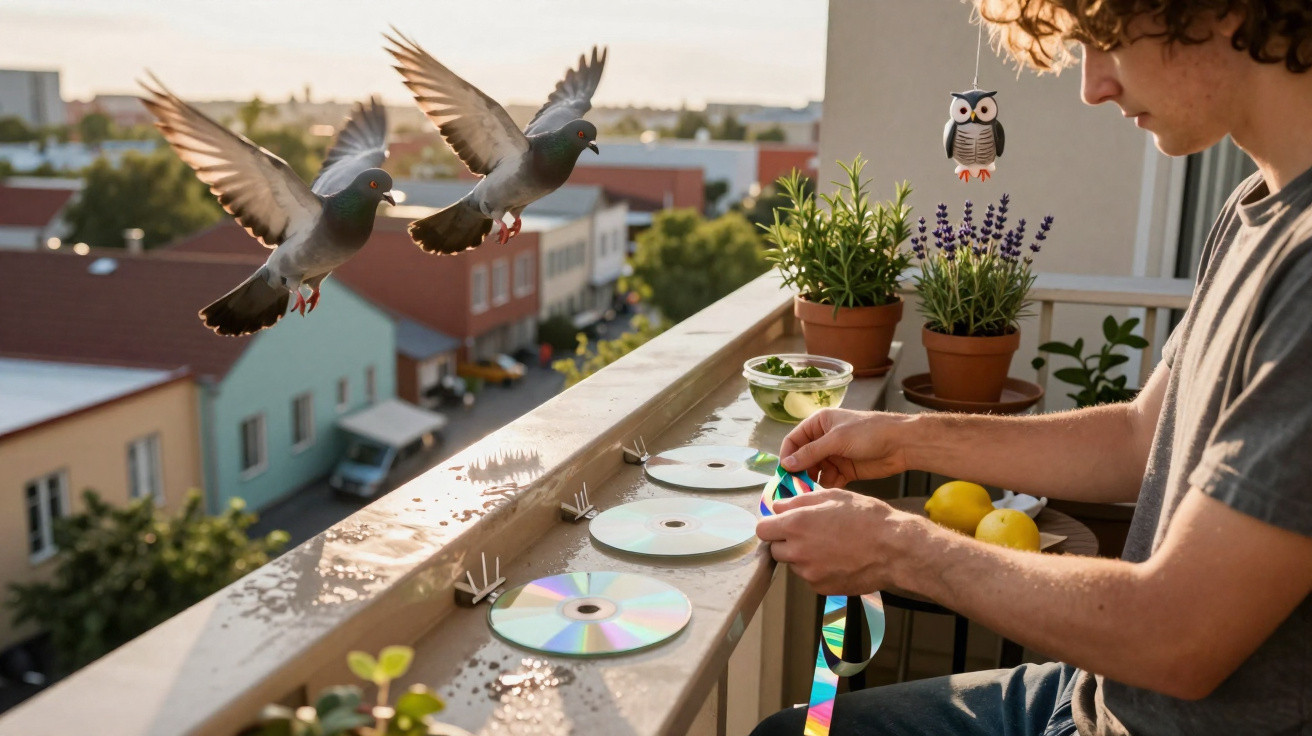
- Aluminium foil or ribbons: Attach strips of foil or reflective ribbon to the railing. The wind creates movement and flashes of light.
- Old CDs: Hang several discs from a string. Their spinning surfaces dazzle and unsettle the birds.
- Wind chimes and pinwheels: Colourful pinwheels or wind chimes create visual stimuli as well as faint sounds.
To prevent pigeons becoming used to the decorations, move the objects from time to time. Otherwise, the birds will eventually realise that the shiny items pose no genuine danger.
Pigeon deterrent technology: what is genuinely useful
People dealing with severely affected areas, such as large roof terraces or courtyards, often turn to technical solutions. Their effectiveness depends heavily on the circumstances.
Ultrasound and sound devices
Shops sell devices that emit high-frequency sounds which people can barely hear but animals may find disruptive. They are intended to drive pigeons away, though they often affect other species too. In densely populated areas with many domestic and wild animals, it is worth checking whether their use is sensible and permitted.
Artificial predators as deterrents
Models of birds of prey or balloons with large eye patterns signal danger. They work only if positioned realistically and moved regularly. If a decoy remains motionless in the same spot for months, pigeons quickly recognise that there is no threat.
Structural and protective measures for persistent cases
Some buildings seem to attract pigeons irresistibly. In these situations, a structural solution that physically blocks access is often the only answer.
Protective netting and closed nesting sites
- Protective netting: This blocks access to balconies, courtyards or roof overhangs. Although its appearance is debated, it is highly effective.
- Closing openings: Seal gaps beneath roofs, open shafts and spaces in façades with suitable mesh.
The resident mentioned at the beginning also sealed a small gap below the roof overhang, where pigeons had already begun gathering nesting material. This removed not only their resting place, but also a potential breeding site.
Legal limits and moral responsibility
Anyone taking action against pigeons must operate within a clearly regulated framework. Many towns explicitly prohibit feeding them in order to prevent uncontrolled population growth. Poison, traps and any methods that could injure the birds are unacceptable.
“Keeping pigeons away does not mean fighting them – it means showing them that another place is more pleasant.”
The aim is to keep living spaces clean for people without causing animals suffering. Those who consistently choose non-injurious measures improve their home environment while remaining compliant with the applicable rules.
How to combine the methods sensibly
Experience shows that a single measure rarely delivers lasting results. The best effect comes from combining several elements.
| Problem | Suitable measures |
|---|---|
| Light infestation, little nesting activity | Remove food sources, vinegar solution, spices, reflective objects |
| Regular visits, heavy droppings | Awkward surfaces (wires, spikes, Perspex) combined with smell and movement tricks |
| Nesting sites already in use | Block access structurally, consider protective netting, use predator decoys selectively |
The woman who had previously scrubbed every week eventually combined three things: no more food scraps, unstable perching surfaces created with taut cords, and a strongly scented vinegar solution on the former landing spots. After a few weeks, her patio was surprisingly empty – and she only needed to clean normally rather than fight a constant battle.
Practical everyday tips
Getting rid of pigeons does not necessarily require major spending. Even small changes in routine can help: wipe down the breakfast table immediately, do not leave a bowl of crisps outside overnight, and choose plants that do not scatter seeds.
Those living in rented or owner-occupied flats with shared spaces should involve their neighbours. If one household secretly feeds the birds, it undermines everyone else’s efforts. A brief notice in the communal hallway or a conversation with neighbours often achieves more than an expensive ultrasound device.
There is also a welcome side effect: making your own balcony unfriendly to pigeons automatically means more tidiness, fewer odours and a more hygienic environment. It benefits more than just the tiles, and makes it easier to enjoy the outdoor space again – without having to begin every visit holding a cleaning cloth.

Comments
No comments yet. Be the first to comment!
Leave a Comment