
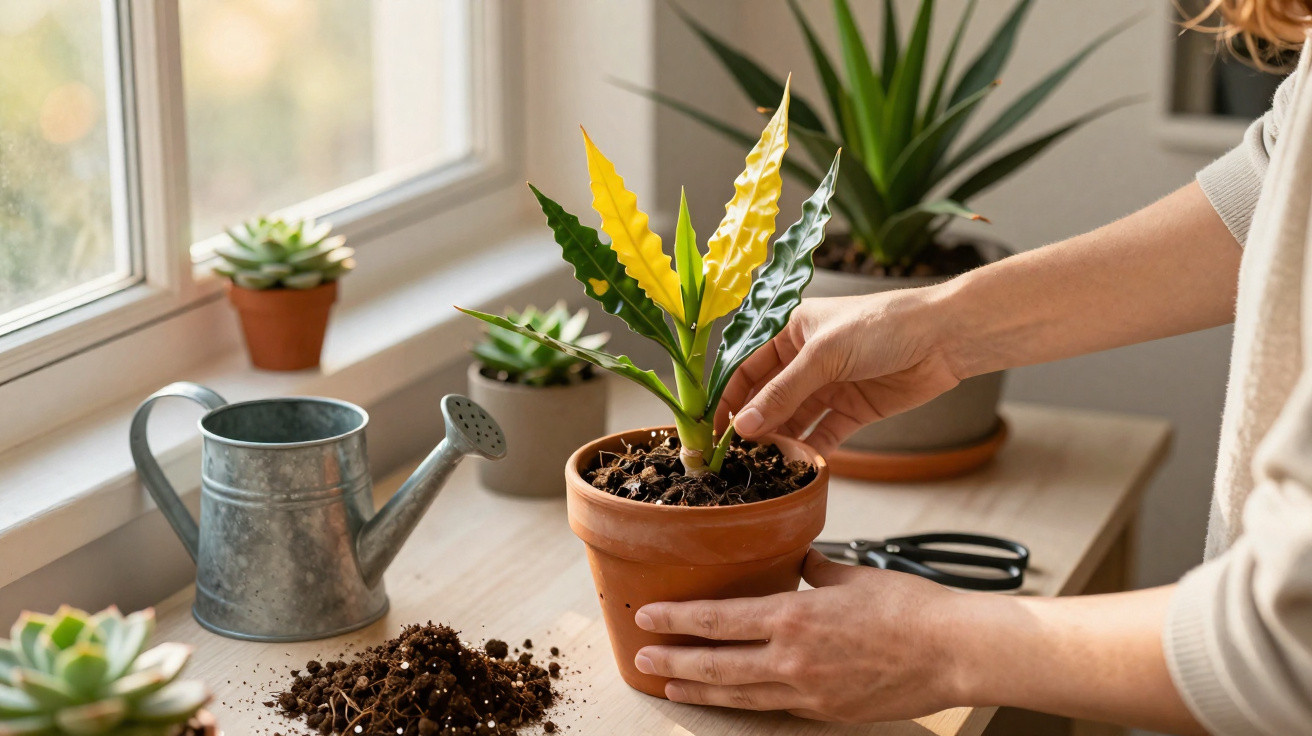
Many jade plants do not die because their owner lacks a “green thumb”, but because of common care mistakes: too much water, too little light or the wrong pot. A few straightforward measures can often save a plant that already appears beyond recovery – and restore the vigour of this thick-leaved lucky plant.
Warning signs: how a money tree shows that it is unwell
The quickest way to assess its health is to check the leaves and smell the compost. A close look at these signs will usually reveal the cause within seconds.
- Soft, yellowing leaves and spongy stems indicate overwatering. Root rot is often already present.
- Wrinkled, shrivelled or falling leaves signal drought stress: the plant is drawing on its water reserves and shedding what it can no longer support.
- A musty, mouldy smell and compost that remains wet point to waterlogging and rot around the roots.
- Bone-dry compost pulling away from the sides of the pot indicates severe lack of water; the roots are then sitting in brittle growing medium.
- A white, cotton-like coating on leaves or stems suggests an infestation of mealybugs or woolly aphids.
Anyone who understands the signals from their money tree can almost always distinguish between thirst, drowning and pests – and take targeted action.
Immediate rescue measures: what to do straight away
Before repotting or using special treatments, follow a short emergency plan. It will often determine whether the plant recovers or declines for good.
If it has been overwatered: get it out of the wet compost
When a money tree has received far too much water, every hour matters. If the compost is dark, cold and soaking wet in the pot, the roots need access to air.
- Carefully lift the plant from its pot and shake away loose compost.
- Inspect the roots closely: cut away anything black, mushy or translucent with clean scissors.
- Thoroughly wash the pot and saucer, then discard the old wet compost.
- Leave the plant with its roots exposed to dry for several hours, or preferably overnight, in a bright, airy place away from direct sunlight.
This “drying shock” may seem drastic, but jade plants are resilient. Their leaves store substantial amounts of water, so they tolerate this treatment well.
If it is drought-stressed: reintroduce moisture gradually
A completely dried-out money tree should not be “pumped full” of water at speed. A sudden rush of moisture can damage its roots.
A gentle way to restore moisture:
- Place the pot in a bowl of water, ensuring that only its drainage holes are in the water.
- Leave it for 30 to 60 minutes, allowing the compost to absorb water from below.
- Remove the pot, let it drain thoroughly, and only then return it to its usual position.
- Leave it undisturbed for the next few days and water again only once the top layer of compost has dried out.
If pests are present: act without delay
Mealybugs and woolly aphids often hide in leaf axils or on young stems, quickly weakening a money tree. Their characteristic sign is a white, wool-like coating.
Use this consistent approach:
- Separate the plant from other houseplants.
- Thoroughly wipe affected areas with a cotton pad soaked in alcohol (around 70%).
- Check again after 7 to 10 days and repeat the treatment until no new insects appear.
- For a heavy infestation, use an appropriate pest treatment or a potassium soap product.
The sooner you respond to pests, the less energy the plant loses – and the better it can concentrate on fresh growth again.
Repotting a money tree correctly: a fresh start for the roots
After waterlogging or when the compost is very old and compacted, a money tree often needs a complete restart in a fresh pot. It may sound laborious, but a clear sequence makes it manageable.
- Remove remaining compost from the roots and cut away old, rotten or foul-smelling parts.
- Allow the roots to dry for 12 to 24 hours on newspaper or kitchen roll.
- Choose a pot with drainage holes, ideally terracotta, which allows moisture to escape more easily.
- Add a 2–3 centimetre drainage layer of expanded clay pellets or coarse gravel at the bottom.
- Mix a loose, free-draining growing medium, for example:
- 50% succulent compost or ordinary potting compost,
- 25% coarse sand,
- 25% perlite or lava grit.
- Set the plant in place, firm the compost only lightly, and do not water for the first four to five days so that cut root surfaces can heal.
At this stage, the money tree may look even sadder for a while. Although unsettling, this does not mean all is lost. New fine roots usually form once the root system has settled.
Watering systematically: how much water a money tree really needs
The most important care rule is: water only when the compost has dried out again. As a succulent, the jade plant stores water in its leaves and copes much better with brief dry spells than with constant dampness.
Useful rules of thumb:
- Spring and summer: water deeply roughly every 10 to 15 days, then allow the compost to dry completely.
- Autumn and winter: depending on room temperature, it often needs only a little water every three to four weeks.
- Finger test: if the top two to three centimetres of compost feel dry, watering is fine.
- Never leave water standing in a decorative outer pot or saucer – pour away any remaining water after 20 minutes.
A little dryness strengthens a money tree; continual dampness weakens it. Understanding this halves the risk of root rot.
Light, position and fertiliser: the conditions for a strong money tree
Light determines whether a money tree grows compact and healthy or becomes weak and leggy. A bright location close to a window is ideal, particularly in a south- or west-facing room.
- A bright windowsill with sun in the morning or late afternoon is ideal.
- Soften intense midday sun behind a thin curtain to prevent leaf scorch.
- Avoid permanent positions directly above radiators, as warm air dries the leaves and compost excessively.
- Keep it away from draughts: alternating cold and warm air currents stress the plant and can cause leaf drop.
Fertilise only when the money tree is visibly growing and appears stable. A liquid fertiliser formulated for succulents, or a heavily diluted houseplant fertiliser, is entirely sufficient.
| Months | Fertilising interval | Note |
|---|---|---|
| March – September | every 3–4 weeks | only for a healthy, growing plant |
| October – February | no fertiliser | the plant is resting; do not burden the roots |
Too much fertiliser is more harmful than none: roots can burn, leaves may develop brown edges, and the plant can suddenly look unwell despite supposedly being “spoilt”.
Preventing setbacks: simple rules for long-term care
Once a money tree has been saved, it should not immediately begin struggling again. These clear, easy-to-remember principles will help:
- Always use a pot with drainage holes.
- Include a drainage layer in the lower part of the pot.
- Use only airy, permeable growing medium, never pure peat or heavy garden soil.
- Inspect leaves and stems regularly, especially their undersides.
- Adjust the watering routine to the season and room temperature.
Following these steps helps you spot small issues before the money tree visibly becomes unwell. New, plump leaves and firm stems show that the rescue effort is working – this can take several weeks, but usually results in noticeably stronger growth than before.
Why a money tree reacts so sensitively to water
The jade plant originates from regions where rainfall is relatively infrequent but heavy when it arrives. During long dry periods, it stores water in its leaves and stems. This is precisely why its roots are so sensitive to remaining wet for extended periods: they are adapted to brief moisture followed by rapid drying.
Understanding this removes the fear of giving “too little” water. It is better to water properly once and then pause than to keep adding small amounts. Many plant enthusiasts report that, after a distinct break in watering, their money tree suddenly starts growing again and produces rich green new leaves.
Practical examples: common mistakes and better solutions
One frequent situation is this: the plant sits in a sealed decorative outer pot, water collects at the bottom, and the compost at the top appears dry. Concern leads to more watering, while the root area becomes a permanent water bath – ideal conditions for rot. The solution is to empty the outer pot regularly or use a saucer instead.
Another scenario is a money tree placed in a dark hallway “so that it is out of the way”. Its stems become long and thin, while its leaves turn smaller and paler. Simply moving it to a bright window will usually help. Over time, growth becomes more stable; excessively long stems can later be trimmed back to make the plant look compact again.
Knowing these patterns makes it possible to recognise trouble early and respond with small adjustments before major rescue work is needed. This helps the money tree remain what it is intended to be in many homes: a long-lasting, easy-care lucky plant with thick, strong leaves.
Comments
No comments yet. Be the first to comment!
Leave a Comment