
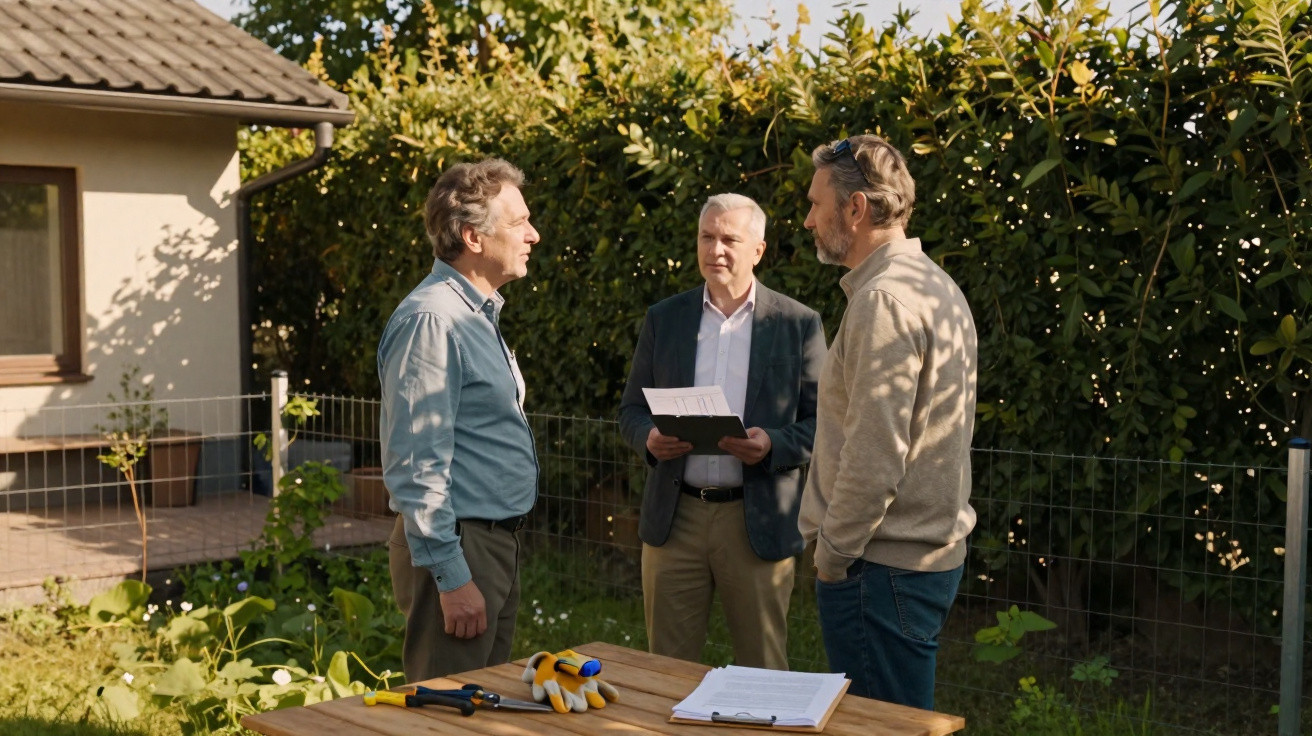
The atmosphere can shift quickly.
Throughout the UK and Europe, neglected boundary hedges are quietly sparking long-running disputes between neighbours. One household wants to make full use of its garden, while the other values its privacy and planting. Caught between them is a notably strict body of law – along with a little-known process that can compel an uncooperative neighbour to take action without immediately starting a full-scale legal battle.
When a hedge becomes a legal issue rather than a garden feature
A handful of wandering twigs will seldom create a dispute. Problems tend to begin when a hedge:
- leaves a patio or sitting room in continual shade;
- hangs over into a garden or across a roof;
- obstructs daylight, views or access routes;
- makes it seem as though your own land is getting smaller.
At this stage, the concern is no longer merely visual. Lawyers describe this as a “neighbour nuisance”: an unusual interference exceeding the ordinary inconveniences of daily life.
When a hedge eats your light and your space, the argument shifts from taste to rights.
Many people either endure the annoyance for years without speaking up, or reach for the secateurs and cut back everything extending beyond the fence. Although that reaction is understandable, it can be legally hazardous. In numerous civil-law systems, the hedge owner retains significant rights over its branches and height, even where the disturbance is genuine.
Shared hedge or private hedge: why ownership matters
The starting point may appear simple, but it affects every later step: who owns the hedge?
How a shared hedge operates
Where a hedge has been planted precisely on the boundary, it will generally be regarded as jointly owned. Both neighbours own one half and are responsible for looking after their respective side. The cost of trimming and decisions about maintenance should also be shared.
Joint ownership brings rights as well as responsibilities. If you refuse to maintain a shared hedge, that may count against you should the dispute go before a mediator or judge.
When the hedge is wholly owned by a neighbour
In many terraced streets, the hedge stands entirely on one side of the boundary, within your neighbour’s garden. Ownership is then straightforward – but it remains subject to legal restrictions.
Civil codes in France and various other European countries lay down defined rules on the height and planting distance of hedges near a boundary. The usual approach is strict:
| Hedge height | Minimum distance from boundary |
|---|---|
| Up to 2 m | 0.5 m |
| Over 2 m | 2 m |
Height is normally taken from ground level to the highest point of the hedge. The distance is measured from the centre of the trunk to the boundary. A hedge trained against a shared wall and maintained below the wall’s top can, in some circumstances, be planted directly beside it.
Even a “perfectly” clipped wall of green can break the rules if it is too close, too tall or too dark.
In addition to these measurements, a court may find that an abnormal nuisance exists: for example, permanent shade across a terrace, a view that is entirely obstructed, or branches that damage guttering. This can create legal leverage even if the initial planting distances were observed.
Legal options: what you may and may not require
Where the rules on distance and height have not been followed, the affected neighbour has particular rights. Under the French civil code, for instance, a neighbour may require:
- a hedge to be cut down to its lawful height;
- or its removal if it was planted too close to the boundary.
Exceptions do exist. A longstanding hedge that has remained unchallenged for more than 30 years may acquire what lawyers call “prescription”, meaning the arrangement becomes legally established. Agreements made by former owners may also alter the standard rules.
Overhanging branches: the unexpected rule
The point most commonly misunderstood concerns branches crossing the boundary. Many garden owners believe they can cut off anything that enters their land. Civil codes frequently take the opposite view.
The owner of the hedge usually must cut the branches. The neighbour next door has the right to insist, not to do it unilaterally.
You can often cut roots, brambles and small shoots that enter your garden at ground level yourself. Any cut must be made exactly along the boundary. For substantial branches, however, the law commonly requires you to make a formal request to the hedge owner.
A step-by-step approach before the dispute escalates
Courts are not sympathetic to garden disputes that could have been resolved through a conversation across the fence. Official guidance in France and elsewhere promotes a gradual process, supported by evidence that you have acted reasonably.
Step 1: discuss the facts, not accusations
Begin with a brief conversation. Steer clear of remarks such as “your hedge is a disgrace”. Instead, set out the practical facts:
- “The hedge now reaches about four metres, and our terrace stays in shade all day.”
- “Branches are touching our roof and blocking the gutter.”
Taking printed extracts of the rules on permitted height and planting distance can move the discussion away from emotion and towards a practical solution. Once they appreciate the risk involved, many neighbours will comply.
Step 2: the registered letter that changes the situation
If the issue remains unresolved, lawyers advise sending a clear written request by registered post with proof of delivery. It should:
- set out the factual position, including height, distance and damage;
- refer to the applicable legal provisions on planting and nuisance;
- give a reasonable time limit for pruning or making adjustments.
A calm, factual letter signals that you are prepared to go further, without instantly turning the dispute into a shouting match.
Retain copies of every letter sent and every reply received to create a proper file. This record becomes essential if the disagreement develops into formal proceedings.
The overlooked solution: conciliator plus evidence
Behind the legal terminology lies the practical “trick” that frequently encourages obstinate neighbours to act: free conciliation supported by convincing evidence.
Who is the conciliator that people overlook?
In France, a conciliateur de justice is an impartial volunteer who is trained and approved by the judicial system. For many everyday disputes involving up to 5,000 euros, meeting such a conciliator is now compulsory before a claim can be brought.
Their task is straightforward: bring both neighbours together in a calm setting, check the relevant law and seek a written settlement. There are no wigs or robes – simply an organised discussion led by somebody with no personal interest in the conflict.
Moving the quarrel from the garden fence to a conciliation room instantly cools the temperature and puts rights back at the centre.
Making conciliation genuinely effective
Turning up without preparation will weaken your case. Several simple steps can make a substantial difference:
- Take dated photographs of the hedge from several viewpoints, clearly recording its height and any overhang.
- Use a tape measure or measuring app to establish the approximate height and distance from the boundary.
- Take printed copies of the relevant legal provisions.
- Collect all written communications, including text messages, emails and copies of the registered letter.
If a neighbour still ignores the matter, instructing a bailiff or comparable official to prepare a formal report can prove decisive. It records the condition of the hedge and the nuisance on a particular date, giving the conciliator – and, if necessary, a judge – objective proof.
When a judge is the final option
If conciliation does not succeed, or either party declines even to attend, court proceedings become possible. The local judicial court can then grant what is called an injunction to perform: an order requiring the hedge owner to prune the hedge or move the planting.
A court may also impose a daily financial penalty for every day of non-compliance. That combination – a legal obligation with a financial sum continuing to accrue – can quickly turn prolonged inaction into prompt pruning.
The real pressure rarely comes from shouting over the fence, but from a judge’s order backed by a running fine.
Beyond the hedge: practical cases and consequences
Two typical situations demonstrate how this approach can work in practice.
The terrace left in darkness
A family discovers that its formerly sunny patio is now in almost permanent shade after a neighbour allows conifers, planted less than a metre from the boundary, to grow beyond four metres. When a polite conversation achieves nothing, the family sends a registered letter, compiles photographs and requests conciliation.
At the meeting, the neighbour recognises that both the height and distance breach the code, and that a judge could order a severe reduction regardless. They sign an agreement under which the hedge will be cut back to two metres twice each year. The relationship remains cool, but it does not break down entirely.
The house with a blocked gutter
In another case, bare branches from an uncared-for hedge repeatedly obstruct a roof gutter and cause damp inside a wall. In this instance, a bailiff’s report documenting the cost of the damage strengthens the claim. Once conciliation fails, the court orders both pruning and compensation for the repair work.
These situations illustrate that careful records, even in a seemingly ordinary hedge dispute, are more likely to determine the outcome than arguments or covert late-night pruning.
Key terms to understand before sharpening the secateurs
A number of legal ideas regularly arise in hedge disputes and may be difficult to follow:
- Shared hedge: a hedge positioned on the boundary and jointly owned and maintained.
- Abnormal neighbour nuisance: interference that is so serious or persistent that it goes beyond normal tolerance.
- Thirty-year prescription: in some legal systems, a situation becomes fixed in law after being left unchallenged for three decades.
- Injunction to perform: a court direction requiring a person to carry out a specific task, such as cutting a hedge.
Understanding these expressions will not make you a lawyer, but it can help ensure that conversations and letters are framed in terms neighbours – and judges – recognise.
There is a psychological element too: people are more willing to cooperate when a process feels clear, fair and guided by an impartial third party. A combination of measured discussion, a strong paper trail, conciliation and, where unavoidable, legal action will often achieve a quicker and cleaner outcome than years of quiet resentment and secret pruning missions after dark.





Comments
No comments yet. Be the first to comment!
Leave a Comment