
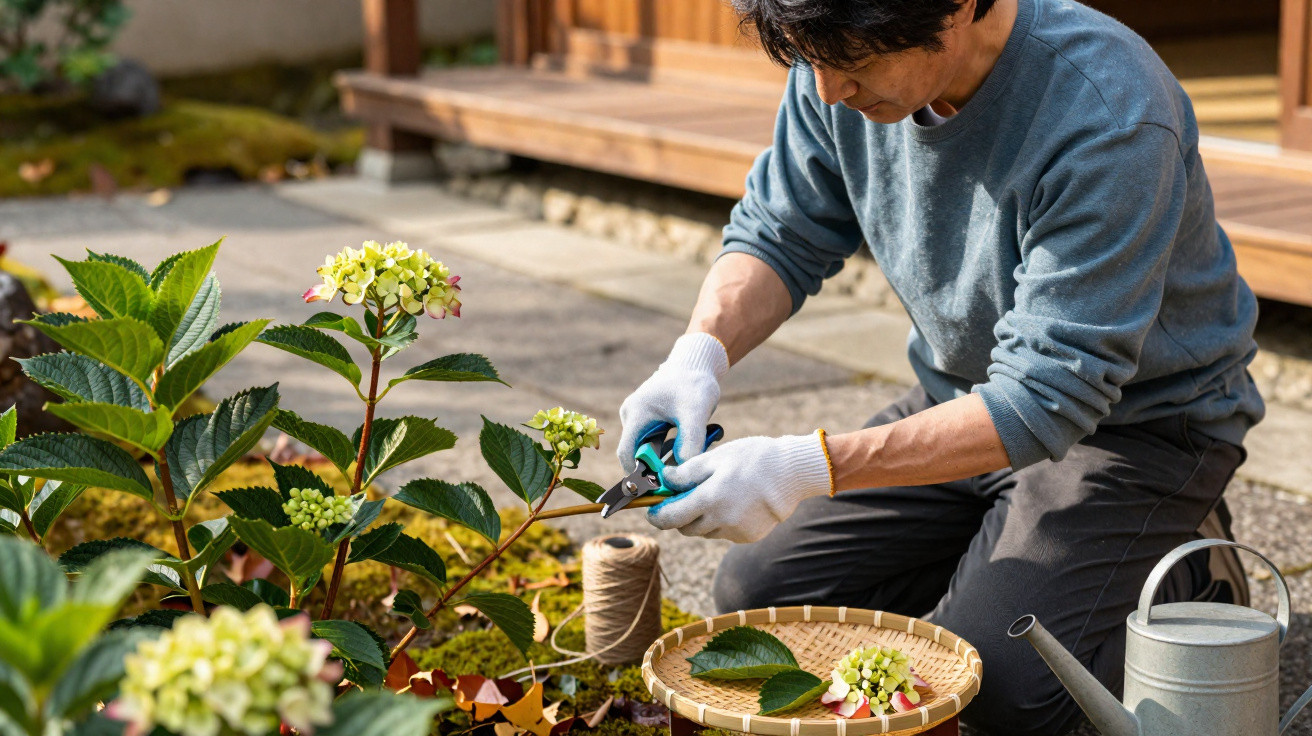
Do you give your hydrangeas a severe tidy before winter, or prefer to leave them untouched? Japanese gardens offer a softer, more measured and unexpectedly peaceful answer-while still producing impressive regrowth.
I first saw a gardener pruning ajisai-hydrangeas-in Kamakura shortly after the equinox, as the cicadas fell quiet and the air took on a fresh, tea-like aroma. He worked in purposeful intervals, holding his hand over each stem as though feeling for a subtle rhythm before making one crisp cut above a pair of swollen buds. A second gardener came behind him with a bamboo broom, gathering leaves into tidy crescent shapes that felt almost ritualistic. What stayed with me was how sparingly he pruned, and the assurance that took. He removed just five stems.
What Japanese gardeners really do each autumn
For Japanese gardeners, light and air matter as much as a shrub’s height. Instead of cutting hydrangeas into evenly rounded mounds, they create breathing room by taking out dead, congested stems and only a small number of the oldest canes at ground level. The intention is to maintain an open centre and a reliable framework for the following year’s blooms. Spent flowers may be cut back to the first robust pair of buds, or retained as a modest winter cover where frost is expected. Cut less, see more clearly.
At Meigetsu-in, Kamakura’s “Hydrangea Temple”, I saw the head gardener feel along the buds using thumb and forefinger, marking each stem as though working through rosary beads. He removed perhaps three or four canes from each shrub, always at the base, before moving on. The crisp, papery mopheads remained on the wind-facing side to soften the impact of cold spells, and were not taken off until late winter. There was nothing overworked or precious about it. It was simply a rhythm, set by the shrub, the slope and sea air moving up the valley.
There is sound botanical reasoning behind this restrained technique. Bigleaf hydrangeas (Hydrangea macrophylla and serrata) form the following year’s flowers on growth made in late summer, meaning severe autumn pruning can remove the display due in spring. Removing selected stems at the base allows old wood to be renewed without cutting off those valuable buds. Panicle and smooth hydrangeas (H. paniculata and arborescens) flower on new wood, so they can withstand firmer shaping later in the year; even so, Japanese gardeners continue to put structure and ventilation first. Sound buds, a well-proportioned framework and fewer cuts ahead of frost are all conditions that regrowth responds to.
The Japanese hydrangea pruning method you can copy this weekend
Choose tools that are easy to control: bypass secateurs, a compact pruning saw and rubbing alcohol to wipe them quickly between shrubs. First, remove all dead, diseased or rubbing growth, cutting it back to the base. Then take out up to one third of the oldest canes, identifiable by their dull bark, to let light into the middle. Finally, deadhead back to the first pair of plump buds, making a slight sloping cut away from an outward-facing bud. In cold gardens, retain the dry flowerheads as wind protection and cut them back in late winter. A mature shrub should have eight to twelve sturdy canes, with room around each one.
The usual mistake? Trimming the top as though it were a hedge. This cuts every stem to the same level and may remove next year’s flowers from bigleaf varieties. Another common error is cutting macrophylla back hard in autumn, then being puzzled when the spring display is disappointing. We have all made that “quick tidy” only to regret it later. In truth, nobody carries out this routine every day. Make one straightforward pass, then leave the shrub alone.
A Kyoto gardener once put it to me this way: slow hands make fast gardens. His point was that restraint in autumn accelerates the spring flush. Remove a little, cut back to strong buds, shelter the shrub’s core and rely on its natural schedule. You are not imposing a shape-you are encouraging one.
“Prune for light, not for size,” said Mr Sato at Meigetsu-in. “If your hand finds the right bud, the flower finds you next year.”
- Pocket checklist: Clean tools; remove dead or diseased growth; thin the oldest canes from the base.
- Deadhead to the first strong pair of buds, with the cut angled away from the bud.
- Keep some dried heads in exposed, frosty gardens; remove them in late winter.
- Retain a combination of young and middle-aged stems to ensure continuing blooms.
- Mulch with leaf mould or rice straw to protect the roots through winter.
Spring regrowth: what to expect and how to encourage it
In spring, the paired buds you preserved will swell like waking knuckles before sending out fresh green shoots that form flower clusters early. Apply a modest amount of balanced, low-nitrogen fertiliser around the drip line and cover it with compost to support this burst without making the shrub spindly. During dry weather, water thoroughly rather than frequently, so the roots are encouraged to reach deeper. After heavy rain, a few bamboo supports can spread out stems that have flopped, disappearing beneath the leaves as growth becomes denser. When late frost is forecast, cover the plant with horticultural fleece overnight and remove it at first light. Your patience in autumn rewards you twice-first with consistent growth, then with abundant flowers. Send a photograph to a friend when the first flowerheads gain colour. It is infectious, in the best possible sense.
| Key point | Detail | Benefit for the reader |
|---|---|---|
| Prune for light and air | Thin the oldest canes from the base and avoid hedge-style shearing | Reduces disease, retains next year’s buds and preserves a natural form |
| Know your hydrangea | Macrophylla/serrata flower on old wood; paniculata/arborescens flower on new wood | Avoids accidentally losing flowers and helps determine timing |
| Small cuts, big results | Deadhead to the first strong buds; retain 8–12 canes; minimise autumn wounds | Produces stronger spring regrowth and more dependable flowering |
FAQ:
- Can I prune hydrangeas in autumn (“fall”) without losing flowers? Yes-provided you prune gently. With bigleaf types, limit yourself to dead or damaged growth and a few of the oldest canes at the base. Do not cut back hard, as this removes next year’s flower buds.
- Should I leave the dried flower heads over winter? In colder or windier gardens, keep some in place as small caps that protect against frost and wind. In sheltered locations, they can be cut back now to the first strong pair of buds.
- How much thinning is safe? Remove up to a third of the oldest canes from a mature shrub. Cut them at ground level to open up the centre and allow in light.
- What about panicle or smooth hydrangeas? These bloom on new wood. Gentle shaping in autumn is suitable, although many gardeners wait until late winter to channel energy into vigorous new spring growth.
- Do I need to feed after pruning? A light top-dressing of compost and a balanced, slow-release fertiliser in late winter is sufficient. Avoid heavy nitrogen feeds, which encourage weak, soft shoots.

Comments
No comments yet. Be the first to comment!
Leave a Comment