
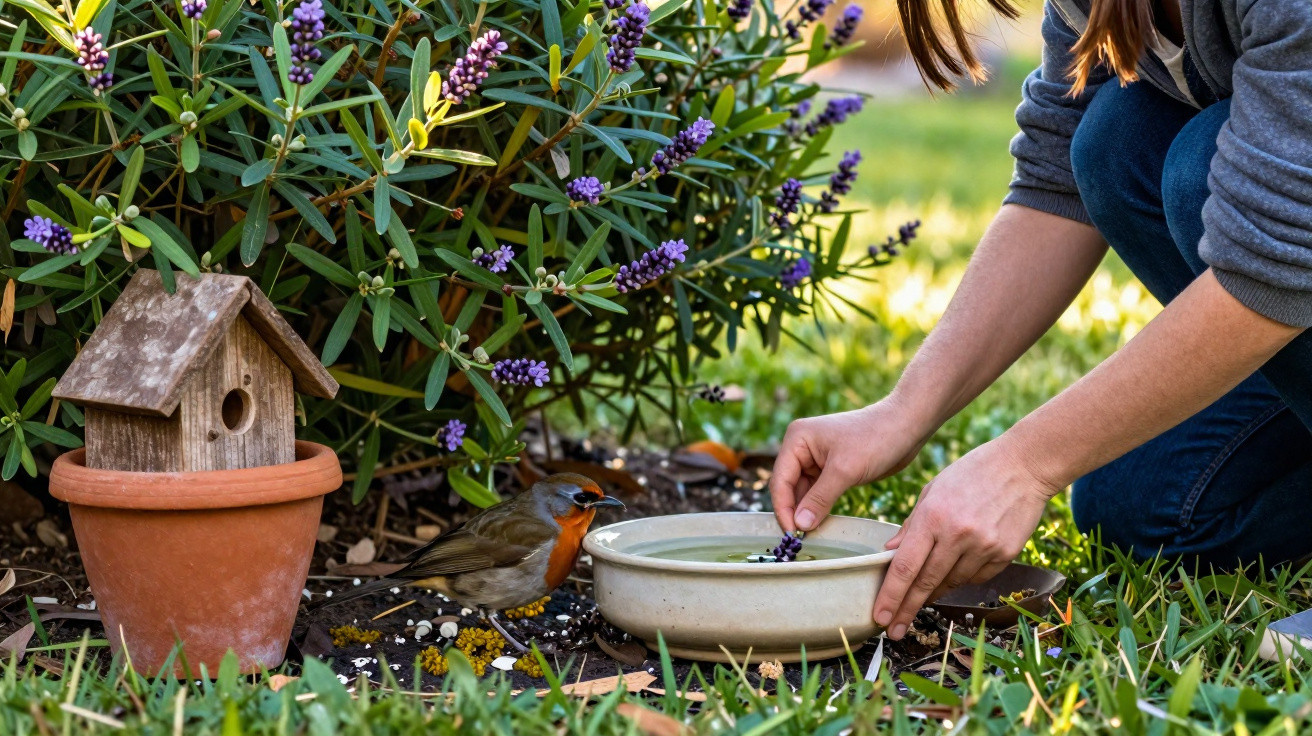
No feeder is hanging up. No seed has been thrown down. There is only a wet, unremarkable lawn and the soft background noise of a weekday morning. First a blackbird landed, followed by two sparrows; each stopped and cocked its head, seemingly working through an unseen checklist.
Viewed from the kitchen window, it almost appears choreographed. Winter has left the garden stripped back. The seed mix has run out, the suet balls have disappeared, and even the bird table has been scrubbed and put away. Yet the birds return, looping around the same branches and investigating the same nooks with confident persistence.
They act as though something is available here that we cannot detect.
Why birds return to gardens where “nothing” is available
Look more carefully and a pattern emerges: birds use particular gardens much as people revisit a favourite café, even when they are not expecting a meal. They travel along known routes, inspect their preferred perches and linger by the same stretch of hedge. The area may seem vacant to us, but for them it is a mental map full of understated possibilities.
They recall places where they have previously found food, water, shelter or protection from predators. A garden that has treated them well becomes fixed in their memory like a dependable address. Even after a feeder has gone, that location stays active in their internal GPS.
Studies have found that familiar garden species, including blue tits and robins, can retain memories of rewarding feeding sites for months. So birds that appear to be merely passing by are often returning to a familiar point on a route they know well. For a bird, the past is unseen, yet it has considerable force.
There is also a concealed feast that most of us scarcely notice. Think of leaf litter beneath a shrub, longer grass beside a fence, or a patio crack where ants congregate. Birds excel at locating what humans miss. After rain, a lawn that appears devoid of life can provide beetle larvae and worms in abundance. A moist spot under a plant pot may harbour spiders and woodlice.
Garden studies in Europe and North America indicate that even modest areas of mixed planting can draw dozens of bird species over a year. A great many of these visits take place without anyone putting out even one seed. The natural food supply hidden in the soil, bark and hedges is enough to bring them back.
Shelter is important too. Gardens containing thick shrubs, plants at differing heights and a few tall trees offer more than nourishment: they provide security. When a sparrowhawk flies over the roofs or a local cat stalks beside the wall, some gardens serve as escape corridors. A dense hedge, prickly conifer or even an untidy heap of branches can separate safety from catastrophe.
Birds repeatedly assess these secure places. They retain knowledge of where they could plunge into cover and where a predator lost track of them. Such memories may shape their daily journeys more powerfully than the prospect of a feeder. Food can be found elsewhere; a dependable bolt-hole cannot.
How to quietly make your garden a bird “magnet”
The surest way to encourage birds to return when you are not feeding them is to add what ecologists describe as “structure” to the garden. This means layers at different heights and small spaces to hide. Include low ground cover, mid-height shrubs, a tree or tall climber, and a few upright dead branches. To birds, that is not mess: it is architecture.
Begin with a single corner. Allow the grass there to grow slightly longer. Put in a dense shrub such as hawthorn, holly or laurel, then grow a spreading plant beneath it, such as lavender or hardy geranium. Place a shallow water tray or saucer nearby and replace the water every few days.
Before long, you may spot birds using a repeated route: fence, shrub, water tray, hedge, then away again. With wings and feet, they are learning the layout you have created.
It is easy to assume that attracting birds requires immaculate feeders, perfectly kept lawns and sophisticated bird tables. However, some of the most active bird gardens recorded are a little untidy, full of insects and slightly rough at the margins. In a calm suburban road, the untidy garden is often the one alive with sound at dawn.
Let us be honest: nobody really spends an hour a day maintaining a garden for birds. Most of us find ten minutes at the weekend, perhaps briefly inspect the water bowl in the evening, and then other commitments take over. Birds do not require perfection. They react to reliable shelter, food and water, rather than faultless appearances.
The greatest error is clearing everything away in one go: severely cut-back hedges, empty flowerbeds, every leaf removed, and no pots or climbing plants remaining for cover. Another problem is erratic feeding, with plentiful seed for weeks followed by nothing at all, winter after winter. Birds can adjust to change, but they notice when a place turns unpredictable.
As one urban ecologist told me during a chilly January survey:
“Birds don’t see ‘gardens’ like we do. They see corridors, hiding spots and snack stops. Give them three of those, and they’ll write your address into their daily flight plan.”
Your garden need not be completely redesigned to become one of these dependable stops. Small, nearly effortless actions can alter the way birds use your patch of ground.
- Keep one corner wild by letting grass and weeds grow, and avoid clearing away all fallen leaves.
- Provide water with a basic dish at ground level, as well as a raised dish if possible.
- Grow at least one thick, thorny shrub to offer protection.
- During the harshest months, maintain one feeder, even if it contains only a small quantity of seed.
- Avoid pesticides that eliminate the insects birds come to forage for.
After these features are established, the garden remains worthwhile even on days when the seed tub is forgotten in the shed. Birds will continue to call in, inspect their regular places and retain your garden on their unseen circuit.
The quiet pact between your garden and its regular birds
There is a peculiar reassurance in recognising that your garden has a life beyond your control. Birds arrive early, well before you venture outdoors. They follow tiny routes you hardly ever see, slipping into a neighbour’s ivy, emerging above the rear wall and disappearing once more into a distant oak. Your garden is only one scene in their moving film.
On a summer evening, as swifts shriek overhead and a blackbird sings from a television aerial, you may sense this wider network falling into place. Your scruffy patch of long grass connects to the fruit tree next door, then to a roadside hedge, a park, a river and fields beyond the town. Every returning bird shows that your small piece of land still belongs in that chain.
Most of us have experienced the moment when a garden seems silent, only for a single robin to appear like a small daily miracle. That visitor has not arrived at random. It is choosing your garden based on months or years of minor encounters with its boundaries, plants and routines. You water at dusk. You seldom allow the cat outside at dawn. You left an old terracotta pot beside the wall, and spiders made it their home.
When birds keep visiting without visible food, they are interpreting these clues more clearly than we can. They are placing their trust in past experience rather than current appearances. To a blue tit, an empty feeder hook still announces “this place once fed me”. To a wren, a quiet hedge says “I’ve hidden you before”.
The lack of obvious food may, in fact, show that the relationship between gardens and birds goes beyond a bag of seed. It is about the long term: structure, memory and the way living creatures come to depend on small, repeated actions. A few centimetres of extra grass growth. A water bowl topped up on a hot day. Choosing not to clear away every trace of decay at once.
When you begin to think of the garden as part restaurant, part refuge and part familiar street corner, daily bird visits take on another meaning. They are not random or magical. They are simply the visible edge of a quiet understanding between your ground and the wings that have chosen to remember it.
| Key point | Detail | Benefit for the reader |
|---|---|---|
| Birds remember “good” gardens | They return to locations where food, water and safety were previously available, even when feeders are empty now | Helps explain why regular birds continue visiting your garden |
| Hidden natural food sources | Soil organisms, insects, seeds and sheltered corners create a continual natural buffet | Demonstrates that a slightly wilder, less manicured garden may attract more bird activity |
| Shelter is as important as seed | Dense shrubs, plants of varying heights and safe hiding places make gardens into refuges | Offers practical ways to make your garden a dependable stop on birds’ everyday routes |
FAQ:
- Why are birds in my garden if I never feed them? They are probably finding insects, seeds, water and shelter that are easy for you to overlook, particularly among dense plants and untidy corners.
- Do birds really remember individual gardens? Yes. Many species build mental maps of safe, productive places and revisit them each day or seasonally.
- How long will birds keep visiting after I stop feeding? They can carry on visiting for weeks or months, checking whether food has returned while also using the area for shelter or as a resting point.
- What single change helps most if I have a tiny garden or balcony? Add water and at least one dense plant or climber; together, they offer a place to drink and somewhere to hide.
- Is a perfectly tidy garden bad for birds? “Bad” is perhaps too strong, but highly neat spaces commonly provide fewer insects, hiding places and nesting locations than gardens that are a little wilder.

Comments
No comments yet. Be the first to comment!
Leave a Comment